Sign in. It’s quick, free and it’s up to you.
An account is an optional way to support the work we do. Find out more.
Sign in. It’s quick, free and it’s up to you.
An account is an optional way to support the work we do. Find out more.
MCNULTY SMYTH ASSOCIATES is run by architect Sarah McNulty and her husband – engineer Dermot Smyth. The practice was established in 2009 and works on projects both north and south of the border. Dedicated to creating beautiful, timeless homes that work for their owners, here Sarah shares a barn-inspired family home with a view of the Mourne Mountains with Ruth O’Connor.
Having previously worked with an established firm specialising in private family homes, Sarah McNulty notes that creating bespoke, once-off homes for private clients is “a completely different animal to working on commercial projects like apartment buildings or high-density housing” – requiring a more personal, finely-tuned approach at every stage. “It’s much more personal and the relationship with the client is key to the success of the project,” she says.
“At McNulty Smyth Associates we are keen on working with clients who really value craft and thoughtfulness and the process of getting to their forever home. We deliberately take on fewer clients so we can dedicate the time and attention needed to deliver a high level of quality. Our clients want something beautiful that works for everyday living and that cannot be achieved without time and thought.”
Sarah says that the goal throughout a project, but particularly in the early stages, is to keep things very open when discussing plans with clients. “In the early stages, we keep things deliberately open – it’s about creating space for real collaboration. Our role is to draw out how the client wants to live and to guide that vision with a thoughtful design approach. They should feel a deep sense of ownership in the home we create together and it should feel unmistakably theirs.”
Many of the couple’s projects focus on ideas of materiality and texture. “There’s an intent to what we do – there’s a grounding and a warmth to it. It’s not just about materials, it’s about how you put them together; often, when something looks really simple, you can be assured that there was a lot of consideration and craft involved in getting it to look that way.”
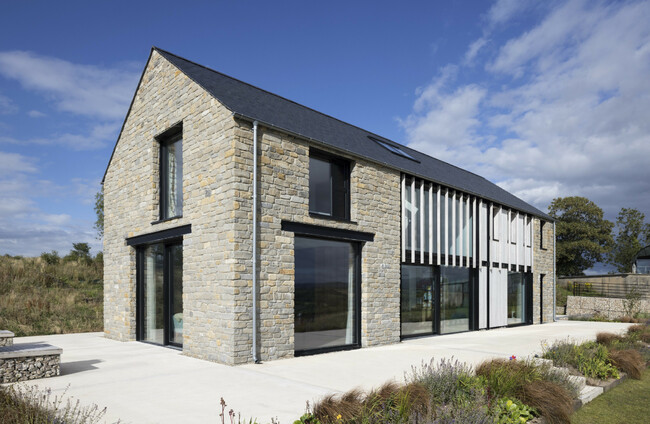
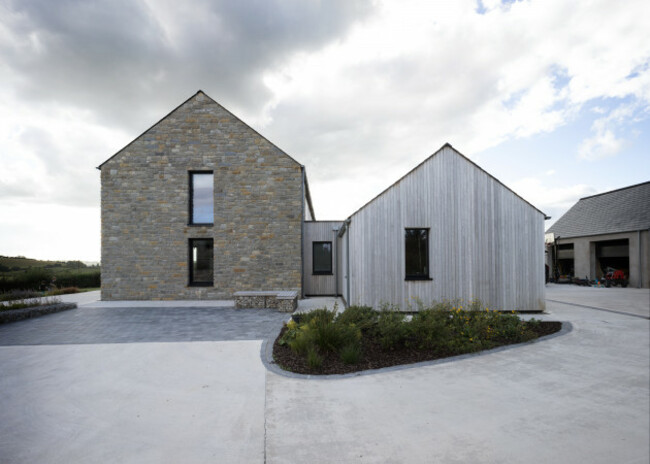
Set within the rolling hills of rural Northern Ireland, the barn-inspired home featured here blends traditional agricultural architecture with contemporary, energy-efficient design – merging vernacular charm with modern innovation.
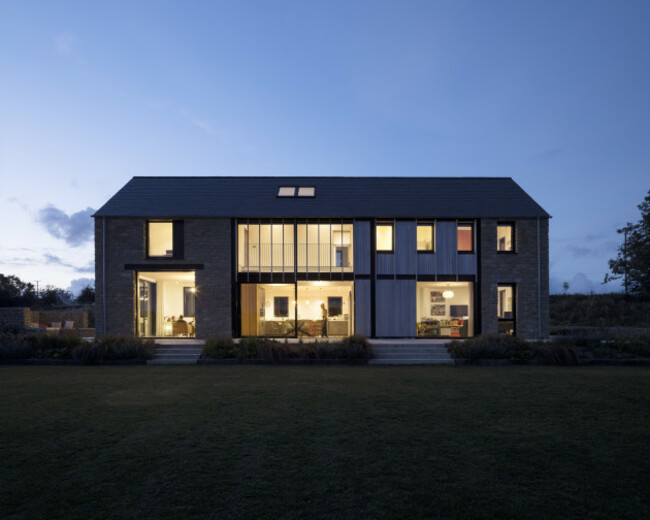
The design of the home takes its cues from nearby agricultural buildings, blending their forms and materials with elements that hold deep personal meaning for the client – such as the exposed steel structure – to create a timeless, contemporary home that is rooted in family and place. Think of a barn that has been pulled apart with a contemporary insert placed in the middle – the stone-clad sections punctuated by a vertical timber and glass insert which maximises natural light and frames panoramic views of the surrounding landscape.
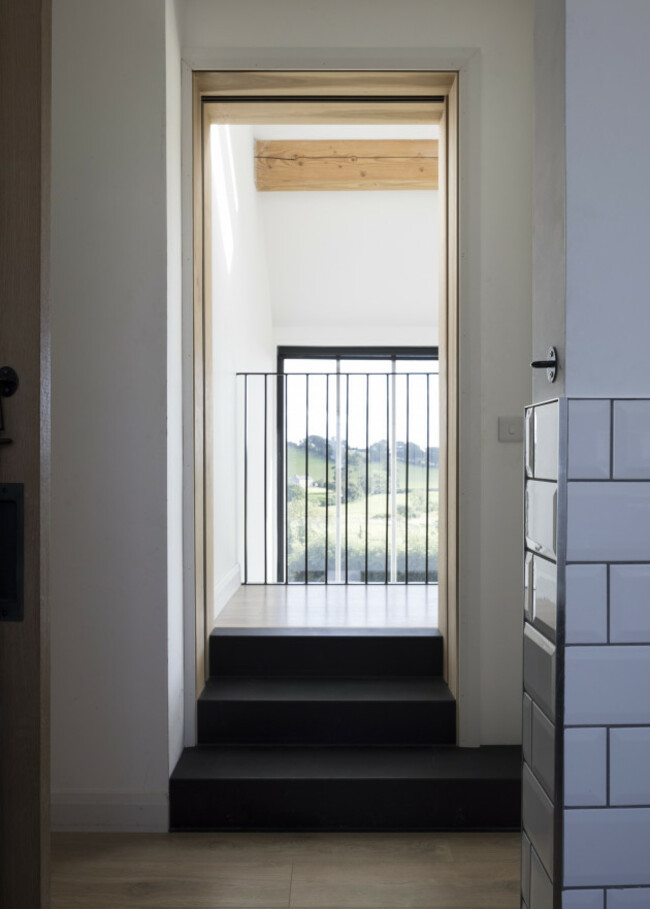
“When it comes to views, it’s interesting – people often come into a house and say ‘wow you’re so lucky to have this view’ but sometimes it’s not possible for people to truly appreciate or see the view until it is captured in the right way in a design,” says Sarah. “This idea really informs every project we do – the idea of capturing the essence of the place in terms of how the house is positioned or how the view is captured.”
“Sometimes on a site where you think there isn’t a view, something special can still be captured – a moment can be created even in a city project where there is no obvious ‘view’. Here we had the incredible Mourne Mountains in the background but sometimes it can simply be a glimpse of a special tree in a garden.”
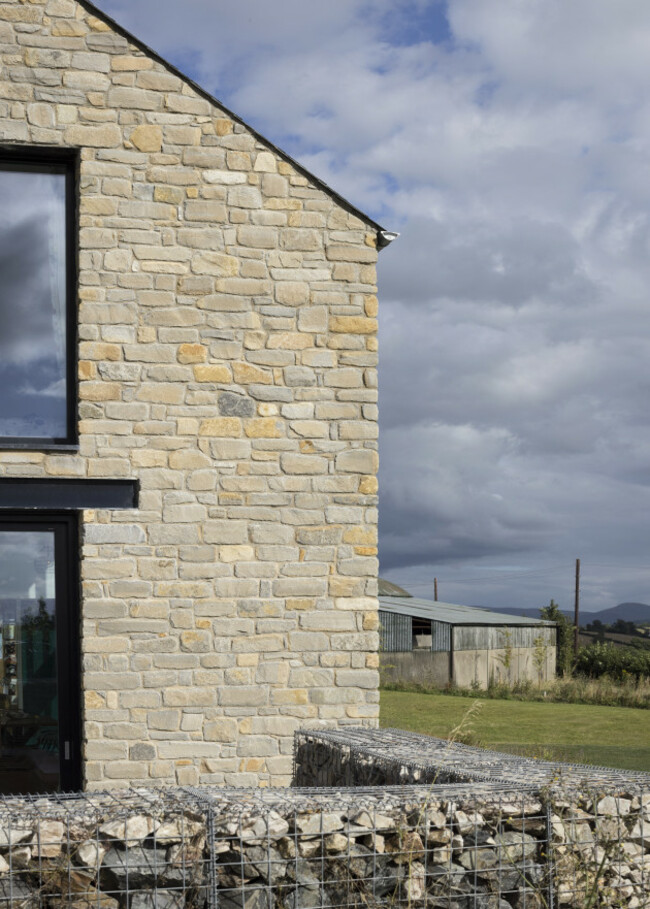
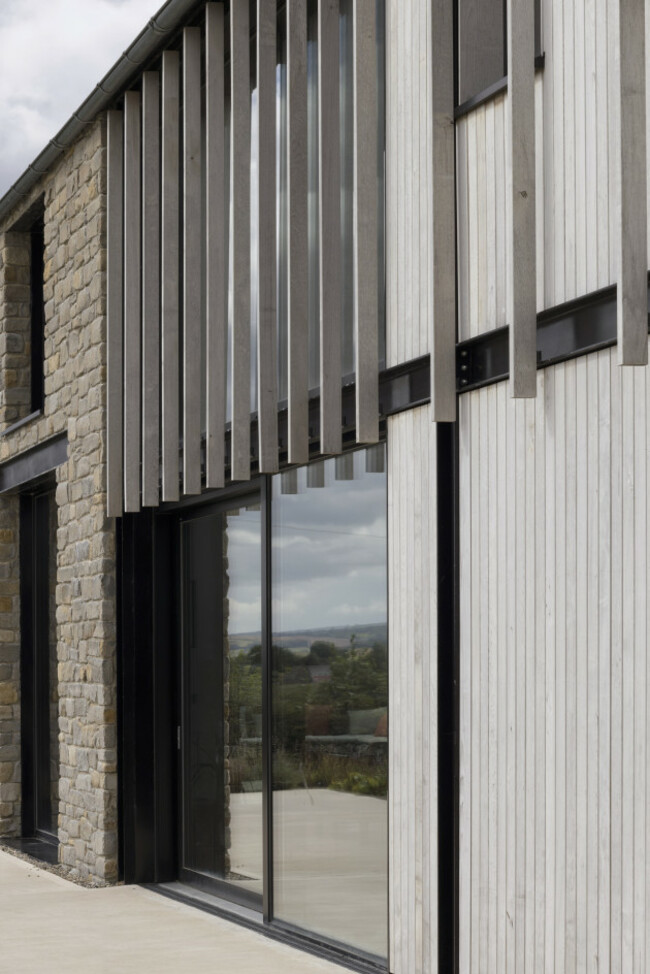
Materially, this house responds to its rural context with honesty and texture. Timber cladding transitions into solar-shading fins along the south elevation of the home while weathered stone, exposed steel, raw metal gutters, and a brushed concrete terrace reinforce the influence of the home’s rural setting.
“It was important to these clients that the house had a rural feel and felt related to the landscape and to family occupations. That generated the approach to our design,” says Sarah who was also influenced by a two storey stone barn in the locale which served as inspiration for both clients and architect. “These clients wanted their home to have an aged feel so that informed the choice of stone as well as the timber cladding.”
“We do a lot of research to choose the appropriate wood for each project where we propose it. In this case we selected Western Red Cedar which is treated to retain its colour and which is a beautiful wood that has a consistent grain,” says Sarah who says that many people in Ireland are nervous about using wood in their home design.
“People in Ireland are often nervous of using wood because it has been done badly in the past but if you know how to detail it properly it can be beautiful to use and adds lovely materiality to a building. Look at New Zealand, Canada or Sweden where timber cladding is used frequently – wood can be used in the Irish climate if the proper thought process and knowledge goes into a project.”
This house is constructed using Insulated Concrete Formwork (ICF). Triple-glazed three-metre sliding doors and a roof clad in interlocking insulated panels using the same system help achieve high energy efficiency in the home while an air-source heat pump and a Mechanical Ventilation with Heat Recovery (MVHR) system provide a low-energy approach to heating and ventilation.
“In the south of Ireland the regulations have driven new houses to be more sustainable and more energy efficient. In Northern Ireland the building regulations are generally less stringent than in the south but these clients wanted to build a house that performed better than what is currently required by regulations in the North,” explains Sarah.
“They choose to use a product called Insulated Concrete Formwork (ICF) which is basically like huge Lego blocks of insulation which you can stack up. We are always keen to use innovative technologies and had to learn how to detail it for construction drawings but it is a fantastic system. The concrete is poured inside and then it is overclad with the materials you see (such as the stone). In this project the roof was also made using the same method so you end up with an entirely insulated and airtight form prior to any external lining being added.”
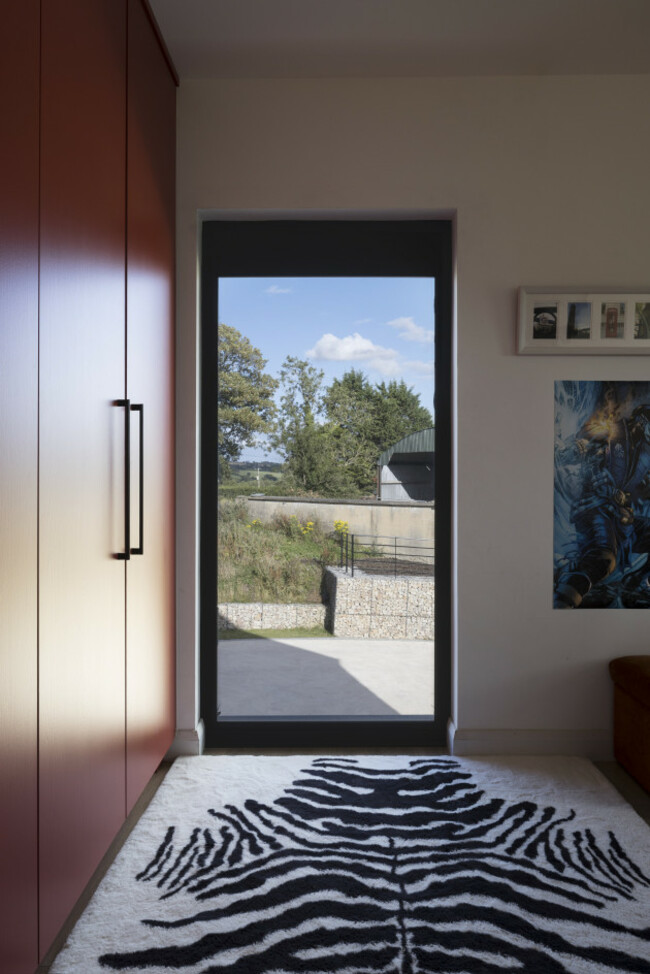
If the energy efficiency of this home is designed to future-proof it then so too is the layout. The internal layout prioritises adaptability and future-proofing with a flexible floor plan that includes a gym that can convert into a future bedroom if needed thus allowing the home to evolve as the family’s needs change over time.
“Clients often approach us when their families are young, but our focus is always on creating a home that lasts a lifetime. Instead of designing a ground-floor bedroom that later becomes just a guest room, I prefer creating versatile spaces that really work hard and that adapt effortlessly to every stage of family life,” says Sarah.
“In this case the client is really into fitness so we designed a gym that, in the future for whatever reason, could become a downstairs bedroom. There are many reasons why this might be the case in a family home – the kids get older, parents need to move in or eventually the clients get older. Sometimes a downstairs bedroom doesn’t really work for example if you have a very young family and want to keep everyone on the same level at nighttime so what we’ve done here can be an excellent solution.”
The functionality of the layout is also carefully considered by McNulty Smyth who offer architecture, structural and interior design services to their clients. “We are thinking about the interiors from the get-go. We sometimes work with great interior designers but if we are not working with an interior designer we will advise clients to get us involved in the interiors from an early stage particularly from a layout perspective.”
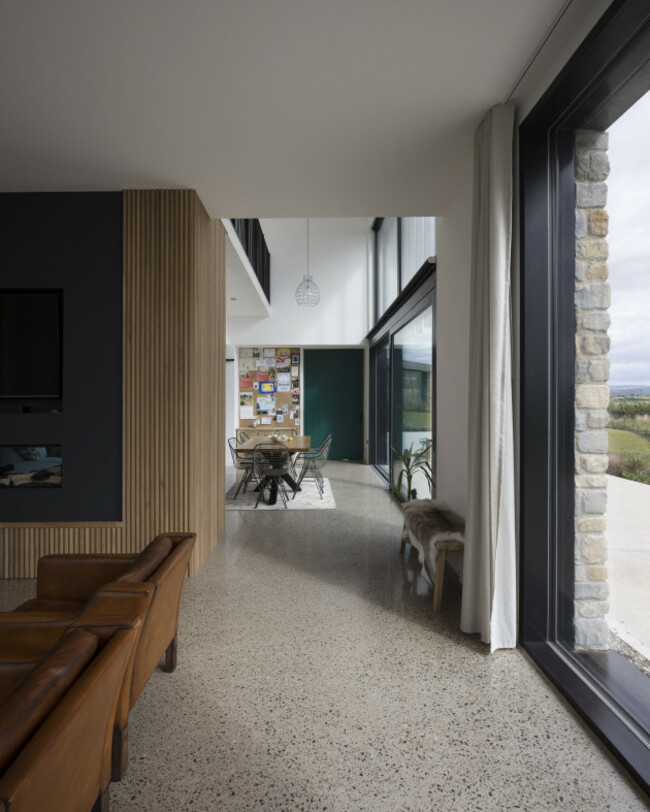
We love to design and detail internal joinery whenever appropriate – like the bespoke oak panelling, integrated bookcase, TV, and fire unit in this project – seamlessly wrapping from the kitchen into the adjoining sitting room to create a standout feature.”
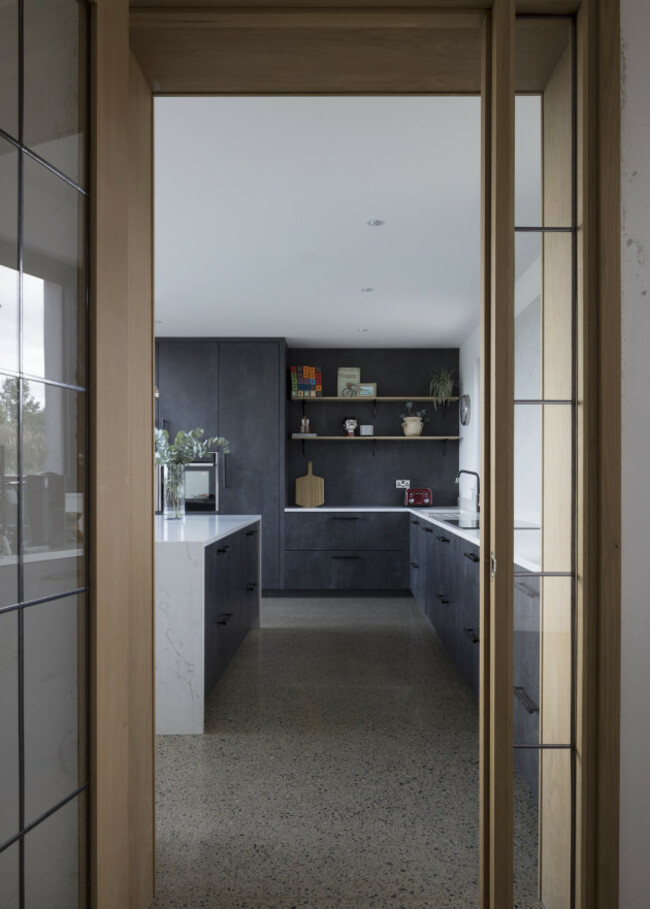
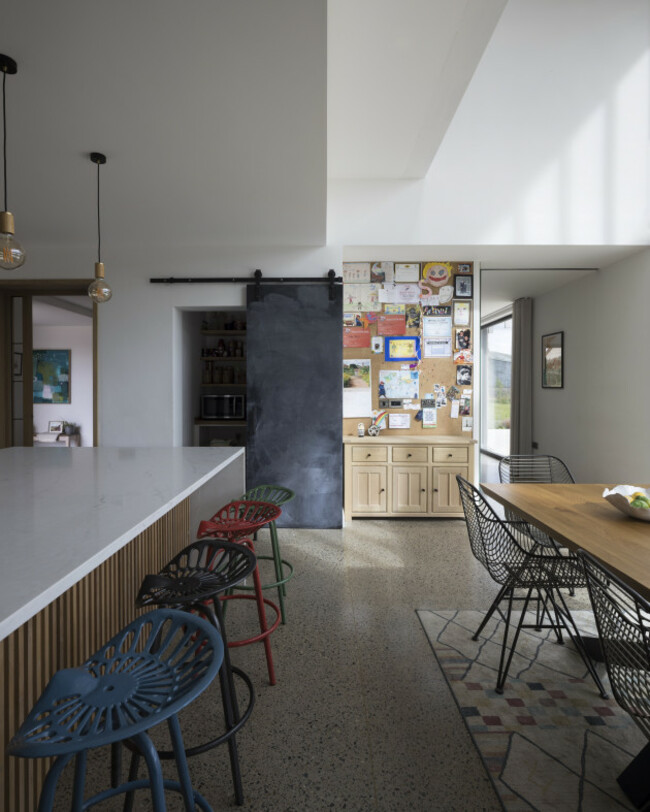
“These clients had a clear vision for the kitchen style. The brushed, black-stained, matt-lacquered veneer was their choice – a textured finish that aligns beautifully with the agricultural design approach of the house. They sourced the kitchen cupboard handles from Buster and Punch, and I love their thoughtful selection of details, like the tractor seat stools, which subtly nod to the agricultural setting.”
When put together, the combined choices give this home real personality – grounded in place and full of warmth and meaning for the family that lives there.
To embed this post, copy the code below on your site



have your say