Sign in. It’s quick, free and it’s up to you.
An account is an optional way to support the work we do. Find out more.
Sign in. It’s quick, free and it’s up to you.
An account is an optional way to support the work we do. Find out more.
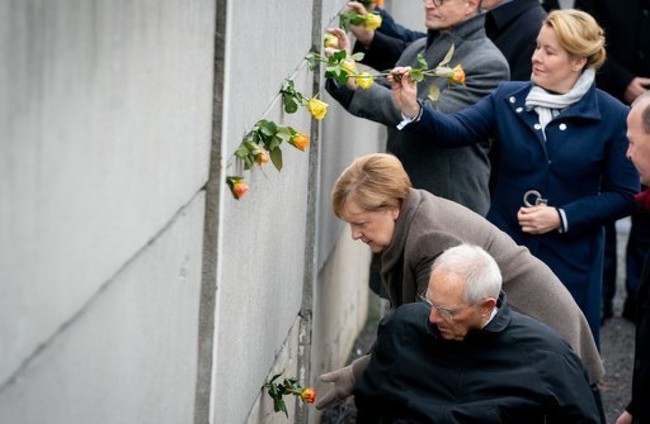
EUROPE “MUST STAND up for democracy and freedom, for human rights and tolerance”, Chancellor Angela Merkel said today as Germany commemorated the fall of the Berlin Wall in 1989.
Such values “must always be lived out and defended anew,” Merkel told political leaders and European guests at a ceremony, warning that these freedoms cannot be taken for granted.
Speaking in the Reconciliation Chapel on the former “death strip” that ran alongside the wall, the chancellor said that the barrier that divided communist East from democratic West was “history”.
Merkel herself grew up in East Germany and was a scientist working in Berlin on 9 November, 1989.
That communist authorities finally opened border crossings that day “teaches us that no wall that shuts people out and limits freedom is so tall or broad that it cannot be broken through,” Merkel said.
The chancellor and guests including the presidents of Poland, Hungary, the Czech Republic and Slovakia had earlier been invited to stick roses through holes in a section of wall still standing at the Bernauer Strasse memorial, just north of central Berlin.
Groups of schoolchildren from around Europe, including war-torn Ukraine, also spoke in their native languages to the leaders about the emotions the anniversary wakens for them.
NATO
The fall of the Berlin Wall ushered in the end of communism and German reunification, but ahead of the anniversary the Western alliance that helped secure those achievements is riddled with divisions.
Two days before the date that brought epochal change, France’s President Emmanuel Macron dropped a bombshell, declaring that transatlantic partnership NATO was suffering from “brain death” and that Europe itself was “on the brink”.
Merkel responded with uncharacteristic sharpness, saying Thursday “I don’t think that such sweeping judgements are necessary”, and the ensuing storm over NATO laid bare the growing differences among traditional allies.
The bad tempered prelude to the festivities stood in sharp contrast to celebrations five years ago, when former Soviet leader Mikhail Gorbachev and ex-Polish president and freedom icon Lech Walesa were present.
This time, leaders of former Cold War powers are absent, as Donald Trump’s America First policy, Britain’s Brexit struggles and Russia’s resurgence put a strain on ties.
US Secretary of State Mike Pompeo’s visit ended yesterday while Macron is only planning a flying visit tomorrow, leaving the actual anniversary on November 9 without globally prominent figures.

To embed this post, copy the code below on your site







have your say