We need your help now

Support from readers like you keeps The Journal open.

You are visiting us because we have something you value. Independent, unbiased news that tells the truth. Advertising revenue goes some way to support our mission, but this year it has not been enough.

If you've seen value in our reporting, please contribute what you can, so we can continue to produce accurate and meaningful journalism. For everyone who needs it.

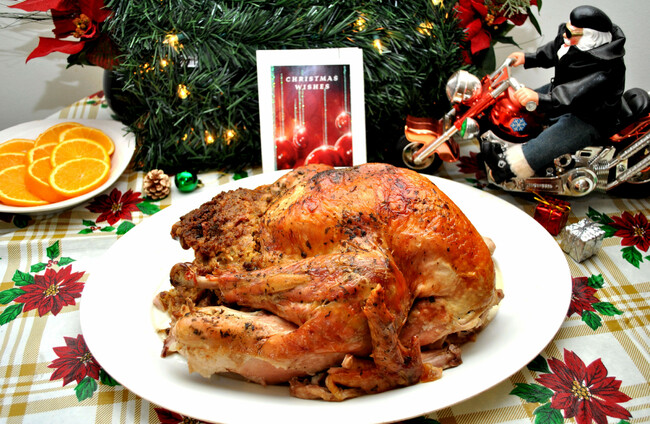
Some Christmas turkeys may have to be slaughtered earlier due to the bird flu concerns

Is there a risk to humans from bird flu, and what will happen to the Christmas turkey?

Humans can get bird flu but it does not spread easily to humans, and the spread of bird flu from human to human is very rare.

FROM MONDAY, ALL owners of poultry and captive birds will be ordered to either house them indoors or confine them so that they do not have access to other birds.

It follows a second bird flu outbreak on a commercial turkey farm.

On Tuesday, it was confirmed by the Department of Agriculture that there was a bird flu outbreak on a commercial turkey farm in Co Carlow.

This was the first outbreak of bird flu in a commercial poultry flock since 2022.

It’s understood that around 3,000 poultry have had to be culled following this.

It was then confirmed yesterday that a second commercial turkey flock, this time near Kells in Co Meath, was also hit by bird flu.

It’s understood that this is a much larger operation than the one in Co Carlow.

The risk of bird flu comes primarily from wild birds, and so far this year, more than 40 wild birds have been infected, including 12 at Fota Wildlife Park in Co Cork which prompted the attraction to close temporarily.

Bird flu is also having an impact north of the border, where a compulsory housing order came in overnight.

It’s been reported that a flock of about 15,000 turkeys were to be culled in Co Fermanagh after a suspected case of bird flu was detected on a farm.

The culling of 12,000 chickens is also understood to be under way at a commercial poultry premises near Pomeroy, Co Tyrone.

What exactly is bird flu and does it pose a risk to humans?

Bird flu is a type of flu infection that spreads among birds.

It is also known as ‘avian influenza’ and the strain currently circulating in Ireland is reported to be the highly pathogenic H5N1 bird flu.

Usually, birds who contract bird flu die within a day or so, but it’s being observed that it is taking up to three days for birds to be killed by the H5N1 strain.

This means there is more time for the virus to spread.

The virus can also spread through bird droppings, which is why bird keepers are asked to refrain from doing anything, such as leaving out food, that could attract wild birds.

What are the signs that a bird may have bird flu?

The main sign is a sudden death.

Apart from this, symptoms include a swollen head, closed and runny eyes, loss of appetite, difficulty breathing, diarrhoea, and fewer eggs laid or eggs with watery whites.

Can humans get it, and if so, how?

Humans can get bird flu, but it does not spread easily to humans.

And should a human contract it, the spread of bird flu from human to human is very rare.

However, you can get bird flu if you are in close contact with a bird that has it.

Close contact includes touching infected birds that are dead or alive, touching their droppings or bedding, and killing or preparing infected poultry for cooking, but you cannot get bird flu by eating poultry or eggs that are fully cooked.

The public meanwhile has been asked to report sick or dead wild birds to the Department’s avian check app.

What are the symptoms in humans?

Symptoms of bird flu in people include a temperature of 38 degrees or above, feeling hot or shivery, aching muscles, headache, and a cough or shortness of breath.

Other early symptoms may include diarrhoea, sickness, stomach or chest pain, bleeding from the nose and gums, or conjunctivitis.

It takes about three to five days for the first symptoms of bird flu to appear.

Meanwhile, the HSE provides free flu vaccinations to certain cohorts, such as those aged 60 and over, those with underlying medical conditions, healthcare workers and pregnant people.

The vaccine is also being offered for free to those who come into regular close contact with poultry “to recognise the risk in those occupations”.

Dr Éamon O’Moore, Director of National Health Protection with the HSE, told RTÉ that should someone have bird flu, there is a “theoretical risk of mixing” bird with the type of flu typically found in humans.

“To avoid that, we protect occupationally exposed people and encourage this for people in appropriate occupational health groups.”

What should you do if you think you have bird flu?

You should speak to your GP if you have recently travelled to an area affected by bird flu and were within 1 metre of live or dead birds.

You should also speak to your GP if you had contact with anyone who died unexpectedly and was from an area that had an outbreak of bird flu.

Tests can be done to confirm bird flu, which include taking a sample from your throat and nose using a swab to test for the virus, or by testing your phlegm for the virus.

If you have symptoms of bird flu, you’ll be advised to stay at home or be treated in hospital. 

You may also get antiviral medicine that can help reduce the severity of the condition and prevent complications.

What about the Christmas turkey?

Robert Fitzsimmons, a poultry farmer in east Cork with around 3,000 turkeys in his flock, told RTÉ he’s doing “everything he possibly can” to avoid an outbreak.

He added that his turkeys have been locked down since the outbreak in the Fota Wildlife Park in Cork.

He remarked that the turkeys’ “welfare comes first” and that there is a lot of room for the turkeys.

He added that a bird flu outbreak in his flock “would be devastating to the business” and that “it’s tough on people losing livestock”.

However, when asked if Christmas turkeys would be slaughtered earlier due to the bird flu concerns and be smaller as a result, Fitzsimmons said “each case will be different”.

“It’s not that simple to change and we’re set up to do this for years and years, and it’s difficult just to change because something comes and throws a spanner in the works.

“We normally process our birds in the second week of December, we’ve been doing that for years, so we would like to get that time to get them fattened and flavoured, but we may have to go earlier this year.”

When asked if there could be a shortage this year, he said that “if this gets worse it could be very serious” and also expressed concern that it could reach chickens and “be very serious for the food chain”.

Readers like you are keeping these stories free for everyone...
A mix of advertising and supporting contributions helps keep paywalls away from valuable information like this article. Over 5,000 readers like you have already stepped up and support us with a monthly payment or a once-off donation.

Close
36 Comments
This is YOUR comments community. Stay civil, stay constructive, stay on topic. Please familiarise yourself with our comments policy here before taking part.
Leave a Comment
    Submit a report
    Please help us understand how this comment violates our community guidelines.
    Thank you for the feedback
    Your feedback has been sent to our team for review.

    Leave a commentcancel

     
    JournalTv
    News in 60 seconds