Sign in. It’s quick, free and it’s up to you.
An account is an optional way to support the work we do. Find out more.
Sign in. It’s quick, free and it’s up to you.
An account is an optional way to support the work we do. Find out more.
IN THE LAST two weeks, the US position on the Israel-Iran conflict has been marked by contradiction and confusion that resembles the Trump administration’s haphazard approach to tariffs and trade policy.
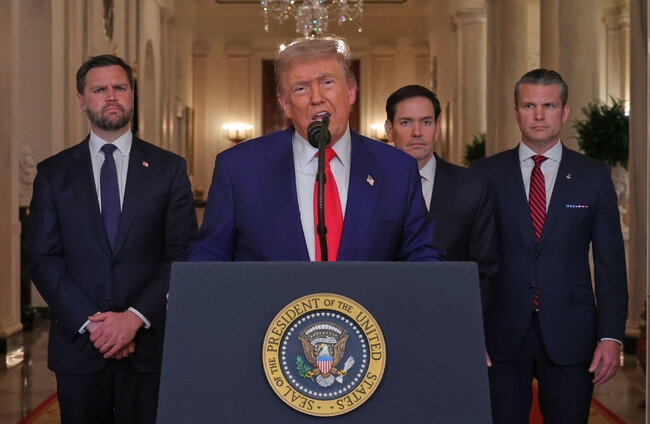
Yesterday, US Defence Secretary Pete Hegseth and Secretary of State Marco Rubio both insisted that the US was not interested in overthrowing the government of Iran, but last night President Donald Trump said the opposite.
“Anything can happen in conflict. We acknowledge that,” Hegseth said.
“But the scope of this was intentionally limited. That’s the message that we’re sending.”
Trump then sent a very different message later the same day.
“It’s not politically correct to use the term, ‘Regime Change,’ but if the current Iranian Regime is unable to MAKE IRAN GREAT AGAIN, why wouldn’t there be a Regime change???” Trump said
Iran “must now agree to end this war”, Trump said after the US strikes on Saturday night, insisting that under no circumstances should it possess a nuclear weapon.
There has been no evidence to show that Iran was developing nuclear weapons, but the US, European powers and Israel have all said there is. In fact, US intelligence had recently assessed Iran was not trying to build nuclear weapons.
“We continue to assess Iran is not building a nuclear weapon and that Khamenei has not reauthorized the nuclear weapons program he suspended in 2003,” the US report said.
Q: Your intelligence community says they have no evidence that Iran is building a nuke
— Aaron Rupar (@atrupar) June 20, 2025
TRUMP: Then my intelligence community is wrong. Who said that?
Q: You director of national intelligence Tulsi Gabbard
TRUMP: She's wrong pic.twitter.com/RI9Jzouagh
Right up until Israel launched its unilateral attack on Iran on 13 June, the Trump administration had been in talks with Iran as the two sides tried to find a replacement for the agreement reached during the Obama administration, which Trump tore up in 2018.
Even as Israeli airstrikes rained down on Tehran, Trump was still urging Iranian leaders to “make a deal”.
US officials also denied being involved in the Israeli attack, but said Washington had been informed of them ahead of time.
Trump said last week that he would make a decision about US involvement in the conflict “within two weeks”.
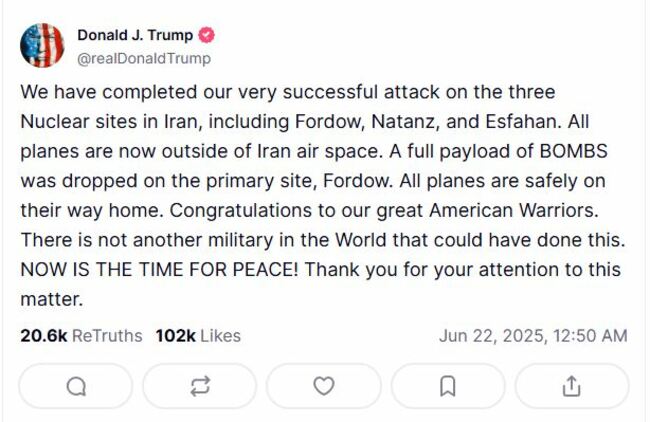
He then announced that US bombers had hit Iranian nuclear energy facilities a couple of days later, in a post on his Truth Social website.
“NOW IS THE TIME FOR PEACE!” Trump wrote while declaring he had ordered the bombing.
Hegseth similarly said the bombing was aimed at achieving “peace”. He also said that Iran had been “stonewalling” the US in recent negotiations.
Despite these comments from the White House and Pentagon, the prospects of Iran coming back to the negotiating table under the current circumstances look extremely unlikely, if not impossible.
More broadly, Trump’s decision to join Israel’s war against Iran has also contradicted campaign promises he made to keep the US out of conflicts, particularly in the Middle East.

To embed this post, copy the code below on your site














have your say