Sign in. It’s quick, free and it’s up to you.
An account is an optional way to support the work we do. Find out more.
Sign in. It’s quick, free and it’s up to you.
An account is an optional way to support the work we do. Find out more.
WE’VE ALL BEEN there, right? You go to clean your windscreen but get nothing when you pull on the stalk. On average drivers use 20 litres of water per year to clean their windscreens, but during certain conditions such as our recent snow this can lead to increased usage and therefore a higher chance of it running out right when you need it.
This is exactly what happened last summer when Daniel and Lara Krohn were travelling in their family car. They watched as their dad tried to clean the windscreen but the reservoir was empty and the windscreen just kept getting dirtier.
They found this quite amusing considering it was pouring with rain outside and there was water everywhere, apart from where it was wanted.
It was then that they had their clever idea.
“My sister and I thought this was really funny and then the answer suddenly seemed obvious. Simply reuse the rainwater,” said 11-year-old Daniel.
“We couldn’t believe that no-one has thought of it before,” added 9-year-old Lara.
The siblings then set about testing their idea.
“We took apart our toy fire engine and fixed the pump to a model car inside an aquarium. Then we added a filtering system to ensure the water was clean. It just worked really well.”
Lara and Daniel took their design to a local science competition and they won.
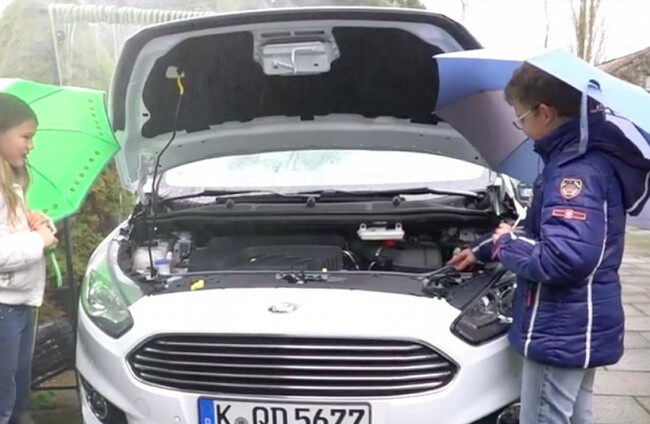
Engineers at Ford heard about the duo and decided to test the concept on a full-size Ford S-Max. They connected the bottom of the windscreen to the washer reservoir via a series of rubber pipes.
“Daniel and Lara’s idea has been staring drivers in the face for decades – and it has taken one moment of ingenuity to bring it to life. In less than five minutes of rainfall the washer reservoir is completely full,” said Theo Geuecke, a supervisor in the Body Exterior Hardware department at Ford of Europe.
With growing populations and increased strain on water supplies, technologists including those at Ford, are having to look for ways to reduce water waste. Water usage by vehicles is expected to increase as additional cameras and sensors also need to be kept clean. Ford engineers are already working on ways to capture water, via rain and condensation, including a way of gathering moisture from the air and filtering it into drinking water.
According to Ford, “with 291 million cars on European roads, if such a ‘Krohn’ system was in every car, it would save almost six billion litres of water each year.”
Here’s hoping we see such a system on production models soon.
Want to make sure you don’t miss out on anything going on in the world of motors? Like us on Facebook and and follow us on Twitter for the latest updates.

To embed this post, copy the code below on your site









have your say