We need your help now

Support from readers like you keeps The Journal open.

You are visiting us because we have something you value. Independent, unbiased news that tells the truth. Advertising revenue goes some way to support our mission, but this year it has not been enough.

If you've seen value in our reporting, please contribute what you can, so we can continue to produce accurate and meaningful journalism. For everyone who needs it.

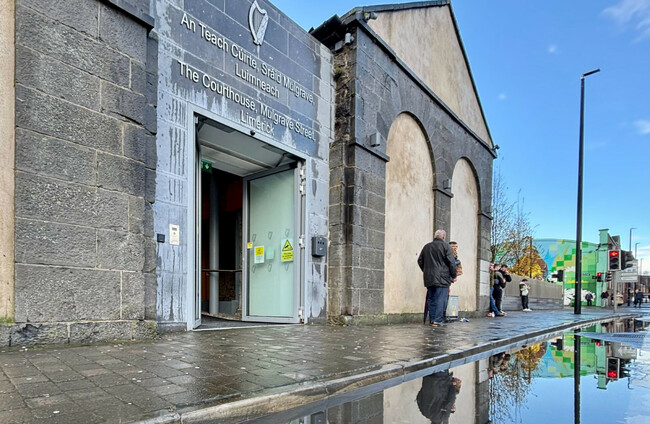
Court sat at Limerick Circuit Criminal Court. Niall O'Connor/The Journal

Mother found guilty of the attempted murder of her eight year old daughter

The girl sustained more than 70 stab wounds during the attack by her mother, a Russian national, the jury heard.

A JURY HAS found a woman guilty of the attempted murder of her eight year old daughter, in Co Clare, four years ago.

The girl sustained more than 70 stab wounds during the attack by her mother, a Russian national, the jury heard.

The woman had also attempted to strangle her daughter. The woman, who cannot be named to protect her daughter’s legal right to anonymity as a minor, had denied the charge before the Central Criminal Court, sitting in Limerick.

This afternoon the jury of seven men and five women told trial judge Kerida Naidoo that they were all agreed that the defendant was “guilty” of the girl’s attempted murder.

The woman wept in court as she was led away into custody. She will be sentenced at the Criminal Courts of Justice, Dublin, on 2 March.

The trial heard the defendant had told gardai, following her arrest, that she was “out of my mind” at the time she attacked her daughter.

The girl was kept alive by heroic gardai from the Clare Division who broke into a locked bedroom at the accommodation centre where the mother attacked the girl.

Paramedics at the scene continued to stem the blood flow at the bedroom and transferred the girl by ambulance to University Hospital Limerick and then onto Crumlin Children’s Hospital, Dublin, where she received life-saving treatment and surgery at both hospitals.

The court was shown a DVD recording of the girl’s interview with gardaí, who months after the attack, in which she told them her mother had stood over her in her bed on the morning in question, and told her: “I’m going to kill you and then I’m going to kill myself, because that is what’s best.”

The girl said her mother used a “big kitchen knife” to stab her.

She said her mother also “dragged” her into an en suite bathroom and continued stabbing her in her stomach, chest, back and legs.

“When she was dragging me to the bathroom, I looked back and the bed was covered in blood,” the girl told gardaí.

The girl – who was not cross examined by the accused’s defence barrister – said her mother told her that she had feared people were going to take her away from her and that it was “best” if they both died.

A witness called by the prosecution, UK consultant forensic psychiatrist Dr Richard Church, gave evidence last week that, in his opinion, the defendant could not rely on a defence that she was insane at the time.

Church said that, while he believed the defendant was aware of what she was doing, he said he did not believe that the accused had not known that what she was doing was wrong at the time.

Church said he took “great care” in considering a defence of “insanity”, but, he said he was “not satisfied” that the accused could rely on it.

From reading the book of evidence in the case, Church said the defendant had allegedly concealed the knife used in the attack and had locked the door to the room where the alleged attack occurred — these were, Church said, “behaviours indicating that she knew that what she was about to do was wrong”.

The court heard the defendant had previously accessed psychiatric hospital services in her native Russia where she was diagnosed there with “bipolar active disorder”.

In March 2022, six months prior to the attack on the girl, the defendant and her daughter fled the war in Ukraine to Ireland and they stayed in a number of temporary accommodation premises.

Church said his view was, that at the time of the attack on the girl, the defendant was suffering with an “adjustment disorder in addition to a personality disorder”, which “manifested in a severe response to her circumstances”.

He said he believed the defendant was suffering from a number of stresses in her life at the time; that she had poor coping skills, and that she suffered emotional outbursts.

Following her arrest, the defendant told gardai she stabbed her daughter multiple times with a kitchen knife and tried to strangle her.

She said that she had been having suicidal thoughts at the time.

The defendant said she had become paranoid that others thought she was a poor mother and that Tusla, the child and family agency, would come and take her daughter from her.

She said she had contemplated various means of suicide and killing her daughter.

During interviews with gardai the defendant confirmed that a knife gardaí showed to her, which was seized from the scene, was the knife she said she used in the attack.

“Chaos took over my mind,” the defendant told Gardaí.

Defence witness, Dr Paul O’Connell, a consultant forensic psychiatrist Central Mental Hospital, told the court that, in his opinion, the defendant was in the throes of a mental disorder at the time and that, in his opinion, the accused was not aware at the time that what she was doing was wrong.

The accused’s barrister, senior counsel, Mark Nicholas, told the jury that if it accepted the evidence of O’Connell, they could consider that the accused was not guilty by reason of insanity.

The jury disagreed and took just over eight hours to deliver its unanimous guilty verdict.

Readers like you are keeping these stories free for everyone...
A mix of advertising and supporting contributions helps keep paywalls away from valuable information like this article. Over 5,000 readers like you have already stepped up and support us with a monthly payment or a once-off donation.

Close
JournalTv
News in 60 seconds