Sign in. It’s quick, free and it’s up to you.
An account is an optional way to support the work we do. Find out more.
Sign in. It’s quick, free and it’s up to you.
An account is an optional way to support the work we do. Find out more.

THE CRUCIAL 1.5 degree climate tipping point will be reached by the end of this decade, the EU’s climate monitoring service has warned.
New research from the Copernicus climate research institute shows that the current rate of global warming means the Paris Agreement’s temperature limit of 1.5 degrees for long-term global warming could be reached by the end of this decade.
The limit was set to avoid the worst impacts of climate change, which research suggests are significantly lower at 1.5 degrees than 2.0 degrees.
Surpassing the limit may cause more extreme weather events, and possibly trigger climate tipping points, including the collapse of tropical coral reef systems.
If the 1.5 limit is reached, the rate of warming would have occurred over a decade earlier than predicted when the environmental treaty was signed to combat climate change in 2015.
The news comes as 2025 is recorded as the third-warmest year so far, only marginally cooler than 2023, and 2024.
Copernicus is the Earth observation section of the European Union’s space programme. It monitors the planet and the environment and is managed by the European Commission.
Carlo Buontempo, Director of Copernicus said reaching the Paris Agreement temperature limit is inevitable. The current rate of global warming stands around 1.4 degrees above the pre-industrial level.
“We are bound to pass it; the choice we now have is how best to manage the inevitable overshoot and its consequences on societies and natural systems,” he added.
The global temperature average for the past three years already averaged more than 1.5 degrees above the pre-industrial level, while the past eleven years have been the eleven warmest on record.
Mauro Facchini, Head of Earth Observation at the European Commission, described exceeding the three-year average of 1.5 degrees as “a milestone none of us wished to reach”.
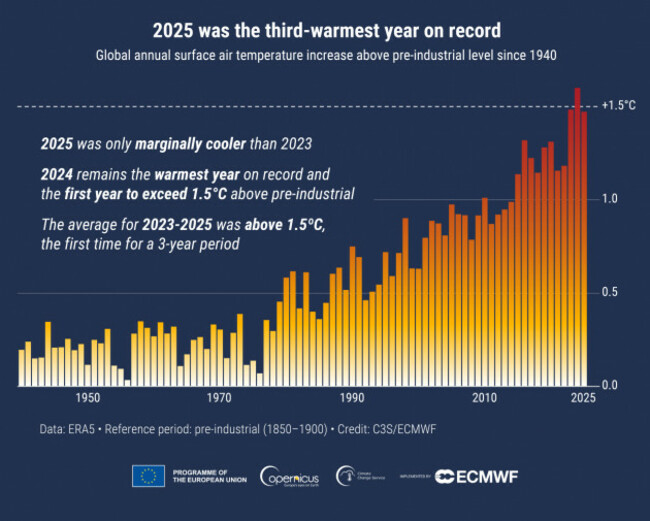
Copernicus said the last three years have been “exceptionally warm” due to the build-up of greenhouse gases in the atmosphere and sea-surface temperatures reaching high levels across the ocean.
Laurence Rouil, Director of Copernicus Atmosphere Monitoring Service said the data paints a “clear picture”.
“Human activity remains the dominant driver of the exceptional temperatures we are observing. Atmospheric greenhouse gases have steadily increased over the last 10 years,” she said.
“We will continue to track greenhouse gases, aerosols, and other atmospheric indicators to help decision makers understand the risks of continuing emissions and respond effectively, reinforcing synergies between air quality and climate policies. The atmosphere is sending us a message, and we must listen.”
In 2025, half of the global land area experienced more days than average with temperature that felt like 32 degrees or above – a concept known as heat stress, which is recognised by the WHO as the leading cause of global weather-related deaths.
In areas with dry and often windy conditions, high temperatures also contributed to the spread and intensification of wildfires, causing emissions that degrade air quality.
Extreme weather events were recorded across many regions in 2025.
Europe experienced its highest annual total wildfire emissions, there were severe storms in Europe, Asia and North America, and wildfires in Spain, Canada and Southern California.

To embed this post, copy the code below on your site













have your say