Sign in. It’s quick, free and it’s up to you.
An account is an optional way to support the work we do. Find out more.
Sign in. It’s quick, free and it’s up to you.
An account is an optional way to support the work we do. Find out more.
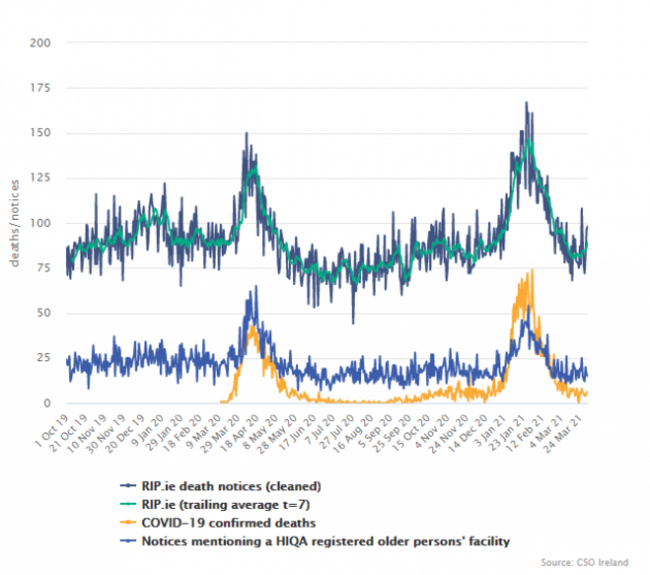
THE CENTRAL STATISTICS Office (CSO) has said that the inclusion of ‘real-time’ CSO data on excess deaths has found that there were “pronounced increases” in the number of death notices in the month of April last year, and January and February of this year.
Official death notices – including the deaths of people who had Covid-19 – can be registered up to three months after the death of a person.
But due to the Irish custom of holding a funeral two to three days after the death of a person, notices on RIP.ie are a good ‘real-time’ indicator of when peaks in excess deaths happen (the average time between date of death and publication of a death notice on RIP.ie is about 1.1 days).
The CSO is using these figures on an experimental basis, and said yesterday that when this RIP.ie data is analysed, from March 2020 to February 2021 provides a range of between 2,034-2,338 excess deaths.
There were significant excess death notices in April 2020 (a total of 3,504 notices), January 2021 (3,919 notices) and February 2021 (3,147 notices).
The average number of deaths was just under 3,200 for January and just over 2,700 for February for the years 2014-2018.
It’s worth noting that those three months were among Covid-19 spikes, when the number of cases in Ireland was high.
Commenting on the results, statistician John Flanagan said: “Most notable are the increases in death notices in April 2020 and in January and February 2021 which stands in contrast to recent years.
“Numbers of deaths notices increased to 3,504 in April 2020 from 2,864 in March 2020. In comparison, the average number of deaths for April for the years 2014-2018 was approximately 2,500, according to CSO published deaths by month of occurrence.”
RIP.ie includes some deaths that occur in Northern Ireland; these were removed in the above analysis.

To embed this post, copy the code below on your site















have your say