We need your help now

Support from readers like you keeps The Journal open.

You are visiting us because we have something you value. Independent, unbiased news that tells the truth. Advertising revenue goes some way to support our mission, but this year it has not been enough.

If you've seen value in our reporting, please contribute what you can, so we can continue to produce accurate and meaningful journalism. For everyone who needs it.

Alamy Stock Photo

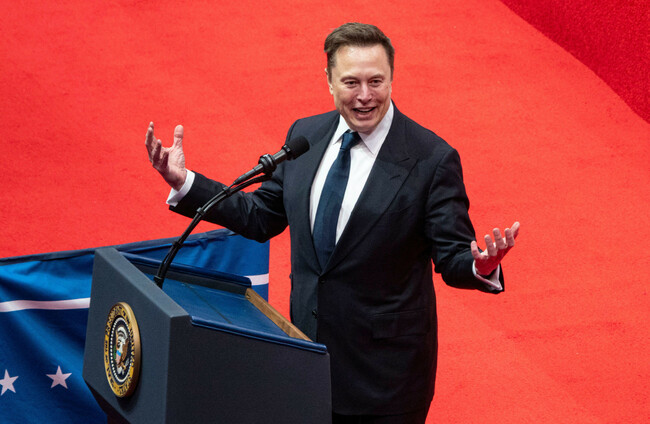
Debunked: Elon Musk wrongly claims Simon Harris blocked 'the will of the people' in Áras race

Musk also endorsed Conor McGregor, who was polling at two percent.

THE WORLD’S RICHEST person, Elon Musk, has broadcast his support for former professional fighter Conor McGregor’s bid to run in for president this October. However, in doing so, he has spread misinformation about how the election will work.

Most recently, he has claimed that Simon Harris, the deputy head of government, has undemocratically torpedoed McGregor’s ability to get on the ballot. 

“Shame on Simon Harris for tyrannically blocking the will of the people of Ireland!” Musk wrote on X, the social media site he bought for $44 billion and posts on dozens of times a day.

“Conor McGregor for President to save Ireland,” his 8 September post concluded.

Musk’s condemnation of Ireland’s Tánaiste and the leader of Fine Gael, Simon Harris, was published in response to a post the day before by an anonymous X user called @CilComLFC, who claims to be from Ireland.

The @CilComLFC account regularly spreads explicitly racist content and misinformation, including claims unlikely to fool many Irish users, such as that footage filmed on Grafton Street, Dublin, actually showed the response to a “massacre” in Carlow.

That user’s 7 September post reads: “BREAKING: Ireland’s Deputy Prime Minister, Simon Harris, has ordered his Party to BLOCK independent candidates, including frontrunner Conor McGregor, from running for President of Ireland.”

It also featured a screenshot of a headline from The Liberal, a website whose claims have been debunked multiple times by The Journal.

The Liberal’s headline read: “‘They’re petrified Conor would win’ – Simon Harris demands all Fine Gael Councillors block Independent Presidential candidate nominations.”

The quote given in the headline is neither mentioned in the article nor attributed to any person or group.

That same headline had also been posted to Conor McGregor’s Facebook page on 6 September, along with claims that Fine Gael’s orders to its councillors were “a direct breach of democracy through the abuse of power and thus, a criminal action!”

In any case, none of these claims make sense given Ireland’s system for presidential elections.

Neither councillors nor TDs can “block” candidates from running for president; and there is little indication that McGregor is a popular candidate, let alone a frontrunner for president.

Nor would McGregor need Fine Gael’s support to garner enough nominations to run for president – nominations that McGregor said (without evidence) on his social media accounts last month that he had secured.

Getting on the ballot

In Ireland, there are two routes by which a candidate can get on the ballot. Candidates must be either nominated by 20 members of the Oireachtas (which includes TDs and Senators); or be nominated by at least four local authorities.

This is mandated by the constitution of Ireland, which clarifies: “No person and no such Council shall be entitled to subscribe to the nomination of more than one candidate in respect of the same election” – meaning that no one TD or senator can nominate two people for president.

Given that there are 234 members of the Oireachtas (174 TDs and 60 senators), as well as 31 local authorities in Ireland, the barrier to run for president is not prohibitively high.

Celebrities with no political experience or party backing have secured enough nominations and run in previous presidential elections.

There is also no mechanism for TDs, Senators or councils to “block” a candidate that has been nominated by anyone else – and they are not obligated to nominate any particular candidate, or even any candidate at all.

Claims that Simon Harris had ordered his party, or Fine Gael-dominated councils, to “block” Conor McGregor are misleading – the Fine Gael leader told his party’s councillors that they cannot back any other candidate but their own Heather Humphreys.

While this involved telling councillors they could lose the party whip if they nominated an additional candidate, practically, no Fine Gael councillor had expressed any wish to do so in the case of McGregor.

Responding to criticism, Harris said it was “utter nonsense” that his councillors should be expected to back anyone other than their own party candidate.

“Show me the line in the Constitution that says Fine Gael must nominate its political opponents. I mean, this is balderdash, and it’s the latest attempt at disinformation and misinformation,” he said.

“The Fine Gael party is backing the Fine Gael candidate. Hold the front page,” he quipped.

Paths to the Presidency

However, if Fine Gael representatives can’t officially block a presidential nominee, could it be argued that Fine Gael’s refusal to endorse McGregor in favour of their own candidate does, effectively, rule out his candidacy?

Such a claim would be puzzling, especially considering McGregor had said he has already secured enough nominations to run for the presidency.

“I have councils on board. TD’s. Senators,” he wrote on X on 27 August. “I even have the most prestigious party of them all,” he said, though he did not go on to name the TDs, senators, or the party whose support he had supposedly secured.

It is entirely possible to secure a nomination for presidency, even if opposed by every representative of Fine Gael.

Fine Gael have 56 TDs and Senators, leaving 178 other Oireachtas members who can nominate a candidate – 12 Senators and 16 TDs are not aligned with any party at all, which would mean McGregor could seek the required 20 nominations from them alone.

In terms of local authorities, about a quarter of all councillors elected in 2024 were part of Fine Gael, though the party did not win the majority of seats in any single council.

They do, however, share control in some councils due to coalitions with other parties or, in the case of Longford’s council, through a deal with one Independent councillor.

In any case, Fine Gael would be unable to unilaterally stop the nomination of Conor McGregor or any other candidate in the vast majority of local authorities.

A clear path remains open for a candidate to achieve the four nominations needed to get on the ballot, even if they did it against Fine Gael’s opposition.

That is, if the other councillors even liked the candidate.

‘Frontrunner’?

Even disregarding Fine Gael, there is very little evidence that McGregor is a “frontrunner” in the presidential election, or that supporting his candidacy would reflect the “will of the people”.

Surveys of local authority councillors, as well as TDs and senators, showed that support for a McGregor candidacy was negligible.

A survey by Sunday Independent/Ireland Think published in April showed that 86% of respondents said they do not think he should be given even a nomination to get on the ballot.

His support may have dropped even further; McGregor, who already had a criminal history, lost an appeal in July over a civil jury finding that he raped a woman in 2018.

Since then, McGregor has made multiple statements suggesting he misunderstands the presidency’s limited, largely ceremonial power. 

A poll published last Sunday asking readers who they would vote for in a hypothetical poll saw McGregor receive just 2% of votes. 

Musk has also previously commented on Irish affairs.

Aside from his endorsement of McGregor’s presidential ambitions, he has also shared misinformation about topics including jailed teacher Enoch Burke, immigration, and crime, in apparent bids to discredit Ireland’s political system and boost the country’s fledging far-right.

The Journal’s FactCheck is a signatory to the International Fact-Checking Network’s Code of Principles. You can read it here. For information on how FactCheck works, what the verdicts mean, and how you can take part, check out our Reader’s Guide here. You can read about the team of editors and reporters who work on the factchecks here.

Readers like you are keeping these stories free for everyone...
It is vital that we surface facts from noise. Articles like this one brings you clarity, transparency and balance so you can make well-informed decisions. We set up FactCheck in 2016 to proactively expose false or misleading information, but to continue to deliver on this mission we need your support. Over 5,000 readers like you support us. If you can, please consider setting up a monthly payment or making a once-off donation to keep news free to everyone.

Close
JournalTv
News in 60 seconds