Sign in. It’s quick, free and it’s up to you.
An account is an optional way to support the work we do. Find out more.
Sign in. It’s quick, free and it’s up to you.
An account is an optional way to support the work we do. Find out more.
LAST UPDATE | 7 Oct 2025
PROPERTY OWNERS WHO fail to pay the new Derelict Property Tax could find themselves on Revenue’s annual tax defaulter list, Finance Minister Paschal Donohoe has told The Journal.
The new tax announced as part of Budget 2026 today will replace the current Derelict Site Levy as part of a Budget measure that aims to bring empty housing back into stock.
Donohoe said that legislation to bring the measure into effect will be tabled next year.
The measure will essentially change what is currently a levy that is collected separately by local authorities into a tax that is collected more centrally by Revenue.
Currently, every local authority in Ireland maintains a Derelict Sites Register that includes sites which are deemed derelict by the city or county council in which they are located.
However, sources have said it is a “mixed bag” in terms of how each council collects the tax, with some also criticising the lack of work in mapping dereliction in an area.
Asked whether local authorities had dropped the ball on dereliction, Donohoe said:
“We need to do better when it comes to dereliction.”
He said while local authorities “do excellent work”, but it is “increasingly obvious that there are really significant difficulties with the collection of the current derelict levies”.
Councils are “good at many, many things”, but the minister said the Revenue Commissioners is an organisation “that is very good at collecting taxes”.
Asked if those who fail to pay their tax will end up on the annual defaulters list, Donohoe said: “People who end up on the default public list are normally people who have tax outstanding of quite large amounts of money, so yes, that is indeed possible, that the charges in relation to this new tax could see someone’s overall unpaid taxes go up by a lot.”
Donohoe said he would prefer to see derelict properties brought back into use.
“We want to move to a national mapping regime,” said the minister, stating that the mapping will be done by local authorities.
“Revenue will use these maps to then levy a tax,” he added.
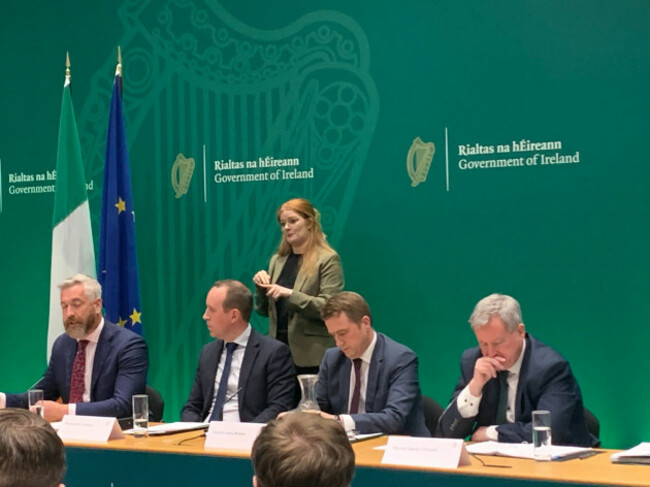
The Journal asked Housing Minister James Browne about the dereliction property tax this evening, while also referring to the comments by the finance minister about the tax defaulters list.
Browne said “dereliction is anti-social behaviour in his view”.
He added: “We are declaring a war on derelictions in this country.”
“Enough is enough,” said Browne, stating that it is in every provincial town in this country.
On whether the tax levy could be increased above the 7% in the future, Browne said that that if the government feel it needs to be increased, that is something that will be discussed.
The aim is to make it “so uncomfortable” for those that hoard their derelict properties so that they release them by either selling them or doing them up, Browne told reporters at Government Buildings this evening.
He said the message he wants to get across to those property owners is that “you have been getting away with it up until now, we are coming after every derelict property”.
Junior Housing Minister John Cummins said there are a number of schemes to help property owners convert their properties.
“That was the carrot, now we’re coming with the stick.
“Use the carrot, if you don’t, the stick is coming with the tax,” he said.
Currently, the sites on the site register are subject to an annual levy of 7% of their market value if they are considered to be in a “ruinous, derelict, dangerous or neglected condition”.
The levy continues to apply until the site is no longer deemed derelict, while unpaid levies attract interest of 1.25% per month.
If necessary, local authorities can take the landowner to court to recover this amount or compulsorily purchase the site from its owner.
Browne said there have been challenges with the current system, stating that there is now an opportunity to look at it, through the new legislation.
“Revenue has firepower,” he said, stating that he hopes it will have a “motivating effect to people who do have these properties”.
Money owed to local authorities under the levy becomes a charge on the land until it’s paid.
Donohoe said today that the new tax will be applied at a rate of at least 7%.
Preliminary registers listing derelict properties will be published from 2027.
In another bid to tackle dereliction and bring unused housing back into stock, Donohoe also announced that five large regional towns – Athlone, Drogheda, Dundalk, Letterkenny and Sligo – have been added to the Living City Initiative.
The initiative gives tax relief to people who carry out renovations on old buildings in so-called “special regeneration areas”.
Until now, the scheme only applied to buildings built before 1915 in Ireland’s major cities – Dublin, Cork, Galway, Limerick, Waterford and Kilkenny.
However, the scheme is set to be strengthened with the inclusion of five new towns and its extension until the end of 2030, while it will also apply to residential properties built before 1975.
Business owners will be able to avail of the scheme to bring residential units over shops into use, and relief available from the scheme will be increased from €200,000 to €300,000.
To embed this post, copy the code below on your site











have your say