Sign in. It’s quick, free and it’s up to you.
An account is an optional way to support the work we do. Find out more.
Sign in. It’s quick, free and it’s up to you.
An account is an optional way to support the work we do. Find out more.

AMERICAN SUBURBIA HAS long been a tantalising place for screenwriters to kick up a bit of dust. Behind the picture-perfect families, trimmed lawns and picket fences, who knows what kind of darkness dwells?
In the work of David Lynch, all sorts of bizarre and unsavoury weirdness takes place in deepest, whitest suburbia. The hugely popular series Desperate Housewives leaned into the Stepford Wives angle of American domestic perfection. More recently in The Chair Company, the suburbs provided ample fodder for absurdist Tim Robinson to spin yet another odd story.
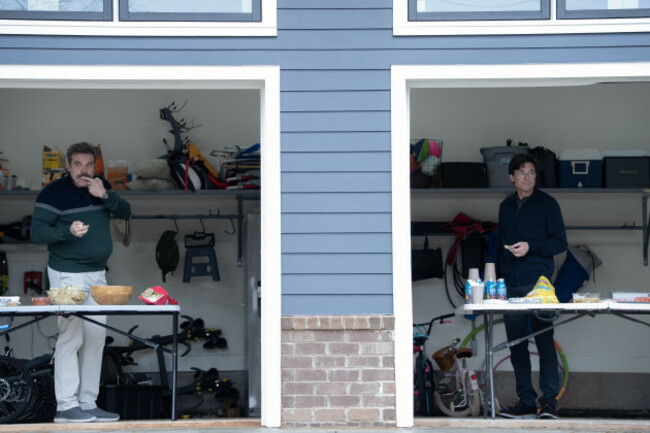
In DTF St Louis, suburbia and middle-age are both open prisons for protagonists Clark Forrest (Jason Bateman), Floyd Smernich (David Harbour) and Smernich’s wife Carol (Linda Cardellini). There’s little joy for any of them to be found in marriage and family life. They could leave, but at what cost?
Odd couple
Bateman excels at playing seemingly ordinary, bland characters who have a seam of barely-contained menace running through them. He’s on fine form here as Clark, who meets Floyd at work at the local Twyla, Missouri news channel. Clark is a weatherman, and Floyd the sign-language interpreter who saves Clark’s life as they broadcast live during a cyclone.
It’s probably welcome relief for David Harbour, who is best known for his long stint in the Stranger Things franchise, to play a new small-screen character. But if he was hoping for something glamorous, he doesn’t get that in Floyd.
Floyd is a depressed stepfather who seeks solace in food. He’s no longer attracted to his wife Carol, and she’s not into him either. His stepson Richard sees him as a pain in the ass.
(The fact that in his real life Harbour was inveigled in his own domestic drama via his marriage to Lily Allen adds another layer to this complicated tale.)
Clark, meanwhile, is trapped in suburban ennui. His wife Eimy (Wynn Everett) thinks he’s a great father, but he’s also the kind of guy who spies on his next door neighbour when she’s sunbathing. He cycles a reclining bike, which is treated as an immediate signal that there’s something up with this chap.
Then a new, intriguing figure turns up in Clark’s life: Floyd’s wife, Carol, the kind of gal who listens to motivational podcasts during her runs.
When Clark and Floyd become buddies, it looks like both have found a pal who’ll help them out of their prospective ruts. But Clark is soon introducing Floyd to a new app called DTF St Louis, where “happily married” couples can hook up with strangers. (If you don’t know what DTF means then… google at your own risk.)
Combine that with Clark’s growing interest in Carol, and you’ve the recipe for some pretty explosive happenings.
Askew world
The men’s friendship sets off a chain of events that end – midway through episode one – in a key character ending up dead. The pair attempting to unravel what happened are detectives Donoghue Homer (a fantastically drole Richard Jenkins) and Jodie Plumb (a delightfully deadpan Joy Sunday).
It’s when Donoghue and Jodie are introduced that the quirkier, absurd side to this series comes to the fore. DTF St Louis takes place in a universe that’s a little askew. Plenty is recognisable: brand names are mentioned which signify bland ubiquitousness, like Jamba Juice, Purina, and Outback Steakhouse.
But then there are the odd moments, like how the police station is a cold, brutalist building. A key conversation between Donoghue and a witness takes place with them both sitting awkwardly on concrete plinths. The dressing room where the body is found is at the Kevin Kline Community Pool, which also raises a chuckle.
The series takes familiar images and ideas around middle-age, marriage and suburbia and wrings them out, asking to what lengths Clark and the Smerniches will go to inject some excitement into their lives.
Flashbacks
The mystery unfolds at a relatively slow pace, perhaps mirroring the slow dawning on Floyd and Clark that their friendship is opening a door into a dark period of their lives.
What led up to the killing unravels in flashback. Innuendo-laden conversations between Carol and Clark provide some light relief; episode two reveals that Clark’s sexual desires combine eroticism with (literally) crushing domesticism.
None of this trio are exactly how they present themselves to others, and DTF St Louis gently reveals exactly how they’ve been fooling each other, and us.
If you’re seeking a soapy, straightforward thriller, then DTF St Louis isn’t that.
But if you’re into a series which gives its characters a lot of complicated emotions to chew on, and which takes joy in spotlighting the hidden desires of seemingly ‘normal’ couples, then there’s a huge amount to enjoy in this quirky, blackly comic thriller.
DTF St Louis is available to watch on Sky and NOW.
To embed this post, copy the code below on your site







have your say