Sign in. It’s quick, free and it’s up to you.
An account is an optional way to support the work we do. Find out more.
Sign in. It’s quick, free and it’s up to you.
An account is an optional way to support the work we do. Find out more.
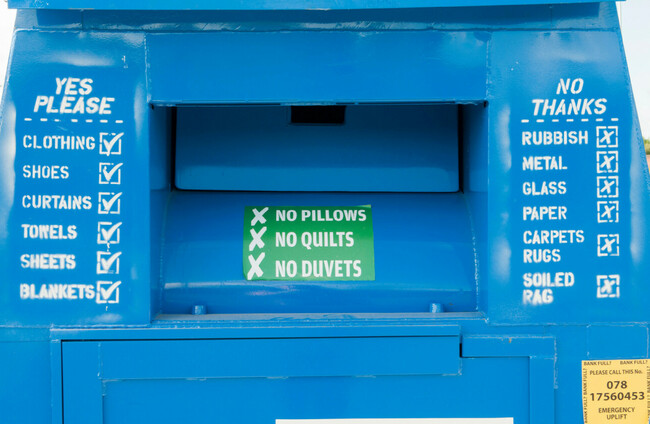
DUBLIN CITY COUNCIL is replacing its network of clothes recycling banks with a new operator.
Under a new four-year contract, charity organisation Enable Ireland will take over the collection and processing of clothing from bring banks across the city, replacing Clothes Pod.
The new service came into effect on Monday, with the rollout of new banks expected to be completed within two weeks.
Enable Ireland provides services to children and adults with disabilities and their families from more than 40 locations across 15 counties, and generates funding through its network of charity shops and commercial activities.
The change comes after disruption to collections last year, when the previous operator Clothes Pod suspended services due to capacity issues.
A note circulated to councillors earlier this month outlines how the new system is expected to operate.
All items removed from Enable Ireland clothes banks will be taken directly to Enable’s Dublin warehouse to be sorted. Textiles and non-textile items (like shoes, handbags and toys) are sorted and separated for re-use or recycling.
Around 15% of clothing collected will be resold through Enable’s charity shops across the country, with the remainder sorted and graded for reuse or recycling.

Daily collections will be carried out at each location during the first month of the contract to establish demand at individual sites, with the aim of ensuring banks do not overflow.
All locations will also be monitored daily, with any litter removed, Dublin City Council said.
Clothes that aren’t “suitable for resale in Enable’s shop network” will be sold to Enable’s recycling partner, Cookstown Textile Recycler, who will then sell items to markets overseas, including in Asia, Africa and Eastern Europe, while recyclable materials will be sent to markets in Europe and the UK.
Items deemed unsuitable for reuse or recycling, typically less than 5%, are likely to be incinerated at a waste-to-energy plant in Northern Ireland.
Green Party councillor Janet Horner said the increased transparency was a key improvement.
“Transparency is really the thing that has been seriously missing from how we have done clothes recycling up till now,” Horner said.
Textiles account for roughly 9% of Ireland’s waste, she noted, and there has been long-standing uncertainty about what happens to clothing once it leaves collection points.
“A lot of it ends up going to developing countries and becoming a problem there,” Horner said.
“Sometimes it’s helpful for people to have it, but a lot of the time it is just dumping unwanted clothing elsewhere.”
Environmental group Voice Ireland also welcomed the move, describing it as a “meaningful shift” in how clothing collection is managed and monitored.
The organisation has previously highlighted gaps in transparency in the sector, finding that most donated clothing is exported and that the final destination of many items is unclear.
“It’s an encouraging sign that years of advocacy are starting to resonate with decision-makers,” Voice Ireland said in a statement.
“We’re not there yet, but we are moving.”
Horner said greater visibility is essential to tackling the broader issue of fast fashion and overconsumption.
She added that increasing the amount of clothing reused locally, including through charity shops, is a positive step.
“I think that’s the ideal, to keep clothes in use as long as possible,” Horner said.
Enable Ireland and Clothes Pod have been contacted for comment

To embed this post, copy the code below on your site














have your say