We need your help now

Support from readers like you keeps The Journal open.

You are visiting us because we have something you value. Independent, unbiased news that tells the truth. Advertising revenue goes some way to support our mission, but this year it has not been enough.

If you've seen value in our reporting, please contribute what you can, so we can continue to produce accurate and meaningful journalism. For everyone who needs it.

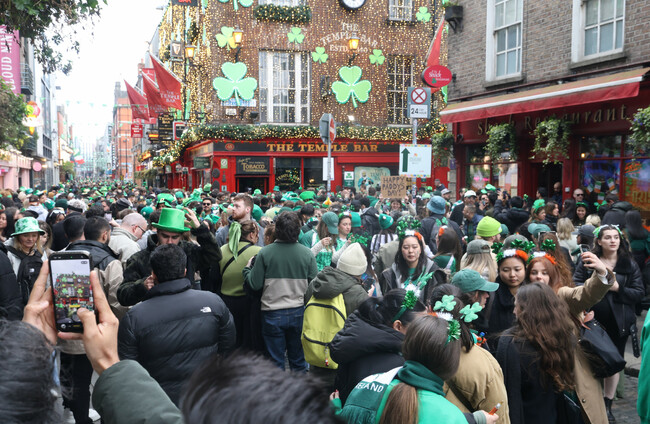
Temple Bar pictured on St Patrick's Day. Rolling News

Dublin City Council is considering a tourist tax of up to €5 per night for visitors

One possible method of taxing examined was a tiered system based on hotel types, with the levy rising to €5 for five-star hotels.

DUBLIN CITY COUNCIL is considering introducing a tourist levy of up to €5 per night on visitors staying in the capital, as part of efforts to raise funding for infrastructure and services.

The proposal, outlined to councillors at a finance committee meeting yesterday, would see Dublin join the majority of EU countries in applying some form of accommodation or “bed” tax.

According to council officials, 21 of the 27 EU member states already operate similar tourist levy schemes, as well as a number of local regions in the UK.

Ross Curley, head of the council’s economic development office, said such levies are typically designed around a “user pays” principle, and explained that the funds would be used to support infrastructure, environmental measures and cultural initiatives.

“The three core ways of charging are per person per night, per room per night, or a percentage of the room rate,” he said, noting each model comes with different levels of complexity and revenue potential.

One option under consideration would see a tiered system based on hotel type, with charges of €2 per night for lower-rated accommodation, rising to €5 for five-star hotels.

A simpler flat rate could also be introduced, with Curley noting that even a €2 charge per room per night could generate around €17.5 million annually for the council.

He also pointed to examples across Europe and the UK, including Porto, which charges €3 per person per night, and Amsterdam, where a 12.5% levy generated more than €570 million in 2024.

In Venice, visitors pay between €1 and €5 depending on the type of accommodation.

Curley said international evidence suggests such taxes do not necessarily deter visitors if implemented correctly, despite concerns from the tourism and hospitality sector.

Dublin was ranked the fourth most expensive city break destination in 2023, but remains a “high value proposition” for tourists, he said.

Council research suggests public support for the idea, with 64% of Dubliners backing the introduction of a tourist levy in a recent survey, Curley said.

Dublin’s four local authorities (Dublin City Council, Fingal County Council, South Dublin County Council and Dún Laoghaire-Rathdown County Council) met in September last year to begin a drive for national legislation to enable councils to implement a tourist tax.

Fingal County Council wrote to the Minister for Finance in late 2024 to request this but the government has not announced any plans for its introduction so far.

Around 6.4 million overnight international tourists visited Ireland last year, according to CSO figures.

Readers like you are keeping these stories free for everyone...
A mix of advertising and supporting contributions helps keep paywalls away from valuable information like this article. Over 5,000 readers like you have already stepped up and support us with a monthly payment or a once-off donation.

View 148 comments
Close
148 Comments
This is YOUR comments community. Stay civil, stay constructive, stay on topic. Please familiarise yourself with our comments policy here before taking part.
Leave a Comment
    Submit a report
    Please help us understand how this comment violates our community guidelines.
    Thank you for the feedback
    Your feedback has been sent to our team for review.

    Leave a commentcancel

     
    JournalTv
    News in 60 seconds