We need your help now

Support from readers like you keeps The Journal open.

You are visiting us because we have something you value. Independent, unbiased news that tells the truth. Advertising revenue goes some way to support our mission, but this year it has not been enough.

If you've seen value in our reporting, please contribute what you can, so we can continue to produce accurate and meaningful journalism. For everyone who needs it.

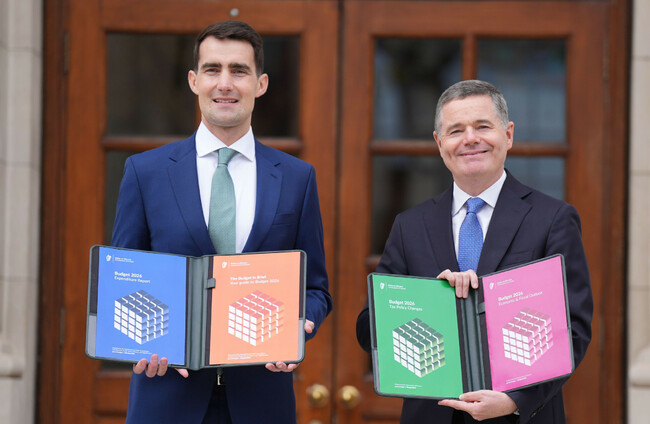
Jack Chambers and Paschal Donohoe outside Government Buildings ahead of Budget 2026 announcement on 7 October. Alamy Stock Photo

ESRI warns government didn’t pay attention to concerns voiced ahead of the Budget

The ESRI said Budget 2026 was a “missed opportunity” to fortify the public finances.

ONE OF THE biggest think-tanks in the country has said the government did not pay attention to concerns it and other experts raised ahead of Budget 2026. 

In its Quarterly Economic Commentary published today, the ESRI said that potential Budget issues went “largely unheeded” by the government in the final Budget by Paschal Donohoe before he left to take a job at the World Bank. 

The report noted that it is “well understood” that Ireland needs to “tighten its budgetary stance” and that the “current reliance on windfall corporate tax revenues creates a vulnerability for public finances”.

However, the ESRI warned that Budget 2026 “exacerbated” both of these concerns and did not take “due account of future risks”.

“The fiscal stance was loosened and a higher level of vulnerability with respect to windfall revenues was achieved,” said the report’s authors. 

It added that the “most noteworthy figure” from the Budget documents was the projected government deficit of €13.6 billion when adjusted for the windfall corporate tax revenues.

The Irish Fiscal Advisory Council recently accused the government of spending money in the Budget “like there’s no tomorrow” despite “significant and predictable budgetary pressures”.

Alan Barrett, a research professor at the ESRI, noted that there was some good news: while the earlier part of this year was dominated by uncertainty created by Trump’s policies on tariffs, “the global economy has shown resilience and Ireland has benefited”.

However, he added that Budget 2026 was a “missed opportunity to set the public finances on a trajectory that is less vulnerable to any weakening in windfall corporate tax revenues”.

And while the ESRI criticised Budget 2026, it welcomed the Department of Finance’s ‘Future Forty’ report on risks to the public finances.

The Future Forty report projected that living standards in Ireland will decelerate throughout the 2030s and 2040s, while public spending will face “sustained pressure” through to 2050 and beyond.

It said this is due mainly to demographic shifts, slowing productivity, climate costs and a slowdown in corporation tax receipts.

The ESRI noted that the Future Forty report points to pressures related to population ageing and that measures such as increasing the retirement age might be required to curtail this.

Elsewhere in its report, the ESRI noted that Ireland’s positive economic performance continues, with growth in consumption and tax receipts.

However, it warned that there is evidence of a “moderate slowdown in the labour market”, with employment growth likely to continue but at a slower pace. 

Conor O’Toole of the ESRI remarked that Ireland’s economy is expected to continue to perform “robustly” in 2026 but cautioned that “downside risks remain”.

He pointed to “vulnerabilities relating to our exposure to any downturn in activity from multinational corporations through tax and employment channels”.

Housing

The ESRI said it expects housing output to remain below demand for 2026.

While the second quarter of 2025 saw a jump in housing completions to over 9,000 units, the number of completions levelled off in the summer.

The ESRI said it now seems likely that completions will be in the region of 35,000 for 2025, and it expects just under 36,000 units next year, which would mean another year when housing output falls short of what is required.

It warned that Ireland faces “considerable investment needs to cater for a growing population and to deal with bottlenecks in infrastructure and housing”.

The ESRI remarked that increasing housing production “will be a challenge” and called for structural reforms, such as those outlined in the recent Accelerating Infrastructure Taskforce report, to be “prioritised as a matter of urgency”.

The Accelerating Infrastructure Taskforce report, which the ESRI described as “valuable and encouraging”, includes a plan to reform and remove administrative blockages to infrastructure completion.

The ESRI said these reforms are “of the scale and magnitude needed to have meaningful structural change and remove administrative barriers to activity”.

Readers like you are keeping these stories free for everyone...
A mix of advertising and supporting contributions helps keep paywalls away from valuable information like this article. Over 5,000 readers like you have already stepped up and support us with a monthly payment or a once-off donation.

Close
47 Comments
This is YOUR comments community. Stay civil, stay constructive, stay on topic. Please familiarise yourself with our comments policy here before taking part.
Leave a Comment
    Submit a report
    Please help us understand how this comment violates our community guidelines.
    Thank you for the feedback
    Your feedback has been sent to our team for review.

    Leave a commentcancel

     
    JournalTv
    News in 60 seconds