We need your help now

Support from readers like you keeps The Journal open.

You are visiting us because we have something you value. Independent, unbiased news that tells the truth. Advertising revenue goes some way to support our mission, but this year it has not been enough.

If you've seen value in our reporting, please contribute what you can, so we can continue to produce accurate and meaningful journalism. For everyone who needs it.

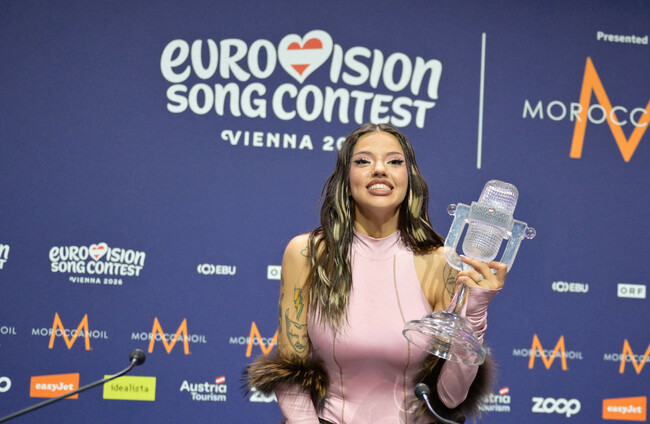
Bulgarian singer Dara won the contest in Vienna. Alamy Stock Photo

Eurovision loses 35 million viewers this year after boycott over Israel’s participation

Ireland and four other countries boycotted the song contest this year, with RTÉ opting not to air the live show.

THE 2026 EUROVISION Song Contest was watched by 131 million viewers, organisers said Friday, down 35 million on the year before after Ireland and four other countries boycotted over Israel’s participation.

Bulgaria won the contest for the first time with Dara’s catchy floor-filler “Bangaranga” sweeping the 70th edition of the world’s biggest live televised music event, with Israel finishing in second place. The UK finished last.

RTÉ joined broadcasters in Spain, Slovenia, Iceland and the Netherlands in deciding not to send an act or air the contest in protest at Israel’s participation amid its war on Gaza.

The 2025 contest was watched by an average audience of 5.8 million people in Spain, and 3.5 million people in the Netherlands. In Ireland, RTÉ’s broadcast of last year’s contest garnered an average of 268,000 viewers.

This year’s Eurovision was held in Vienna, with the grand final taking place on 16 May.

Protests were held in Vienna over Israel’s participation, and chants of ‘stop of the genocide’ could be heard during Israel’s performance in the semi-final.

The contest is run by the European Broadcasting Union (EBU), the world’s biggest public-service media alliance.

“While some of our figures are naturally lower without those of our five members who chose not to participate this year, we remain committed to doing everything possible to find pathways back for them in 2027,” said Eurovision director Martin Green.

Big Nordic audiences

The biggest share of viewers watching Eurovision was recorded in Finland (93%), Sweden (86%), Norway (83%) and Denmark (79%).

Across the board in 35 measured TV markets, the grand final attracted an average viewing share of 42.6%.

The share for viewers aged 15 to 24 was higher, at 54.8%.

The EBU noted that viewing figures were down 3.8 million in Poland, 3.7 million in Britain and 3.3 million in France, compared to those for Eurovision 2025, held in the Swiss city of Basel.

Eurovision garnered more than a billion views for content on Instagram this year.

“It’s fantastic to see the impact the Eurovision Song Contest is having on young audiences globally,” said Green.

“The hundreds of millions reached via our digital platforms also underlines the Eurovision Song Contest’s 70-year evolution from a TV show to a true global, cultural, multi-platform phenomenon.”

People in 148 different countries and territories cast votes for their favourites.

Outside the 35 participating countries, the biggest votes were received from the United States, the Netherlands, Canada, Spain, Ireland, Slovakia and Turkey.

Around 100,000 tickets were sold for the shows at the Wiener Stadthalle arena, bought by fans from 75 countries.

After Dara’s win, next year’s edition will be hosted in Bulgaria.

Author
View 30 comments
Close
30 Comments
This is YOUR comments community. Stay civil, stay constructive, stay on topic. Please familiarise yourself with our comments policy here before taking part.
Leave a Comment
    Submit a report
    Please help us understand how this comment violates our community guidelines.
    Thank you for the feedback
    Your feedback has been sent to our team for review.

    Leave a commentcancel