Sign in. It’s quick, free and it’s up to you.
An account is an optional way to support the work we do. Find out more.
Sign in. It’s quick, free and it’s up to you.
An account is an optional way to support the work we do. Find out more.
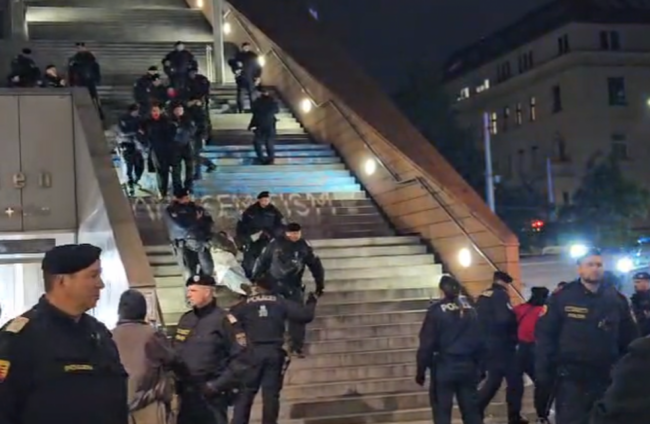

FOURTEEN PRO-GAZA DEMONSTRATORS have been arrested after mounting a protest at a train station close to the Eurovision Song Contest venue in Vienna tonight.
Police said they were detained after repeatedly being asked to remove their face coverings, which is against Austrian law.
One group of seven protesters were detained at about 8.30pm local time (7.30pm in Ireland) – half an hour before the Grand Final began and as fans continued to make their way towards the arena.
Another group remained at the site for several hours, chanting and holding a sign saying ‘disrupt ESC’. There was a steady build-up of police reinforcements in the area, some wearing riot gear, before that group was arrested too.
Several of those detained were carried down the steps to waiting police vehicles.
A Federal Police spokesman said that although the protest had not been formally registered, it was recognised as a spontaneous public assembly under Austrian law.
“As Austrian assembly law prohibits participants from concealing their identity, those individuals were repeatedly instructed to remove their face coverings. 14 participants failed to comply.
“Remaining in a state of ongoing non-compliance constitutes an administrative offence under the Assembly Act, and arrests were carried out on that basis.”
Several protesters were detained by police at the same train station near the arena earlier this evening... Bystander shared this video with me. pic.twitter.com/g1ySyQ0qFz
— Daragh Brophy (@DaraghBroph) May 16, 2026
The contest is taking place once again under the shadow of controversy amid continued protest over Israel’s continued presence in the competition.
Further protest had been expected during the performance of Israel’s Noem Bettan, who took to the stage third in the running order, after chants of ‘stop the genocide’ could be heard during Tuesday’s semi-final.
Austrian host broadcaster ORF said it would not be changing its policy of airing a clean audio feed in the wake of the semi-final show.
No audible booing could be heard in the broadcast as the performance took place. Commentating for the BBC, Graham Norton noted as the song started that there was “a slightly mixed reception in the hall … I’m not sure what we’re hearing”.
The reaction to Israel in the arena is very clear. It even made Graham Norton trip up 😳 #Eurovision pic.twitter.com/heP8F7TffV
— sᴜᴘᴇʀ ᴛᴠ (@superTV247) May 16, 2026
Around 2,000 people attended a pro-Gaza protest in the city earlier today. The march passed around three blocks away from the venue as protests aren’t allowed in the immediate area around the arena itself.
Asked about this afternoon’s protest at the Eurovision press centre this afternoon, Ingrid Thurnier, the director general of Austrian host broadcaster ORF, said everyone had a right to be heard, but that tonight should be about the performers taking part in the contest.
RTÉ is one of five national broadcasters boycotting the event this year over the war on Gaza.
Spain’s RTVE, which is also boycotting, posted a message on social media this evening saying. “The Eurovision Song Contest is a competition, but human rights are not. There is no room for indifference. Peace and Justice for Palestine.”
Ante la celebración de la final del festival de Eurovisión esta noche, RTVE recuerda que ha decidido no participar en esta edición del certamen.
— RTVE (@rtve) May 16, 2026
El festival de Eurovisión es un concurso, pero los derechos humanos no lo son. No hay espacio para la indiferencia. Paz y Justicia… pic.twitter.com/PiCc70cINx
Adding to the woes of contest organisers the European Broadcasting Union (EBU) this evening, the Belgian broadcaster tasked with organising the contestant for next year’s contest demanded a direct vote take place on which countries will be allowed to compete.
“Today, the chances are slim that VRT will send an artist next year,” spokesperson Yasmine Van der Borght said.
“We expect a clear statement from the EBU against war and violence and for respect for human rights.”
EBU members did not proceed with a direct yes-no vote on Israel’s inclusion when they gathered to discuss rule changes around this year’s Eurovision last December, prompting the boycott by RTÉ and the other broadcasters.

To embed this post, copy the code below on your site









have your say