Sign in. It’s quick, free and it’s up to you.
An account is an optional way to support the work we do. Find out more.
Sign in. It’s quick, free and it’s up to you.
An account is an optional way to support the work we do. Find out more.

INDUSTRIAL ACTION BY solicitors has disrupted the work of the courts this week and drawn criticism from one judge.
The issue centres around a government proposal to reform the pay for the lawyers who appear on legal aid cases.
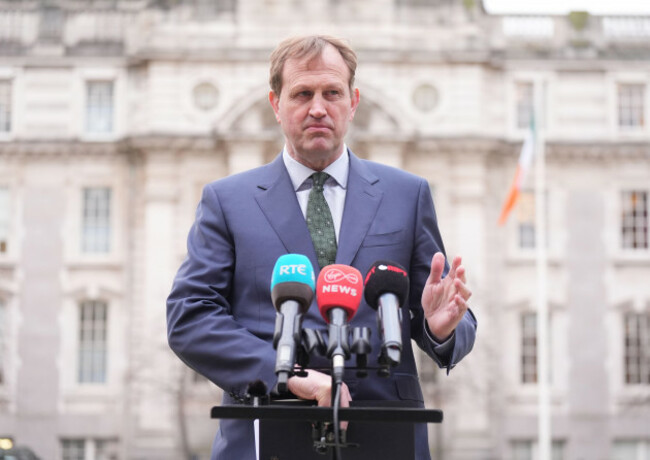
Minister for Justice Jim O’Callaghan has indicated he won’t back down.
Judge Paul McDermott became angry in court on Tuesday with his solicitor colleagues and declared that it was “disappointing to say the least”.
“The court has received no formal notice of any such action being taken from any group of solicitors. Certainly there has been no notification from the Law Society of Ireland that services are to be withdrawn by their members.”
The dispute centres on O’Callaghan’s reform of what is often known as free legal aid.
Legal aid is granted to accused in criminal matters when it is proven to the court that they are unable to pay for adequate legal representation. Solicitors representing defendants then claim this and are paid by the state for their work.
The Department of Justice carried out a report which found that solicitors were “maximising” their earnings through criminal legal aid payments.
The review, seen by The Journal, helped inform O’Callaghan’s decision to make changes to the criminal legal aid fees paid to solicitors. The changes are due to kick in next month.
The introduction of a flat-fee payment model for District Court cases under the legal aid system means that from 1 July, solicitors will receive a single payment of €455 for District Court criminal cases regardless of the number of court appearances involved.
There have been anecdotal suggestions from garda sources of suspicions that lawyers are making unnecessary adjournments to maximise their earnings also.
A number of solicitors have said publicly that, in their view, the measures would have a detrimental effect on their clients.
The department’s report raised a litany concerns.
Officials looked at more than 350,000 District Court cases that took place during 2022 and 2023, and found that cases with criminal legal aid take significantly longer than those without, though the outcomes are similar.
Cases with criminal legal aid take an average of 313 calendar days to complete, compared to 133 days for cases without, it found.
The report warns that the “financial implications” of the additional claims to the state “cannot be overstated”.
In addition, the report also raised concerns about judges “rarely” demanding to see a statement of means that would prove applicants cannot afford to pay their own legal fees.
The department report shows that one legal firm offered a “crash course” to solicitors on how to “maximise” revenue through the scheme.
The seminar showcased how solicitors can maximise the legal aid “by assigning each prosecution in a different solicitor’s name from the same firm” when applying for criminal legal aid certificates.
Over the past two years, the department said it has queried legal aid claims with the courts service and solicitors after it emerged the number of legal aid certificates granted to one single accused has, in several cases, increased dramatically.
However, the report goes on to note that in the vast majority of cases, the same solicitor (and not different solicitors) were in court representing clients.
The department report states that regulations do allow for colleagues from the same legal firm to stand in for each other in cases where the solicitor on the certificate cannot attend the hearing, but the intention “was not to allow for the maximisation of profits under criminal legal aid through abuses of the system”.
The Law Society is the representative body for solicitors.
It said that its focus is on ensuring that reforms to the Criminal and Civil Legal Aid schemes are grounded in practical evidence and reflect the realities of how the District Courts operate, so that the scheme remains fair, workable and sustainable.
“Criminal Legal Aid exists to support people who are often in very vulnerable situations, including children coming before the courts for the first time, individuals dealing with addiction or mental health difficulties, and people facing homelessness, language barriers or acute personal crises.
“We want to ensure that the system continues to work effectively for those who rely on it most,” it said in a statement.
The Law Society said that it wants to discuss with the Department of Justice how the proposed flat fee structure fails, in its view, to reflect the actual number of court appearances required for these complex cases, or the significant amount of work involved outside the courtroom.
“Our objective is to arrive at a model that delivers a fair, efficient and sustainable Criminal Legal Aid system – one that works in practice and, most importantly, works well for those who depend on it,” it added.
The Irish Council for Civil Liberties (ICCL) has attacked the proposal and said it fails to account for how the law is practised at District court level.
“It is ICCL’s view that the impact of introducing a flat fee will undoubtedly lead to a reduction of legal representation for this group, thereby undermining the constitutional right to a fair trial,” the organisation said.
It said the government’s proposal showed “blatant disregard” for the welfare of vulnerable people.
“Most worryingly, it introduces an incentive for legal practitioners to curtail their representation, with an increased risk, according to the Law Society, of inappropriate guilty pleas,” the ICCL said.
At a press conference O’Callaghan was asked why is not for turning about the reforms.
He referenced the anecdotal view that there are unnecessary adjournments being made to lengthen the time of a case at District Court level.
“What I don’t want to see is what’s happening at present, where you have a series of ongoing adjournments with the case not being determined promptly.
“If you look at the statistics in respect to the length of time it takes for a criminal legal aid case to conclude, you can see that it takes 313 calendar days for a district court case subject to criminal legal aid to conclude, whereas for those without criminal legal aid, it’s 133 days.
“So I regret to say, as well, there are very clear abuses going on in the system, and I would not be performing my function as Minister for Justice if I didn’t seek to confront that. And for that reason, that I’m bringing in the reforms on the first of July,” he said.
With additional reporting from Isabel Hayes and Christina Finn.

To embed this post, copy the code below on your site













have your say