Sign in. It’s quick, free and it’s up to you.
An account is an optional way to support the work we do. Find out more.
Sign in. It’s quick, free and it’s up to you.
An account is an optional way to support the work we do. Find out more.
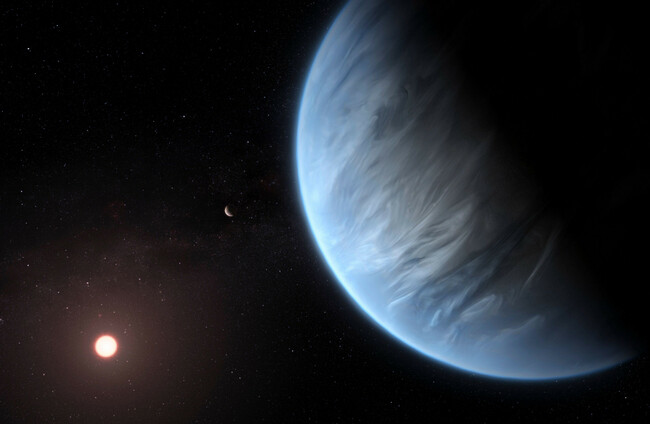
ASTRONOMERS HAVE ANNOUNCED that they have detected the most promising “hints” of potential life on a planet beyond our solar system.
There has been vigorous debate in scientific circles about whether the planet K2-18b, which is 124 light years away in the Leo constellation, could be an ocean world capable of hosting microbial life.
Using the James Webb Space Telescope, a British-US team of researchers detected signs of two chemicals in the planet’s atmosphere long considered to be “biosignatures” indicating extraterrestrial life.
On Earth, the chemicals dimethyl sulphide (DMS) and dimethyl disulphide are produced only by life, mostly microscopic marine algae called phytoplankton.
The researchers emphasised caution, saying that more observations were needed to confirm these findings, and that they were not announcing a definitive discovery.
But the implications could be huge, according to Nikku Madhusudhan, a Cambridge University astrophysicist and lead author of the study, published in The Astrophysical Journal Letters.
“What we are finding at this point are hints of possible biological activity outside the solar system,” he told a press conference.
“Frankly, I think this is the closest we have come to seeing a feature that we can attribute to life.”
But outside experts pointed to disputes over previous discoveries about the exoplanet, adding that these chemicals could have been created by unknown means having nothing to do with life.
More than eight times the mass of Earth and 2-and-a-half times as big, K2-18b is a rare exoplanet that orbits its star in a habitable or “goldilocks” zone.
This means it is neither too hot nor too cold to have liquid water, considered the most important ingredient for life.
Telescopes observe such far-off exoplanets when they cross in front of their star, allowing astronomers to analyse how molecules block the light streaming through their atmosphere.
In 2023, the Webb telescope detected methane and carbon dioxide in K2-18b’s atmosphere, the first time such carbon-based molecules were detected on an exoplanet in a habitable zone.
It also detected weak signals of the chemical DMS, leading astronomers to turn Webb towards the planet again a year ago, this time using its mid-infrared instrument to detect different wavelengths of light.
They found much stronger signs of the chemicals, though still well below the “five sigma” threshold of statistical significance scientists seek for such discoveries.
Even if the results are confirmed, it would not necessarily mean that the planet is home to life.
Last year, scientists found traces of DMS on a comet, which suggested it can be produced in non-organic ways.
However, the concentration of the chemical observed on K2-18b appears to be thousands of times stronger than levels on Earth, strongly suggesting a biological origin, Madhusudhan said.

To embed this post, copy the code below on your site















have your say