We need your help now

Support from readers like you keeps The Journal open.

You are visiting us because we have something you value. Independent, unbiased news that tells the truth. Advertising revenue goes some way to support our mission, but this year it has not been enough.

If you've seen value in our reporting, please contribute what you can, so we can continue to produce accurate and meaningful journalism. For everyone who needs it.

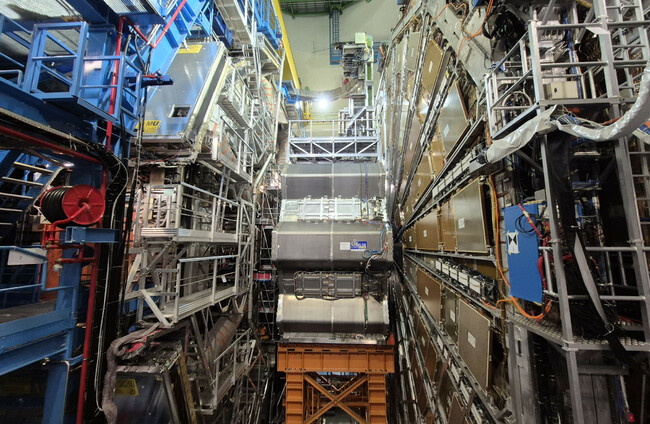
An image of the Large Hadron Collider in CERN. Andrew Walsh/The Journal

'Part of the family': Ireland's application to join CERN accepted 'in principle' after delegation visit

Minister for Science James Lawless told CERN officials that the application “was only the beginning”.

IRELAND’S LONG-AWAITED application to join the European Organisation of Nuclear Research (CERN) has been “accepted in principle”, meaning that Ireland is on the path to membership.

Minister for Science James Lawless visited the CERN site on the Franco-Swiss border today with a delegation of government officials and Irish academics from over 20 Universities and research institutions.

CERN, the world’s largest centres for scientific research, is located near Geneva. Its main focus is the Large Hadron Collider (LHC), a 27km underground ring that collides protons at close to the speed of light.

When Ireland becomes an associate member, Irish researchers will gain access to CERN’s scientific programmes, while Irish citizens can apply for staff positions and fellowships. Irish businesses will also be able to compete in CERN’s procurement contracts.

Associate membership will cost around €1.9 million annually for an initial five-year term, Lawless has said.

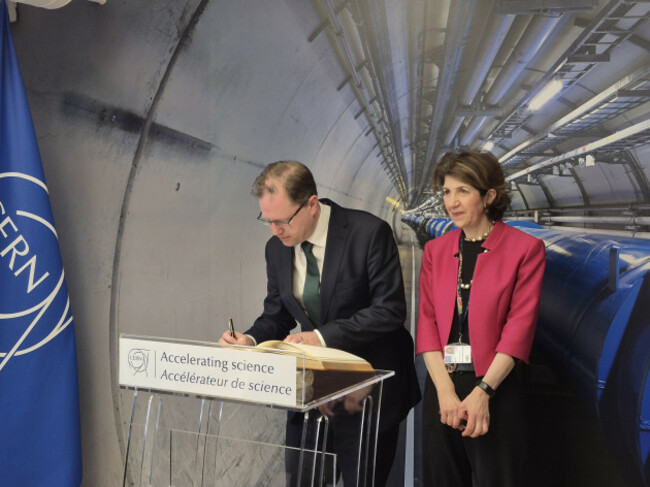
20250219_100823 Minister James Lawless signing the guest book with CERN Director General Fabiola Gianotti. Andrew Walsh / The Journal Andrew Walsh / The Journal / The Journal

He added during a meeting with CERN officials this morning that he had brought a “memo” to cabinet updating the government on the progress of the Irish application.

Subject to funding requirements and Dáil approval, it is expected that the accession process will be completed in 2026.

Lawless added that a motion on Ireland’s CERN application will be brought forward soon, which he claimed would pass “almost unanimously” with “very high cross-party support”.

‘We can benefit greatly’

Speaking to The Journal in Geneva, Lawless explained that CERN membership is something that the science community in Ireland “has long aspired to achieve”.

Lawless was shown a number of the ongoing projects across a number of CERN campuses today, including the Large Hadron Collider.

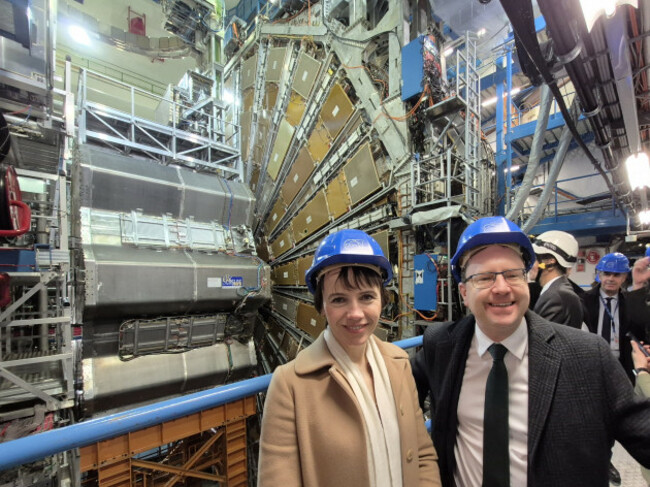
20250219_110752 (1) Minister James Lawless with Government Science Advisor Aoife McLysaght at the Large Hadron Collider in CERN today. Andrew Walsh / The Journal Andrew Walsh / The Journal / The Journal

He said that he had long-supported the initiative, having advocated for the application while serving as spokesperson for science with Fianna Fáil in opposition in 2018.

“The application means that Ireland will finally take its seat at the table with most other European countries, and we can benefit greatly from CERN,” Lawless said.

CERN accepted Lawless’ Irish application “in principle” this morning, he said, meaning that the science organisation and Ireland have a general agreement about the application but the details are still to be worked out.

“Once it’s approved by the Irish government and CERN, we’ll sign the dotted line and become an associate member of the organisation,” Lawless said.

‘Potential for the future’

CERN Director for International Relations Charlotte Warakaulle told Lawless during a meeting this morning that the organisation was “impressed” with the levels of interest from Ireland.

“Joining as an associate member is a small detail, because the relationhip between Ireland and CERN has always been strong,” Warakaulle said.

“Irish industry already has quite an important footprint, even without being an associate member. So there’s really potential for the future,” she added.

“I know there’s much excitement, but whenever Ireland has been discussed as an associate member, it’s clear that member states are very much looking forward to Ireland joining – it feels like a piece of the puzzle has been missing.”

She added that member states are “really excited” to see Ireland join and “be part of the family”. 

Membership perks

Associate membership will allow Ireland’s researchers to participate in CERN’s scientific programmes and will make Irish citizens eligible for staff positions and fellowships at CERN.

Currently, there are 24 full member states and 10 associate member states involved with CERN.

Ronan McNulty, a professor of physics at UCD and a member of CERN Ireland Users’ Group, said there were “three main perks” to Ireland’s membership.

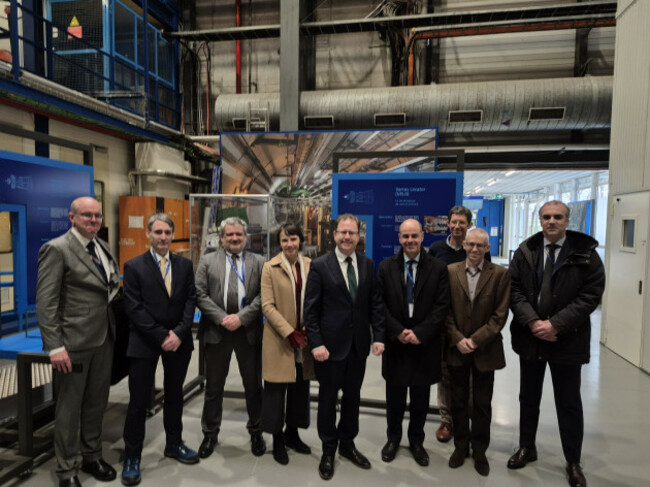
20250219_121925 Ronan McNulty (second from left) pictured alongside members of the Irish delegation in CERN today. Andrew Walsh / The Journal Andrew Walsh / The Journal / The Journal

McNulty said that jobs and student opportunities, financial gain for Irish industries and “knowledge transfer” made Ireland’s CERN application worthwhile.

“For Irish people or companies working with CERN, it’s taking that knowledge and bringing it back to Ireland – that’s the big key thing,” he said.

Readers like you are keeping these stories free for everyone...
A mix of advertising and supporting contributions helps keep paywalls away from valuable information like this article. Over 5,000 readers like you have already stepped up and support us with a monthly payment or a once-off donation.

Close
23 Comments
This is YOUR comments community. Stay civil, stay constructive, stay on topic. Please familiarise yourself with our comments policy here before taking part.
Leave a Comment
    Submit a report
    Please help us understand how this comment violates our community guidelines.
    Thank you for the feedback
    Your feedback has been sent to our team for review.

    Leave a commentcancel

     
    JournalTv
    News in 60 seconds