Sign in. It’s quick, free and it’s up to you.
An account is an optional way to support the work we do. Find out more.
Sign in. It’s quick, free and it’s up to you.
An account is an optional way to support the work we do. Find out more.
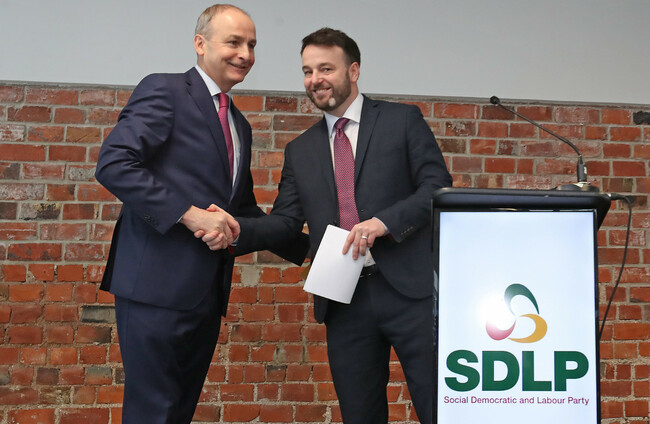
THE PACT ANNOUNCED in 2019 between Fianna Fáil and the SDLP is creeping into action ahead of the Stormont election, as Fianna Fáil TDs and MEPs canvas with some SDLP candidates ahead of Friday’s polling day.
How well that relationship is going depends on what candidate you ask: the agreement caused controversy in 2019 when some members of both the SDLP and Fianna Fáil expressed concern about it.
Members of Fianna Fáil had said at the time that running candidates in the North had been discussed at an Ard Fheis, but a partnership with the SDLP instead of Fianna Fáil running its own candidates had not. Some FF politicians also expressed a concern of a merger with a party with “a damaged brand”.
Three years on from that, there isn’t much more clarity on the policy agreement between the two – the focus ahead of the Stormont elections is logistical supports.
Fianna Fáil TD for Dublin North-West Paul McAuliffe, who is on the Northern Ireland committee and spearheading the party’s support in Stormont, told The Journal that the focus for the party was promoting candidates out canvassing in Northern Ireland.
“The last thing we want is for it to be a Fianna Fáil canvas, and if there are 10-12 FF people in one place, that can be a bit unmanageable. It’s about support from the background, feeling the interest and doing a bit of the logistics.
“When you’re on the door with any candidate, you’re talking about the candidate,” he said.
He said that for the partnership to mean something, the time for Fianna Fáil to show up was for the Stormont Assembly election.
“Every politician knows the value of their volunteers by who turns up at an election. So to make the partnership real, that was something that we needed to do.”
McAuliffe said that Northern Ireland committee chair and Cavan-Monaghan TD Brendan Smith, Cavan-Monaghan TD Niamh Smith, Dublin Bay South TD Jim O’Callaghan, and MEPs Barry Andrews and Billy Kelleher have all been to canvass with the SDLP.
Clare TD Cathal Crowe is to travel up this week to canvass, he adds.
“There will be existing connections that they’ve already have, some of it is about them showing up to people who’ve they’ve worked with.”
When asked what involvement the Taoiseach and Fianna Fáil leader Micheál Martin has in advising the SDLP in relation to the Stormont election, McAuliffe says that he wouldn’t know if the Taoiseach is advising SDLP leader Column Eastwood, but that the Shared Island Unit is a core part of Martin’s policy in relation to Northern Ireland.
The ‘Labour’ in SDLP
SDLP incumbent MLA Matthew O’Toole told The Journal while out on the canvas that the SDLP has good relations with a whole range of parties on the island.
“We are in a unique position, because we are a constitutional-nationalist party, but we are also a centre-left social democratic party. Those are really core values for us.
I had Irish Labour’s Rebecca Moynihan up last week, and we’re going to have more Irish Labour people up this weekend. So I’m very proud of that relationship.
Delighted to have the indomitable @RebeccaMoy on the doors with us in Stranmillis earlier. Great craic and good conversations on cost of living, housing and how social democratic politics can trump tired stand off politics.🌹#PeopleFirst pic.twitter.com/sqO3CtMZPQ
— Matthew O'Toole (@MatthewOToole2) April 13, 2022
When McAuliffe is asked what Fianna Fáil is doing differently under the partnership that other parties aren’t, he says:
“I’d like to think that we’re pushing it hard with in the PP. Even within the SDLP, there’s different views on what the partnership is. I’ve tried to stay out of that, we’ve sent people to places where we’re trying to gain seats or hold seats.”
McAuliffe has canvassed with Paul Doherty in West Belfast, which McAuliffe said wasn’t “a million miles away from my constituency, and we have a lot in common”.
Mentioning the similarities in both electorates’ concerns about the cost of living and the healthcare system, McAuliffe says there are also “cultural differences” that he noticed.
“People are more reticent on the doors to say what way they’re voting. There is a mood for change, but it’s hard to pin down what that change meant. It’s hard to square that.”
A policy partnership
In the longer term, it is about a policy agreement between the two parties.
“We have similar objectives in terms of a shared island and the type of politics – being straight with people,” he said.
“If I have one criticism of the partnership – between Covid and the election and the rest of it – it’s that the electoral systems don’t coincide.”
He said that it’s hard to have a policy debate in the middle of an election, when politicians are more focused on trying to keep their seats.
“The big test for the partnership will be after the results, we have to keep building the relationship up on both sides. On a non-election year, there will be a big focus on that, but at the same time, we’ve started conversations that we will be continuing.
“All politics is about people, that’s why us showing up is important.”
- With reporting from Tadgh McNally.

To embed this post, copy the code below on your site













have your say