Sign in. It’s quick, free and it’s up to you.
An account is an optional way to support the work we do. Find out more.
Sign in. It’s quick, free and it’s up to you.
An account is an optional way to support the work we do. Find out more.

 Investigatesseries
The FOI Files is a brand-new series from our team at The Journal Investigates. Each week, one of our investigative journalists brings you inside the fight for information that we’re all entitled to. They’ll share their documents, their stories – and tips on how to take the journey for yourself.
This week’s file is from TJI’s acting editor Noel Baker.
See here for The Journal Investigates’ most recent investigations.
DID YOU HEAR the one about the Irish diplomat and the parking fine?
It sounds like the start of the world’s worst dad joke, but in fact, it’s more of a puzzle – and the answer is, “Well, you won’t be hearing about it – at least, not yet.”
The Journal recently ran a story based on a Freedom of Information request we had lodged with the Department of Foreign Affairs on the utilising of diplomatic immunity by embassy staff of other countries stationed in Ireland.
As the story back in May outlined, embassy staff here were detected speeding 22 times over a three-year period but diplomatic immunity meant they avoided any penalties.
In the response from the Department, it was stressed that diplomatic immunity isn’t really ‘invoked’ – so it’s not a magic red button that overseas missions here can press when a member of their staff has been caught breaking the law. Rather, it is, in effect, a given. In practice, it means a diplomatic agent will not be liable to any form of arrest or detention, while Article 31 of the Vienna Convention on Diplomatic Relations 1961 (VCDR) provides that a diplomatic agent can enjoy immunity from the criminal jurisdiction of the receiving State.
So unless diplomatic immunity is expressly waived by a sending State, it is in place.
However, the response from the DFA to our original FOI request withheld details on two other, non-speeding related cases, refused under under Section 33 (1) (d) of the FOI Act which refers to records which, if released, “could reasonably be expected to adversely affect the international relations of the State by introducing doubts about the ability of the State to maintain confidential diplomatic communications”.
That sounds pretty serious, but as the decision-maker explained: “In making this determination, I am conscious that this Department is responsible for managing relations between Ireland and its international partners, in a complex and diverse political environment, and the need to ensure that this Department can effectively conduct its functions and engage with international partners in the future.”
However, when we then sent in a follow-up FOI request asking for records in relation to Irish diplomats who have had diplomatic immunity applied, it prompted a different response.
The refusal identified three records that fell within the scope of TJI’s request, which was rejected under the same section of the Act as the two unspecified offences in the first FOI, namely Section 33(1)(d).
According to the decision maker: “In my opinion, these records contain information that could reasonably be expected to affect adversely the international relations of the State.
“The Department of Foreign Affairs and Trade is responsible for managing relations between Ireland and 193 countries. Based on the Department’s direct knowledge and expertise in international relations, its strongly held position is that the granting of access to this information would adversely affect the State’s relations, by introducing doubts among international partners about the Department’s ability to maintain confidential diplomatic channels, thereby leading to a diminution of the level of trust and the reduced likelihood of receiving such information in future.”
What were these records? If your mind has started wandering towards international espionage or the like, sorry to disappoint you. The offences were parking-related.
“In all three cases, the records relate to correspondence regarding alleged parking violations, and fines issued were paid by the diplomatic staff member,” the decision maker said. “There may be other instances of such fines issued directly to the officer that have been resolved without notification to the Department.
“There were no instances where diplomatic immunity was expressly waived in respect of alleged offences, although payment of a parking fine would in itself constitute a limited waiver of immunity.”
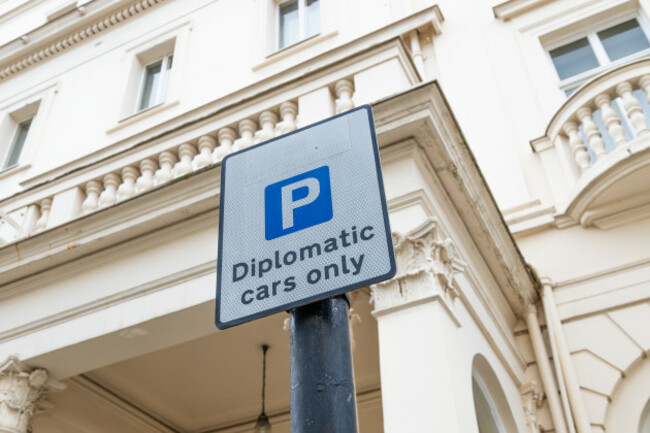
Diplomatic immunity can be a source of controversy. Back in 2020, the UK government announced that Britain would no longer offer immunity from criminal prosecution to the families of the American staff at a military base near where a teenager was killed by a car driven by the wife of an American diplomat.
Yet it seems reasonable to assume that nothing as serious as that occurred with our representatives overseas. In a brief conversation with one expert in the area of international diplomacy, he queried why some details about overseas diplomats here in relation to speeding would be released, but something similar couldn’t be provided regarding our own representatives posted elsewhere. In fact, we don’t even know in which countries the offences took place.
We do know from the response when the incidents occurred. We even know how many pages of records there are.
So, for example, 16 October 2023, Notification of parking fine – four pages. And then on 18 November 2024, parking fine documentation – seven pages on that.
And finally, 16 December 2025, again a notification of parking fine, and again four pages. But that’s it.
So what is it that is so extraordinary about these particular parking fines, which, as we now know, were paid anyway?
Did an Irish diplomat park on a double yellow line outside the Eiffel Tower? Did an Irish representative nip into the Chancellor’s parking spot at the Reichstag? Might someone have blocked the gates of the Vatican?
It seems unlikely, but as things stand, we don’t know. And it does seem a little odd to not allow any details about what occurred, when a parking fine might seem less serious than a speeding offence, for which some details relating to other diplomatic missions operating here were released.
It’s not quite a diplomatic quagmire, still less an actual incident, but it’s a bit of an oddity all the time. So the €30 has been paid and the appeal has been lodged. Watch this parking space.
The Journal Investigates team will be back with another installment of the The FOI Files next Tuesday.

To embed this post, copy the code below on your site












have your say