We need your help now

Support from readers like you keeps The Journal open.

You are visiting us because we have something you value. Independent, unbiased news that tells the truth. Advertising revenue goes some way to support our mission, but this year it has not been enough.

If you've seen value in our reporting, please contribute what you can, so we can continue to produce accurate and meaningful journalism. For everyone who needs it.

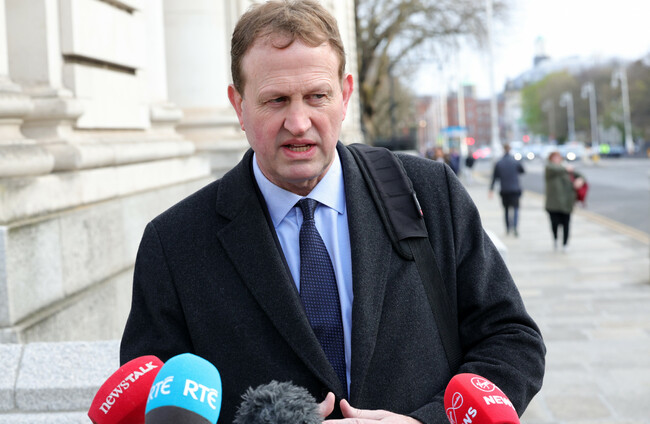
Minister for Justice Jim O'Callaghan Rollingnews.ie

‘Sinister’: Serious concerns raised about Bill allowing gardaí to seize journalists’ phones

Justice Minister Jim O’Callaghan has been urged to urgently clarify the details of the proposed law.

A BILL QUIETLY announced by the Minister for Justice Jim O’Callaghan over the Christmas break has come in for sharp criticism this week over fears it will have a chilling effect on press freedoms and force journalists to reveal their sources.

News that Cabinet had approved the Garda Síochána (Powers) Bill (2025) was announced by the Department of Justice in a press release on Saturday 27 December.

Under the proposed legislation, gardaí will be given greater powers to search digital devices such as phones without prior judicial approval.

According to the Department of Justice, the legislation will ensure that privileged material is handled through a judicially supervised process.

However, while legal professional privilege would be protected as absolute under the law, other forms of privilege, including for journalists, would be managed through a “structured process, including through a determination by the High Court” if required.

The bill will also include provisions on Garda powers to stop and search, and will include requirements for gardaí to make a formal record of all such searches.

The bill will also place on a statutory footing the existing right of people in custody to consult a solicitor before and during an interview, provide for electronic recording of interviews by Gardaí and will “modernise” the custody framework.

Journalists’ sources

Minister O’Callaghan has said the statutory procedures being introduced that deal with privileged material “recognise the fundamental nature of these principles in areas such as the legal profession and journalism.”

However, the bill has been met with criticism and concern from bodies representing journalists and from opposition politicians. 

NewsBrands Ireland, the representative group for news publishers in Ireland, cautioned that the bill, as published, fails to recognise the position of the media in a “couple of key respects”.

The organisation asked that the bill be amended to explicitly recognise the right of journalists to refuse to reveal confidential sources.

Ann Marie Lenihan, ceo of NewsBrands Ireland, said: “The bill needs to explicitly recognise journalistic protection of sources to bring the law into line with recent decisions of the Court of Justice of the European Union and the Irish Supreme Court.”

Lenihan noted that a 2023 decision by Supreme Court Judge Gerard Hogan stated that: “The general protection of sources is integral to a free press”.

Hogan added that, without constitutional protection of the media’s right to protect sources, journalists “cannot reasonably be expected to discharge their functions of educating public opinion and holding government to account in the manner expressly provided for in article 40.6.1 of the Constitution.”

In addition to this, NewsBrands said the District Court should be empowered to take journalistic privilege into account when considering a Garda application for a search warrant, rather than after the application has been granted.

Lenihan said: “The current draft of the bill proposes that a claim of privilege can only be made to the High Court after an electronic device has been seized on foot of a District Court order and potentially accessed. This is too late, in our view.

“We are calling for the legislation to ensure that there is a court hearing to determine whether journalistic privilege applies before a warrant can be granted, as is the case in Northern Ireland and elsewhere. This would serve both to vindicate the rights of journalists and the authority of the courts to decide if the privilege should apply.”

On the political front, several TDs have also raised serious concerns about the bill. 

Independent Ireland leader Michael Collins described the bill as “shocking and sinister” and a “deliberate and cynical attempt to dilute journalistic privilege”, adding that it reads “like a blueprint for an authoritarian state”.

“If enacted in its current form, it will drive a coach and four through the protections that journalists and whistleblowers have relied upon to speak truth to power.

“That is unacceptable in a functioning democracy.

“The public should be alarmed,” Collins said. 

Independent Ireland called for an immediate Oireachtas review of the draft bill and for the inclusion of press and civil society stakeholders in any legislative process affecting journalistic freedom.

He also confirmed that his party will be tabling a Private Member’s Bill which would elevate journalistic source protection to the status of a ‘protected privilege’, with access only in cases of imminent and specific threat to life, property or critical infrastructure, and only under tightly controlled judicial orders.

Elsewhere, Sinn Féin’s justice spokesperson Matt Carthy and Social Democrats justice spokesperson Gary Gannon both said their parties also have serious concerns about the bill.

“Any moves to undermine the role of journalists in holding those in power to account or to create a hostile environment for journalists doing their job must be resisted,” Carthy said, calling on the Justice Minister to drop the proposals.

Speaking on behalf of the Social Democrats, Gannon said:

“What the public really cares about is safe communities. People in our towns and estates are terrified of drug-related intimidation, and we have seen a worrying rise in arson attacks on homes and local services. Yet the Minister seems more interested in consolidating powers on paper than dealing with the real threats people face on the ground.”

On fears that journalists’ phones could be seized by gardaí as a result of this bill, Gannon said the minister must “immediately clarify” if this will be the case and address concerns raised about this legislation by the National Union of Journalists.

“This bill will need detailed scrutiny to make sure it actually tackles drug-related intimidation and violent crime – not just give ministers the opportunity to issue a press release,” he said. 

Séamus Dooley, head of the National Union of Journalists, has said his organisation is concerned that the proposed legislation would “run the risk of not protecting journalists’ sources.”

Speaking to the Irish Daily Mail, he called on the Department of Justice to provide “detailed clarification” as to what the bill will actually do in practice.

“We would be concerned at anything which would threaten sources, or also would serve as a chilling factor for sources, in terms of people coming forward,” Dooley said. 

Readers like you are keeping these stories free for everyone...
A mix of advertising and supporting contributions helps keep paywalls away from valuable information like this article. Over 5,000 readers like you have already stepped up and support us with a monthly payment or a once-off donation.

Close
50 Comments
This is YOUR comments community. Stay civil, stay constructive, stay on topic. Please familiarise yourself with our comments policy here before taking part.
Leave a Comment
    Submit a report
    Please help us understand how this comment violates our community guidelines.
    Thank you for the feedback
    Your feedback has been sent to our team for review.

    Leave a commentcancel

     
    JournalTv
    News in 60 seconds