We need your help now

Support from readers like you keeps The Journal open.

You are visiting us because we have something you value. Independent, unbiased news that tells the truth. Advertising revenue goes some way to support our mission, but this year it has not been enough.

If you've seen value in our reporting, please contribute what you can, so we can continue to produce accurate and meaningful journalism. For everyone who needs it.

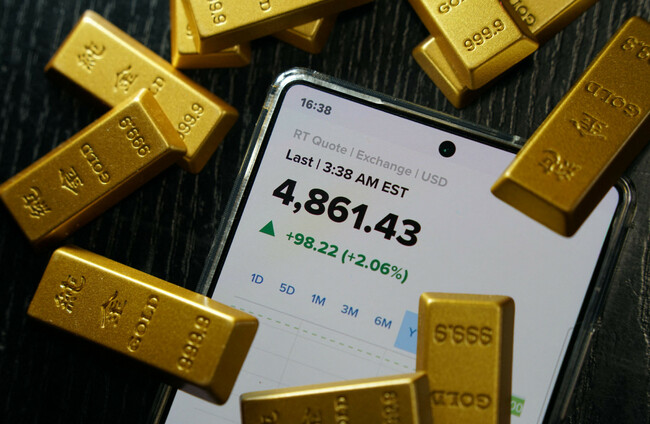
Traders are warning that gold can fall quickly as well as rise. Alamy Stock Photo

The price of gold (and other precious metals) have hit record levels - what does it mean?

The moves are being closely watched by investors, including a number of Irish pension funds.

GOLD, SILVER AND copper have all climbed to record prices in recent days, reflecting just how unsettled global markets have become.

The surge comes amid mounting geopolitical tensions, renewed tariff threats from the US, fears of a potential government shutdown in Washington and growing questions about the future of global trade.

A weakening US dollar has added further momentum, pushing investors towards hard assets as a hedge against uncertainty.

Gold rose above $5,100 (€4,293) an ounce earlier this week before easing back slightly, while silver briefly touched $111 (€93) an ounce.

Copper has also pushed close to all-time highs, driven by strong demand and increasing concern about long-term supply.

While the three metals are rising together, economists and investment experts say they are being driven by different forces.

Signal of uncertainty

Kate English, chief economist at Deloitte Ireland, explained that the surge in the price of gold was largely a reflection of heightened global anxiety.

“Gold has traditionally been seen as a safe haven and is sometimes referred to as a fear gauge,” English said.

“When investors and central banks become worried about the future outlook for the global economy, they turn to gold in the hope that it will hold its value.”

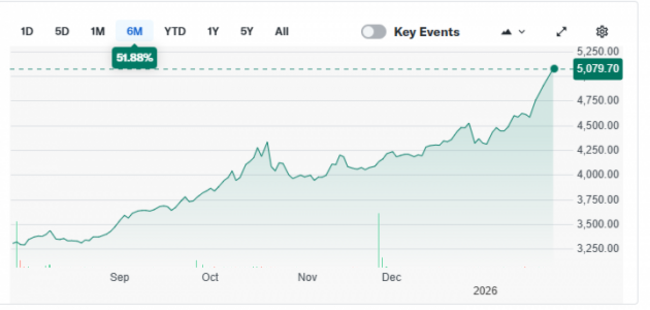
PastedImage-30363 The price of gold over the past six month is up over 50% Yahoo Finance Yahoo Finance

She added the scale of the increase over the past year had been noteworthy.

“The extent of the growth has been incredible, but it reflects the level of uncertainty we’ve experienced around geopolitics, trade policy and the global economy,” English said.

English said demand was also being fuelled by central banks.

“Central banks have been buying significant amounts of gold in recent years, which has created a new layer of demand and helped push prices higher,” she said.

Ireland itself also holds gold as part of its national reserves.

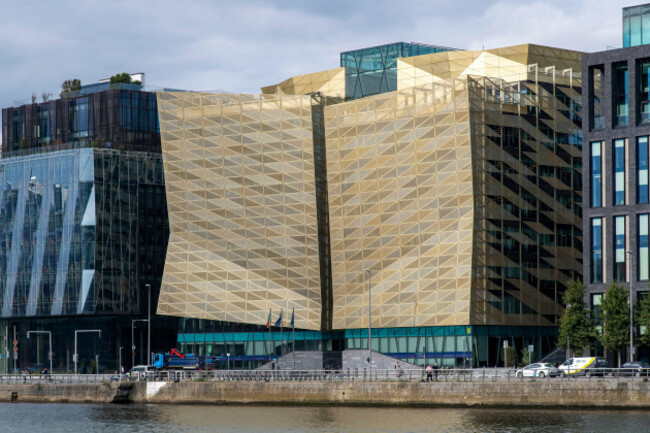
The Central Bank holds around 12 tonnes of gold, stored in custody with the Banque de France and the Bank of England.

dublin-ireland-september-24-2025-building-of-the-central-bank-of-ireland-on-the-north-wall-quay-with-river-liffey-in-front-designed-by-henry-j-lyon The Central Bank of Ireland building on Dublin's North Wall Quay. Alamy Stock Photo Alamy Stock Photo

As prices have surged, the value of that holding has climbed sharply over the past year and is now estimated at more than $1.91 billion (€1.61 billion).

Nick Charalambous, managing director at Alpha Wealth, said the surge in the price of gold had been helped by political instability and a weaker US dollar.

“When confidence in currencies falls, investors tend to look elsewhere,” Charalambous said.

“For Irish investors, dollar weakness can reduce returns from US assets, which has increased interest in gold.”

However, Charalambous warned that gold was often misunderstood.

Gold is not a low-risk asset.

“It’s quite volatile, and anything that can rise this quickly can also fall just as quickly,” Charalambous said.

Technology and supply pressures

Copper’s rally, meanwhile, is being driven by industrial demand rather than fear.

English said copper was essential across construction, transport, power grids, renewable energy and electric vehicles, with demand accelerating further due to the growth of AI and data centres.

“Demand for copper is rising rapidly, but supply hasn’t kept pace,” English explained.

“Mining is expensive and slow, and it can take many years to bring new supply on stream.”

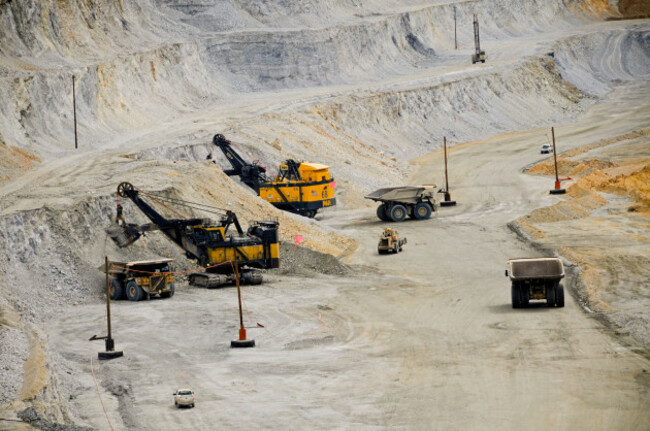
utah-copper-mine A copper mine in Utah, USA. Alamy Stock Photo Alamy Stock Photo

That imbalance, she said, was putting sustained upward pressure on prices.

Charalambous agreed that supply concerns were central to copper’s rise.

“It’s a critical resource for economic growth, but it’s not easy to increase supply quickly,” he said. “That’s why copper prices have been under such strong pressure.”

Silver sits between the two.

English said silver had both industrial and safe-haven characteristics.

“It’s used heavily in electricity and technology, but it also tends to rise alongside gold during periods of uncertainty,” she said. “The scale of the increase suggests it’s being driven by both factors.”

Charalambous said silver prices had surged by around 200% over the past year, fuelled by industrial demand and growing investor interest.

“More clients are asking about silver than ever before,” he said.

“Some see it as an alternative to gold, particularly as gold prices have risen so sharply.”

He cautioned that silver could be especially volatile.

“Silver’s rise has been remarkable, but it could also fall sharply,” he said.

What it means for Ireland

English said there had been no immediate impact on the Irish economy, but the broader signal from markets was important.

“Rising gold prices tell us that investors are very worried about the global outlook,” English said.

Ireland is a small, open economy, so global uncertainty does eventually filter through.

English also pointed to early signs of a slowdown, including softer employment growth and stagnating income tax receipts late last year.

English also pointed to early signs of a slowdown, including softer employment growth and stagnating income tax receipts late last year.

“These aren’t alarm bells yet, but they are indicators we need to watch closely,” she said.

Charalambous said many Irish savers may already have exposure to metals through their pension funds, often without realising it.

“A lot of multi-asset pension funds already hold alternatives, including exposure to gold, silver and copper,” Charalambous said.

“In many cases, that can amount to around 10 to 20% of the fund, with a portion of that linked to metals.”

He said these investments are typically held within diversified portfolios offered by large pension providers, rather than as direct holdings.

“People sometimes think they need to actively buy gold to benefit from it, but for many Irish pension holders, that exposure is already there as part of a broader, balanced strategy,” he said.

However, Charalambous cautioned against increasing exposure purely because prices are rising.

“Metals can play a role as part of a long-term, diversified portfolio, but they’re not suitable for everyone and they’re not low risk,” he said.

Gold is often seen as a safe asset, but it’s actually quite volatile.

He explained that metals were best viewed as a small ‘satellite’ holding rather than a core investment.

“I would be very wary of overexposure,” Charalambous said.

“Moving heavily into any asset just because it has performed well recently can leave people exposed if prices reverse.”

Readers like you are keeping these stories free for everyone...
A mix of advertising and supporting contributions helps keep paywalls away from valuable information like this article. Over 5,000 readers like you have already stepped up and support us with a monthly payment or a once-off donation.

Close
33 Comments
This is YOUR comments community. Stay civil, stay constructive, stay on topic. Please familiarise yourself with our comments policy here before taking part.
Leave a Comment
    Submit a report
    Please help us understand how this comment violates our community guidelines.
    Thank you for the feedback
    Your feedback has been sent to our team for review.

    Leave a commentcancel

     
    JournalTv
    News in 60 seconds