Sign in. It’s quick, free and it’s up to you.
An account is an optional way to support the work we do. Find out more.
Sign in. It’s quick, free and it’s up to you.
An account is an optional way to support the work we do. Find out more.
LAST UPDATE | 27 Jan
THE EUROPEAN UNION has struck the “mother of all” trade deals with India after two decades of negotiations.
The free trade agreement, described by the EU as “ambitious and commercially significant”, comes amidst uncertainty from the world’s leading economies, the United States and China.
The deal is the largest ever concluded by both the EU and India, both of which rank among the largest economies in the world.
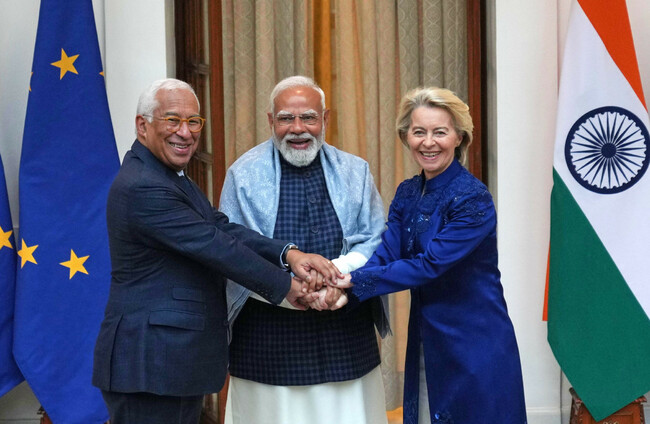
European Commission President Ursula von der Leyen and European Council President Antonio Costa met with Indian Prime Minister Narendra Modi in New Delhi today to finalise the agreement.
The agreement will cut or eliminate tariffs on almost 97% of European exports, saving up to €4 billion annually in duties, the EU bloc said.
“A mother of all deals,” Modi said. “This deal will bring many opportunities for India’s 1.4 billion and many millions of people of the EU.”
He added that the agreement “represents about 25% of global GDP, and one-third of global trade”.
Von der Leyen said that the deal has created “a free trade zone of 2 billion people, with both sides set to gain economically”.
“We have sent a signal to the world that rules-based cooperation still delivers great outcomes. And, best of all, this is only the start – we will build on this success, and grow our relationship to be even stronger,” she said.
A statement from the EU highlighted that the agreement comes “at a time of rising geopolitical tensions and global economic challenges”.
As relations with the US falter under the repeated threat of tariffs, many major US trading partners have sought to diversify their economic trading strategy. India likewise has made efforts to cut its reliance on Russian imports in recent years.
At the weekend, US President Donald Trump threatened Canada with tariffs of 100% if it finalised a deal with China that would see Canada drop tariffs on Chinese electric vehicles, with China lowering tariffs on Canadian agricultural imports in return.
Minister for Agriculture, Food and the Marine, Martin Heydon said the agreement is a “positive one for the Irish agri-food sector”.
He said it provides “significant opportunities for our spirit drinks exports – particularly for Irish whiskey”.
Heydon said exports of Irish whiskey to India are currently subject to import tariffs of 150% but that the agreement will see future tariffs reduced to 40% over a phased period.
The agreement also sees tariff reductions for other agri-food exports, such as processed foods, sheepmeat and beer.
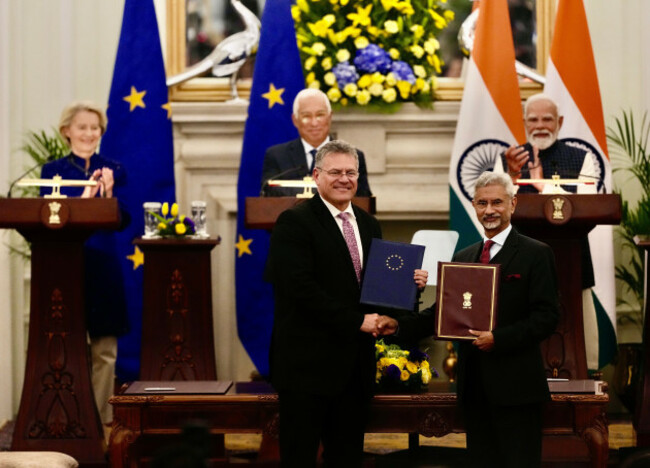
Europe’s key agricultural, automotive and service sectors stand to gain from the agreement – but sensitive agricultural sectors, such as beef, rice and sugar, whose inclusion in an earlier deal struck with South American bloc Mercosur sparked farmers’ anger in Europe, were left out of the agreement.
The Mercosur deal has since been referred to EU courts after a vote by MEPs and its implementation is set to be delayed.
New Delhi sees the EU as an important source of much-needed technology and investment to rapidly upscale its infrastructure and create millions of new jobs.
It also includes a security partnership, providing “new opportunities” for defence companies, Modi said.
Bilateral trade in goods reached €120 billion euros in 2024, an increase of nearly 90 percent over the past decade, according to EU figures, with a further €60 billion in trade in services.
Under the agreement, India is expected to ease market access, and European firms will get privileged access to the Indian financial services and maritime transport market, the bloc said.
Tariffs on cars will be gradually lowered from a top rate of 110% to as low as 10% – with a quota of 250,000 vehicles – while duties on wines progressively go down from 150% to as low as 20%.
Currently at 50%, tariffs on processed foods – including pasta and chocolate – will be eliminated, according to the EU.
Von der Leyen said she expected exports to India to double, and that the EU would “gain the highest level of access ever granted to a trade partner in the traditionally protected Indian market”.
For India, it would boost sectors including textiles, gems and jewellery, and leather goods, as well as the service sector, Modi said.
The accord comes as both Brussels and New Delhi seek to open up markets in the face of US tariffs and Chinese export controls.
India is on track to become the fourth-largest economy this year, according to International Monetary Fund projections.
Additional reporting by AFP

To embed this post, copy the code below on your site









have your say