Sign in. It’s quick, free and it’s up to you.
An account is an optional way to support the work we do. Find out more.
Sign in. It’s quick, free and it’s up to you.
An account is an optional way to support the work we do. Find out more.

REINTRODUCING 100% MORTGAGES would push up house prices and increase the risk “for borrowers and for banks”, according to the Central Bank and the Economic and Social Research Institute (ESRI).
It comes after Independent Ireland called for the banks to bring back these mortgages to the market for first-time buyers in order to help renters and young people buy their first home.
Such mortgages, which is synonymous with the Celtic Tiger era, are not available under Central Bank lending rules that came into force in 2015.
The Central Bank and the ESRI were appearing before the Oireachtas Housing Committee to discuss the challenges currently facing the delivery of housing across the country.
Sinn Féin’s Eoin Ó Broin, Rory Hearne of the Social Democrats and Independent TD Brian Stanley all asked about the calls for the reinstatement of 100% mortgages.
“We think that would be a bad idea,” Mark Cassidy, the director of financial stability at the Central Bank, told the committee.
“It would add to demand without anything back on supply, and therefore add to prices.
“More fundamentally, it increases the risk for borrowers and for banks. There is a greater probability of default in that situation.
“In the event of a loss of income, or in the event of decline in house prices, the borrower is immediately in negative equity and in a much more difficult position and is likely to get into financial distress.”
Cassidy said that the Central Bank believes that a minimum of 10% deposit “remains necessary for first-time borrowers or existing borrowers”.
Dr Conor O’Toole of the ESRI agreed that 100% mortgages are “not a good idea”.
“I think that we’ve learned the hard way that loose credit conditions don’t go well to extend to households,” he said, adding that we “still have scars from that”.
“I think the market potential framework that the Central Bank has instituted over a number of years now protects banks and borrowers and gives more resilience in the system, and I don’t think we should compromise that by extending looser credit conditions,” he added.
In his opening statement, Robert Kelly, the director of economics and statistics at the Central Bank, told TDs and Senators that an average of 54,000 new homes must be delivered annually over the next 25 years in order to address the current housing shortfall.
This will require an additional €7 billion in development finance annually, the bank estimates.
He told the committee members that a persistent gap in housing supply has created a structural shortfall in the housing stock.
“Addressing this shortfall progressively over the next 25 years will require an average of 54,000 new homes annually,” he said.
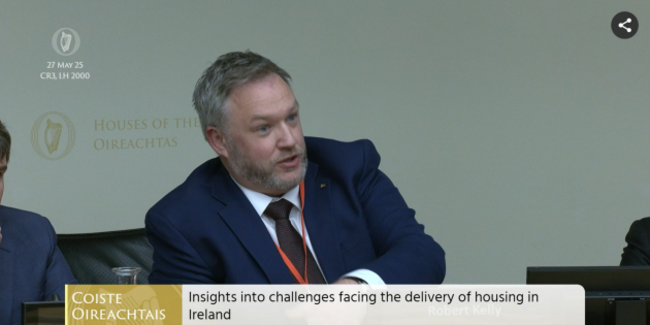
The committee heard that clearing the backlog at a quick pace over the next decade will need “front-loading delivery of an additional 38,000 homes per year”.
Kelly said that persistent inadequate housing supply will lead to rising rents and house prices, which will drive up living costs, reduce disposable incomes, and intensify wage pressures.
An increase of this scale will need construction to be both financially and practically viable, something that depends on preparing serviced land, streamlining planning and lifting construction productivity.
“These are not optional or sequential steps; they must move in parallel,” Kelly said.
He said that investment in essential infrastructure like water, energy and transport networks is needed to deliver homes at scale.
He also said that the planning process is “a crucial enabler in accelerating housing delivery”, with recent data from An Bord Pleanála showing “progress”.
The bank estimates than an additional €7 billion in development finance is required annually to build 54,000 houses each year.
The committee heard that the State has increased spending “five-fold” since 2015 on social housing, affordable rental units and cost-rental schemes.
“However, a thriving, privately financed market is necessary to ensure diverse
tenure types and housing forms,” the Central Bank will say, adding that public investment is required for climate transition and infrastructure.
Kelly added that balancing government spending on housing with these demands “is crucial for sustaining public finances and the economy”, while international investors and domestic banks “will continue to be key sources of capital”.
Meanwhile, the ESRI told the Housing Committee that a “notable weakness was evident” in housing completions last year, with just over 30,000 units completed.
Dr Conor O’Toole of the ESRI said that this was likely driven by land costs and availability, labour costs, material costs, price developments and the policy environment.
“Taking these factors together, coupled with current international uncertainties, we do not foresee any major uptick in 2025 and 2026 in housing supply,” O’Toole said.
“We are currently forecasting just over 34,000 units in 2025 and 37,000 units in 2026.”
He said that increasing efforts must be made “to ensure the timely provision of services to housing developments to reduce the timeframes in the production process”.
Proposed changes to the Rent Pressure Zone (RPZ) rules are currently being discussed by Government.
O’Toole told the committee that RPZs have been “broadly effective” in relation to their aim of limiting rent increases for properties in designated areas.
However, he said that recent research it conducted has highlighted “the clear need for reform of the current RPZ system”.
Rory Hearne asked whether lifting the rent caps would see an increase in supply to the market.
Dr Rachel Slaymaker told the committee that the current cap of 2% is “very tight” and that that is “likely to be acting as a barrier towards potential investment and new construction”.
However, she said there are “a lot of other factors going on with the high construction costs, the inflation we’ve had in those high-interest rates, it’s very difficult to disentangle”.
“I think they are likely acting as a barrier at present, but that doesn’t mean that simply removing them or loosening the caps would suddenly lead to an influx without addressing the other issues around planning delays and interest rates,” she said.

To embed this post, copy the code below on your site














have your say