We need your help now

Support from readers like you keeps The Journal open.

You are visiting us because we have something you value. Independent, unbiased news that tells the truth. Advertising revenue goes some way to support our mission, but this year it has not been enough.

If you've seen value in our reporting, please contribute what you can, so we can continue to produce accurate and meaningful journalism. For everyone who needs it.

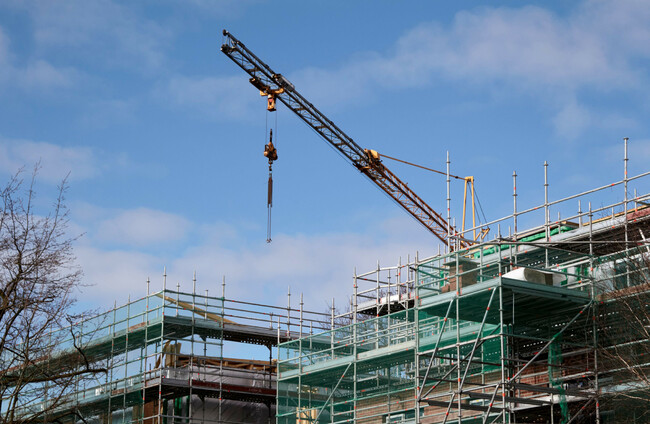
The lack of suitable construction staff has long been identified as a major barrier to scaling up house building. (file image) Alamy Stock Photo

In the middle of a housing crisis, why are Irish builders so unproductive?

With many Irish construction firms stuck in their ways, it’s unlikely new housing development will rise quickly any time soon.

MOST OF THE big brains dedicated to solving Ireland’s housing crisis normally agree on one thing.

Maybe we should – get this! – build more houses??

It sounds so simple. But in practice, it’s clearly something which is hard to realise. During the week, the Central Bank effectively said the government will not hit its short or medium-term housing construction targets.

It expects 32,500 homes will be built in 2025 – a 5,000 reduction compared to its previous forecast.

Its estimates for 2026 and 2027 have also been scaled down. In turn, this makes it essentially impossible for Ireland to reach its medium-term 2030 housing construction targets.

It’s something which doesn’t make much sense to many.

Ireland is crying out for new homes. The large house builders in the market, such as Cairn and Glenveagh, are doing well and making very strong profits.

Why aren’t other construction firms taking advantage and building more?

The Central Bank recently took a stab at answering this question. It put forward two possible reasons:

  1. It’s hard for house building companies to find enough qualified staff
  2. Irish house building companies have low productivity

We’ll touch on point 1 first, before looking at 2 in more detail.

The lack of suitable construction staff has long been identified as a major barrier to scaling up house building.

The crash

Employment in the building sector never recovered after the crash. There was a collapse between 2008 and 2012 – the number of staff in construction plunged from 240,000 to 85,000.

While it has now recovered to about 176,000, it’s still well below its pre-financial crisis peak.

There’s an argument that construction employment was artificially high during the Celtic Tiger. With cheap credit fuelling an unsustainable building bubble, which of course, ultimately popped.

But the circumstances now are very different.

The population jumped by over one million people between 2006 and 2022, and is still rising fast. Additionally, lending rules are much tighter.

Both of these factors mean the demand for housing is likely more sustainable.

However, the number of people going into many areas of construction is relatively low.

The Central Bank noted: “Despite a pickup in construction and engineering courses in the last number of years, apprenticeships for certain occupations such as bricklayers, plasterers, painters, and decorators are low at just 482 nationally.”

On top of that, it’s not like we can just redirect building staff – say get people working on hotels to switch to homes.

Due to high demand for public infrastructure work and retrofitting, the Central Bank research concluded the prospect “of a substantial labour reallocation toward new housing delivery from those activities is limited”.

Long-term, it’s possible that the pool of house building staff could be increased in a few ways. Such as by giving out more work permits for non-EU workers. Or via more domestic apprenticeships.

But these are both longer term solutions. Which means, in the short term, Ireland should instead be trying to maximise its existing pool of workers.

Below EU average

This is where we come to productivity.

Ireland’s construction output is estimated to be about 25% below the eurozone average.

At a very, very simplistic level – this means that, for every three new houses constructed by an Irish developer, a ‘typical’ European one could build four.

It’s worth noting that ‘construction’ is only measured at a high level. So it’s possible that housebuilders may be more efficient than office builders for example, and are being unfairly dragged down.

But the differences between productivity in Irish construction sub-sectors is unlikely to be large.

Broadly speaking, the 25% figure gives an idea of the gap between Irish builders and their international peers.

So, why are Irish builders so unproductive?

In a nutshell – while the likes of Cairn and Glenveagh grab headlines, Irish building companies are overwhelmingly small firms.

Last year, the Central Statistics Office reported that almost 92% of all construction firms were ’small and medium enterprises’ (SMEs). That is, companies employing under 250 people.

Construction has the largest share of its workers employed in SMEs. For example, in the ‘Services’ sector, approximately 67% of people work for SMEs, with the remainder working for larger firms.

Lack of investment

Why does it matter if building companies are small firms? It’s because smaller businesses can’t take advantage of economies of scale. For example, bulk buying products to pay a lower cost per unit.

This would lower input costs, making companies able to spend less money while delivering the same output – ie, being more productive.

Another issue is that Irish builders don’t tend to invest much in new technology. This makes their building processes slower compared to international construction firms.

The Central Bank noted that investment in new machinery and technology by Irish construction companies has dropped at a rate of 2.5% per year over the last decade.

Again, this has come at a time when the country has had extremely high demand for house building and (until recently) more commercial space.

A recent report from the Irish Fiscal Advisory Council suggested that the scars of the financial crisis may have made Irish builders reluctant to spend cash in their businesses.

“When firms see how quickly things can change, they may be more reluctant to invest for the long term,” it said.

This phenomenon isn’t unique to Ireland – construction productivity in countries such as the US is also extremely poor versus the rest of the economy.

These two main productivity problems feed into each other. Small companies likely make smaller profits.

This lowers the amount of extra cash they have to invest in new tech and grow. This means they make lower profits, and the cycle goes on.

So, how can the scourge of low productivity be addressed?

An obvious answer is: invest in technology.

An example would be doing more of the building process in a factory. Then, parts could be delivered and installed onsite.

A government report published last year suggested that this type of process could allow Irish construction businesses to reduce their on-site building time by up to 70%.

The Central Bank suggests it could be done by introducing government policies which encourage economies of scale.

Companies which use more ‘innovative methods’ could be favoured for government building contracts is one suggestion.

However, Progress Ireland, a pro-development think tank, has suggested that technology gains won’t be enough alone. It said tight regulations around land have made it too difficult to build.

In turn, this makes the building process slow and difficult, raising costs and driving down productivity.

A twin-track solution has been suggested as the way forward – incentivise new construction tech, while making it easier for developers to build.

Whatever way it approaches it, a fix is needed.

With many Irish construction firms stuck in their ways, it’s unlikely new housing development will rise quickly any time soon.

Readers like you are keeping these stories free for everyone...
A mix of advertising and supporting contributions helps keep paywalls away from valuable information like this article. Over 5,000 readers like you have already stepped up and support us with a monthly payment or a once-off donation.

Close
88 Comments
This is YOUR comments community. Stay civil, stay constructive, stay on topic. Please familiarise yourself with our comments policy here before taking part.
Leave a Comment
    Submit a report
    Please help us understand how this comment violates our community guidelines.
    Thank you for the feedback
    Your feedback has been sent to our team for review.

    Leave a commentcancel