Sign in. It’s quick, free and it’s up to you.
An account is an optional way to support the work we do. Find out more.
Sign in. It’s quick, free and it’s up to you.
An account is an optional way to support the work we do. Find out more.

IT IS VERY unlikely that the government will hit its target of delivering over 300,000 new homes by 2030, the Central Bank’s latest forecasts show.
Slow housing delivery is a risk to the country’s economic growth, the Central Bank is warning this morning.
In its latest quarterly bulletin, released today, the state’s financial regulator warns that current housing delivery is far behind the pace required.
According to its forecasts, housing completions will reach 32,500 this year, rising to 36,000 in 2026 and 40,000 in 2027.
That’s lower than it was predicting three months ago, when it forecast 37,500 homes being built in 2026, and 41,500 in 2027.
Without a dramatic acceleration in construction, the government would need to deliver over 97,000 homes per year in 2028 and 2029 to hit its target – essentially triple the number of homes currently expected to be delivered this year.
“It’s certainly got to be a challenge to meet those kinds of targets,” Martin O’Brien, researcher with the Central Bank told The Journal.
“The key issue here is that it’s not just direct delivery of housing, but the delivery of the water and energy infrastructure that’s necessary to support that level of housing activity,” O’Brien added.
Ireland’s growing population means the amount of wastewater generated in greater Dublin is projected to increase by over 50% in the next 25 years, with significant increases also expected nationwide.
Demand for electricity is also forecast to grow considerably, according to EirGrid, the state-owned Irish company that operates and develops the high-voltage electricity transmission system across the country.
According to Eirgrid, electricity demand may increase by 45% by 2034.
“If the challenges that we’re seeing in water and energy, and ultimately in housing, aren’t resolved over the medium term, then it becomes a constraint on economic growth,” said O’Brien.
He added that this is having an impact on Irish and international businesses, as they cannot be given guarantees that there will be housing available for staff if they wish to “scale up”.
“It’s definitely one of the areas that we need to think about if we want to continue to be attractive to businesses, relative to other destinations,” O’Brien said.
Over 15,000 new homes were delivered between January and June this year, according to the Central Bank, slightly above previous expectations.
Building commencements for housing declined to 6,325 during the first half of the year, however, down from 34,490 during the same period in 2024.
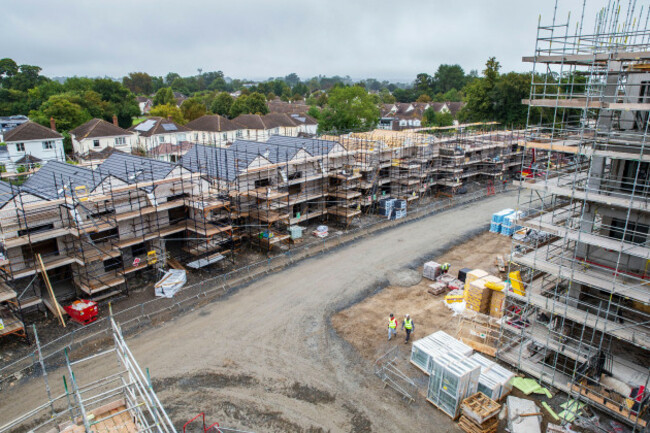
“The volatility in commencements introduces significant uncertainty to the forecast for housing completions,” the Central Bank said.
New home loans don’t point to any “substantial” acceleration in the new supply of homes, and the infrastructural barriers around water and electricity connections are constraining new completions.
The Central Bank’s housing delivery predictions come just weeks before the government rolls out Budget 2026, as well as the new Housing for All plan.
The Budget is not expected to contain any big surprises in terms of housing. It will likely reaffirm the government’s commitment to extending the Help to Buy and First Home Scheme until 2030, in line with the Programme for government.
It’s also expected to confirm the previously-announced increase in capital spending on housing.
While last year’s pre-election budget was described as a give-away by some, expectations for this year are being tempered by government, and the Central Bank has welcomed this.
The government has warned of economic uncertainty ahead, especially with new US tariffs at 15%, prompting a more cautious stance.
This year’s €9.4 billion package includes €1.5 billion in tax cuts and €7.9 billion in spending, up 7.3% for next year.
While the figures were based on a 0% tariff scenario, Taoiseach Micheál Martin suggested this week they’re unlikely to change, though October will tell.
“We aren’t seeing any broad, wide supports that are untargeted in nature,” Martin O’Brien said.
“We would think this is better at this point,” he added.
The Central Bank added that households are expected to spend more as their real incomes rise in the short term, even though one-off government payments will be cut back in the upcoming Budget.
Elsewhere in their quarterly report, the Central Bank predicted that exports of goods and services from Ireland are forecast to grow out to 2027, but more slowly than would have occurred in the absence of US tariffs.
Following months of negotiations between EU and US officials, an agreement in principle was reached in July on Trump’s proposed tariffs, with a follow-up “framework agreement” announced on 21 August.

A costly trade war was averted, but it still left a baseline 15% tariff on most European exports to the United States.
Pharmaceutical products, which had been excluded from the original “reciprocal” US tariffs, are subject to these tariffs.
Trump’s initial announcement of tariffs on the EU at the beginning of the year led to a surge in pharmaceutical exports from Ireland at the beginning of the year, but exports dropped off sharply by 23% in June.
Despite the volatility in the sector’s exports, the Central Bank said that global demand for pharmaceutical products produced in Ireland is currently high, meaning the sector can expect “continued growth in exports over the medium term.”

To embed this post, copy the code below on your site














have your say