We need your help now

Support from readers like you keeps The Journal open.

You are visiting us because we have something you value. Independent, unbiased news that tells the truth. Advertising revenue goes some way to support our mission, but this year it has not been enough.

If you've seen value in our reporting, please contribute what you can, so we can continue to produce accurate and meaningful journalism. For everyone who needs it.


Migrant workers who protested current family reunification rules this week put empty children's school chairs outside of the Dáil. © Paula Geraghty

As government toughens on immigration, will it relax rules on workers' kids coming here?

A review into the government’s policy on family reunification for non-EU workers is due to be published this week.

SOME LIGHT WILL be shed on how far the government’s hardening of immigration policy will go as we are finally due to see the outcome of a review into the restrictions to non-EU workers bringing their families to live in Ireland.

This review was meant to be published months ago but is now due this week.

It has involved engagement with various stakeholders, including those who are lobbying for the restrictions to be loosened, so migrant workers can have their families join them faster.

One NGO source who took part in that process told The Journal: “All of our submissions and conversations have been around relaxing of the rules for migrant workers. I would be shocked and appalled if they hardened restrictions but it is of course possible.

It appears more likely that the hardening is coming on the asylum side which is also shocking.

This review has been ongoing for more than two years. 

In a statement to The Journal, the Department of Justice, Home Affairs and Migration confirmed that the document would be brought to Cabinet by Minister Jim O’Callaghan this week. 

“The policy document will set out the conditions for a sponsor to apply for a family member to be reunited with them in Ireland and will update and clarify the policy generally,” the department said. 

Though multiple stakeholders remain optimistic that rules wouold be relaxed, this is perhaps difficult to envisage at a time when the government is moving to the right on immigration. 

Helen McEntee, when she was Justice Minister, said that while she “fully understands” that people moving to Ireland to work here “would wish to have their family join them”, the consideration of the matter involves “complex” issues.

In April of this year,Minister O’Callaghan said that the review, being carried out by department officials, is examining the “nature and suitability of current income thresholds and waiting periods” that migrant workers currently face.

As it stands, those working under a general employment permit have to wait 12-months to apply for family reunification, and then usually face another 18-months for their application to be processed.

Workers in this category include healthcare assistants, support workers, and factory/farm workers.

Nurses and doctors aren’t in this category, they hold a critical skills permit and while they can face delays in the wait times for their family members’ visa applications being processed, they don’t face the same barriers.

The current policy puts in place a two-tier system that separates those we deem “critical” to our workforces, and those we do not.

That’s despite the fact that staff in our nursing homes and those who work on construction sites are vital to sustaining our healthcare systems and building the houses that the government is so focused on delivering.

Beyond that, recruiting workers to live here but not allowing them to have their children with them creates an emotional burden that can be crushing for those living out the reality of it.

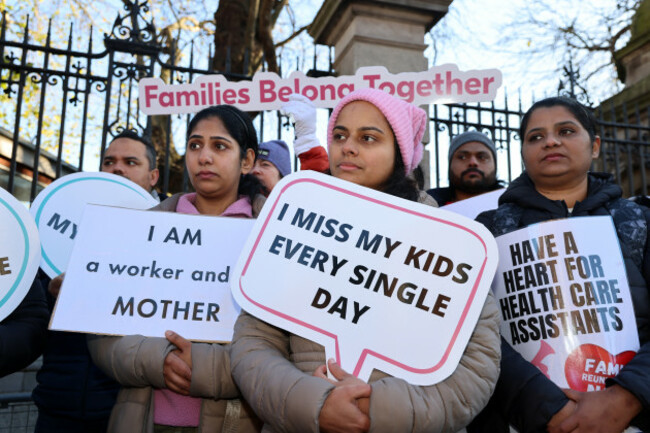
At a protest outside of the Dáil last week, a 50-year-old support worker who has waited for three years to be joined by her husband and their son, who is now 12, told The Journal about the hardship she has endured. 

“You don’t know what it means to go home to an empty house. You cry in bed. You cry on your way to work, and then you get to work and you do your best, you get home again, and cry yourself to sleep,” she said. 

44 MRCI Family Reunion 20-11-25 0U0A7848 Migrant workers call on the Government to end the current rules around family reunification. © Paula Geraghty © Paula Geraghty

This week we heard of government plans to increase the wait times for citizenship and to tighten rules on family reunification for those who come here through the international protection avenue as asylum seekers.

They will have to prove that they can support their loved ones through higher salary thresholds than were previously in place.

One stakeholder who spoke to The Journal expressed fears that he salary threshold for family reunification could be increased and that an accommodation requirement could also be introduced.

Arriving at Cabinet last week, Tánaiste Simon Harris said that the public can expect that a series of proposals will be brought in the coming week on the rules around family reunification for asylum seekers.

“It’s also important to have real clarity around that [family reunification] when someone has a right to be in our country and somebody is working and somebody is in a position to sustain themselves and their family, that’s a different conversation for somebody who’s come to our country and may not be in a position to sustain themselves,” he said.

Harris said that while he’s been accused of populism and “dog whistling” after he said that Ireland is experiencing “too high” a level of immigration, he believes that “migration is a good thing”.

“We benefit from people coming into this country and working in our health service, our country is better,” he said.

It remains to be seen whether valuing our migrant workforce – which is a far bigger group in our society than those who are seeking asylum and those who are granted it each year-  means ensuring that they do not endure a years-long wait to be reunited with their children.

Readers like you are keeping these stories free for everyone...
A mix of advertising and supporting contributions helps keep paywalls away from valuable information like this article. Over 5,000 readers like you have already stepped up and support us with a monthly payment or a once-off donation.

Close
JournalTv
News in 60 seconds