We need your help now

Support from readers like you keeps The Journal open.

You are visiting us because we have something you value. Independent, unbiased news that tells the truth. Advertising revenue goes some way to support our mission, but this year it has not been enough.

If you've seen value in our reporting, please contribute what you can, so we can continue to produce accurate and meaningful journalism. For everyone who needs it.

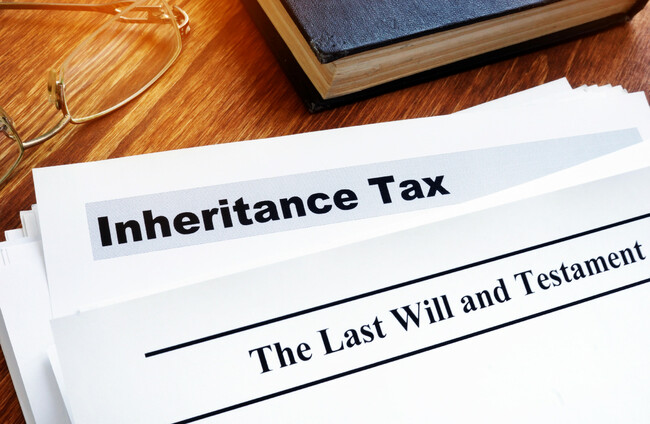
Alamy Stock Photo

A new law could allow people prioritise non-children for inheritance tax purposes, says tax group

Such a move would cost the Exchequer €390 million.

‘CHOSEN RELATIONSHIP’ LEGISLATION could allow individuals select one or two heirs to their estate under the same grouping as parent and child, a specialist expert group has told government.

The Tax Strategy Group, an expert advisory panel at the Department of Finance, has noted that the point has been made that people who are not related could have “equally close and meaningful relationships similar to familial relationships”.

The tax experts state that there are a number of ways to develop a policy to capture these ‘chosen’ relationships.

“For instance, legislation could provide for individuals to select one or two heirs to their estate for Group A Threshold,” it states.

Currently, Group A deals with the inheritance to a child (including certain foster children) when a parent dies. 

This threshold was increased in 2024 to €400,000 from a previous value of €335,000. 

Penalising people with no children

However, in the run up to the election, a debate arose around inheritance tax rules favouring parents and penalising someone who is child-free. 

The net result in this situation, where ‘chosen relationships’ could be included in this grouping, would be a tax-free threshold, state the experts, however the paper said that this was not possible to cost.

“Therefore, the costings have been calculated on the basis of three separate instances of a tax-free €400,000 threshold for each group. This would create an additional cost to the Exchequer of €390 million based on up-to-date Revenue data,” state the review papers. 

The Programme for Government contains a commitment to maintain a broad tax base of which Capital Acquisitions Tax (CAT or inheritance tax) is one contributory element, state the papers. 

“However, it is important to get some sense of the cost of various changes to a particular tax as these are factors which the Minister for Finance must consider when deciding upon his broader budget package. This is particularly relevant this year because of the case being made to expand the scope of Group A to include broader family arrangements,” said the tax experts. 

Both Fianna Fáil and Fine Gael made a number of pledges in their election manifestos around the expansion on inheritance tax groupings. 

Fianna Fáil pledged to review the inheritance tax thresholds applicable when the deceased does not have children. 

The party also said it would increase and adjust the inheritance tax Category A, B and C thresholds in each budget “to reflect the wider increase in property prices in the Irish economy in recent years”. 

Meanwhile, Fine Gael will said it would increase Capital Acquisitions Tax thresholds and raise Group A threshold (for children) to €500,000, Group B (for siblings) to €75,000, and Group C (for others) to €50,000, “building on the progress made in Budget 2025″, it said. 

The tax review papers directly address whether there is discrimination at play when it comes to the differential tax treatment for direct familial relationships and more distant relationships, stating that this has existed in the Irish legal system since the foundation of the State.

“This is reflected explicitly in the Constitution, most clearly in Article 41. The current CAT legal framework, differentiating between Groups A, B and C takes account of this constitutional framework,” states the review papers, stating that it is the beneficiary of the inheritance or gift and not the person who passes away who has to pay the inheritance tax. 

“In this context, it is not clear that there is a case that disponers are being discriminated against. Instead, legal concerns, if any should be viewed from the perspective of those who are liable for the tax i.e. the beneficiary.

“It should be noted that it is not clear that such concerns exist here either, as it is not uncommon for the tax system to tax people in different ways depending on the situation or their circumstances,” states the report. 

The Department is satisfied that the existing inheritance tax legislation and the taxation benefits are not unconstitutional or otherwise unlawful, states the review.  

Breaking down further costings, the group looked at the cost of giving the same status to aunt, uncle and sibling relationships that currently apply to parental relationships – i.e. equalising Group A and B at a tax-free threshold of €400,000. 

This would cost the State €305 million based on the most up-to-date Revenue data.

“The likelihood is that in reality the costs of collating Groups A and B would be lower, but in the absence of appropriate data it is not possible to demonstrate this at this time,” it adds. 

Boosting €3,000 tax-free gift to your child per year

The tax papers also looks at the gift threshold that parents are allowed give to their children on a yearly basis.  

Currently, a parent may give a gift up to the value of €3,000 to a child or anyone
else each calendar year without any CAT arising.

Two parents can make gifts of €3,000 each to a child, resulting in a gift to the value of €6,000 in any year free of CAT.

There is no limit on the number of small gifts a person can receive in a year from different donors.

The small gift exemption applies only to gifts and not to inheritances, but if government were to increase the small gift exemption, for example, in the case of giving their child help towards a deposit to buy a house by €1,000 (to €4,000) such a move would cost €0.7 million, states the paper.

The cost of increasing it to €5,000 per parent is estimated to be €1.4 million, based on the number of CAT returns filed for 2023.  


Readers like you are keeping these stories free for everyone...
A mix of advertising and supporting contributions helps keep paywalls away from valuable information like this article. Over 5,000 readers like you have already stepped up and support us with a monthly payment or a once-off donation.

Close
JournalTv
News in 60 seconds