Sign in. It’s quick, free and it’s up to you.
An account is an optional way to support the work we do. Find out more.
Sign in. It’s quick, free and it’s up to you.
An account is an optional way to support the work we do. Find out more.
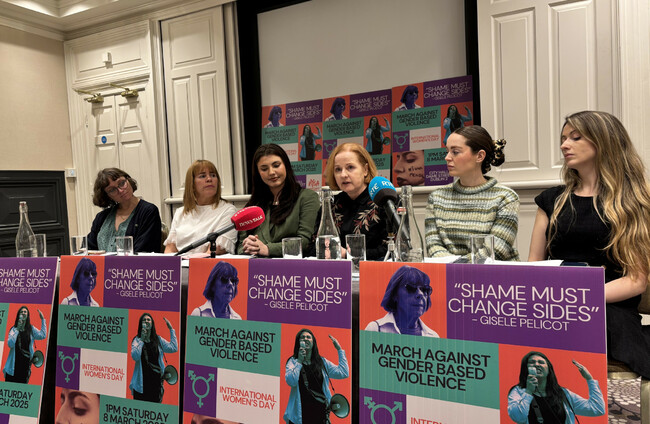
FOUR SURVIVORS OF male violence are calling on the women of Ireland to take to the streets on 8 March to demand government action and reform of the justice system.
At a press conference held today in Dublin, organised by TD Ruth Coppinger, Natasha O’Brien, Paula Doyle, Ciara Mangan and Sarah Grace shared their different experiences of Ireland’s justice system.
They have come together to call on the Government to enact reforms to make the justice system more victim-centred.
Among their demands is for character references to be outlawed in cases of gender-based violence and for the practice of a victim’s counselling notes being used in court to be banned.
Sarah Grace was raped by a stranger who broke into her bedroom in 2019. The ordeal lasted hours.
Today she described it as a “nightmare” but said navigating the justice system after the assault was “the most traumatising and painful ordeal I have ever had to experience”.
“Including the sexual assault itself. And I understand the weight of those words,” she said.
Grace said the “most cruel blow came not at the hands of the man who violated my body”, but at the hands of the justice system.
“A system that allowed the notes of my weekly therapy session, in what I believe to be the sanctity and privacy of a therapy room, to be read by the man who caused the very devastation that I was trying to rebuild myself from,” she said.
Grace continued: “After being lucky enough to secure a guilty conviction, I waived my anonymity in 2021 in the hope that what happened to me would never happen to another survivor. I failed.”
She outlined how she wrote to the then Justice Minister Helen McEntee at the time to inform her of seven major shortfalls in the justice system that needed to be addressed to protect future survivors from the same trauma she suffered.
Top of this list was the use of rape victims’ counselling records in trials.
“Today, almost four years to the day from when that letter was written, every single recommendation still stand. Not one has been addressed,” Grace said.
Paula Doyle was raped in a park by her friend’s husband almost six years ago. The case was concluded last year and her rapist received a seven and a half year sentence.
Today she said her experience of the trial and the time it took to get to the trial was “inhumane” and that talking about it today still gives her goosebumps.
“At times up to the trial, I even felt I was the one on trial,” Doyle said, referring to the use of her counselling notes.
Doyle described this as a “personal intrusion” and a “second violation”.
“My private counselling notes were requested by the DPP five months before our initial trial date. I don’t have to go into it, you know what rape is. He took my body that night. He left it like a piece of rubbish in the hedges.
“How perverse is it now that he has taken time and he can read my notes, what I poured into my therapy sessions, my heart and my soul?
“I’m really still not able to put this completely into words, it just felt like such a second violation, but on a much, much deeper level.
“And it’s done to this day under the supervision of the Department of Justice…where is the justice in that?,” Doyle asked.
“There’s no chance of recovery for a victim. You know, you’re holding on to your life by a thread, and you’re just barely surviving.
“To start off with, to the State you’re not a victim. They don’t see you as a victim. They just see you as a witness up against the convoluted justice system,” she said.
The women, and Ruth Coppinger, want to see victims of gender-based violence provided with representation in cases taken by the Director of Public Prosecutions.
The women are also calling for character references to be outlawed in gender-based violence trials.
Natasha O’Brien was beaten unconscious on a public street by an Irish soldier after she asked him to stop shouting homophobic abuse.
Today she spoke about having to sit in court and listen to character references provided for her attacker.
“What I experienced in the justice system was more traumatising and will haunt me forever,” O’Brien said.
She said character references, and the fact they are provided right at the end of a trial, almost “blur out” everything the victim has said and experienced.
Ciara Mangan was raped by a work colleague at a party when she was 18.
Today she also called for character references to be outlawed in cases of gender-based violence and also spoke of the need to pay attention to what she deemed “the lower levels of sexual violence” – rape jokes, misogyny, victim blaming.
Mangan said there is a capacity to prevent gender-based violence if people spot these actions and call them out.
“These are all the lower levels of the pyramid that paved the way forward to the more grave acts of violence, like rape and sexual assault.”
“The normalisation of this abuse teaches others that this type of violence is acceptable and goes unpunished,” she said.
Coppinger called for people to organise marches in their own towns and cities on 8 March this year for International Women’s Day.
“The Dáil needs pressure put on it. There’s so little interest in this issue over there, it’s shocking. And obviously women are nearly an endangered species in the Government so we don’t expect too much change unless they feel the pressure of ordinary people.”
Speaking on behalf of ROSA Social Feminist Movement, Harper Cleves called on the trade union movement to participate in the marches and protests being organised by ROSA on 8 March.
Sarah Grace concluded: ”It takes a lot of courage and bravery to stand up for change. And up until now, our government has made many promises but really it has left the work to the survivors to call for a better way forward. We believe there is a better way.”

To embed this post, copy the code below on your site














have your say