Sign in. It’s quick, free and it’s up to you.
An account is an optional way to support the work we do. Find out more.
Sign in. It’s quick, free and it’s up to you.
An account is an optional way to support the work we do. Find out more.
THE DESIGNATION OF the Real IRA (RIRA) as a Foreign Terrorist Organisation (FTO) by the United States might unintentionally encourage more people to join the paramilitary group, Irish officials warned in 2001.
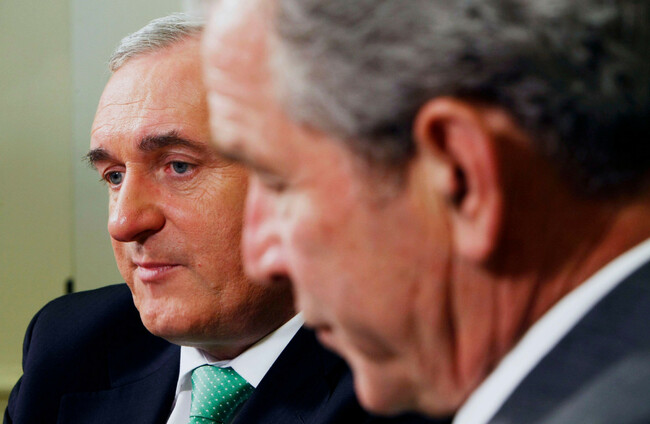
While then-Taoiseach Bertie Ahern was visiting then-US President George W Bush in Washington DC that March as part of the annual St Patrick’s Day celebrations, plans were afoot to add the RIRA (and its aliases) to the FTO list.
At the time, the Good Friday Agreement was still relatively new and the peace process was fragile.
In a briefing note prepared ahead of Ahern’s trip, officials warned that “designation might unintentionally give a boost to dissident republicans by enhancing their status in the eyes of republican supporters in the US and that this might encourage recruitment”.
The confidential file, released as part of the State Papers, also notes that the “main legal effects of designation relate to prohibitions on fundraising, freezing of existing funds and the refusal of visas to, or exclusion from the US of representatives of, a designated organisation”.
In general, State Papers – official documents from Government departments and the President’s Office – are declassified and released to the public 30 years after the fact.
However, some records are released before or after that timeframe for various reasons. For example, records related to the peace process in Northern Ireland are now typically released after 20 years.
Despite the reservations of the Irish government, there was a general consensus among Irish and British authorities that adding the RIRA to the list would also have benefits.
Back in October 2000, then-Justice Minister John O’Donoghue and then-Secretary of State Peter Mandelson agreed that the issue would be further discussed by An Garda Síochána and the Royal Ulster Constabulary (which would be replaced by the Police Service of Northern Ireland in November 2001).
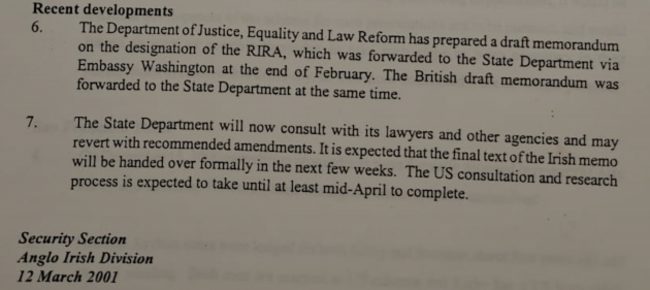
The report of the Garda Commissioner and the RUC’s Chief Constable concluded that, on balance, “it would make operational sense to have the organisation designated” an FTO as this would “make additional legal powers available to law enforcement officials in dealing with” the RIRA.
On foot of this report, the Irish and British governments decided on 24 November 2000 to jointly request that US authorities start the process of designation.
At the time of Ahern’s visit the following March, the US State Department was seeking legal advice on the matter.
Ultimately, the US added the RIRA to its official FTO list the following May.
Later that year, following the September 11 terrorist attacks, US officials wrote to governments in various countries including Ireland asking them to freeze the assets of groups on the FTO list.
John B Taylor, then-US Secretary for International affairs, sent a fax to John Hurley, then-Secretary General at Department of Finance, on 1 November 2001 asking for the RIRA’s assets to be blocked in Ireland.
“Please notify me as soon as possible whether or not you will be able to join the United States in a simultaneous blocking,” Taylor wrote.
“If not, please notify me when you do take blocking action against these terrorists.
“Thank you for your continuing cooperation in the global effort to combat the financing of terrorism.”
The Oireachtas later passed the Criminal Justice (Terrorist Offences) Bill 2002 to strengthen Ireland’s capacity to respond to terrorism including freezing assets.
State Papers reference numbers: 2022/49/125 and 2022/49/40

To embed this post, copy the code below on your site









have your say