We need your help now

Support from readers like you keeps The Journal open.

You are visiting us because we have something you value. Independent, unbiased news that tells the truth. Advertising revenue goes some way to support our mission, but this year it has not been enough.

If you've seen value in our reporting, please contribute what you can, so we can continue to produce accurate and meaningful journalism. For everyone who needs it.

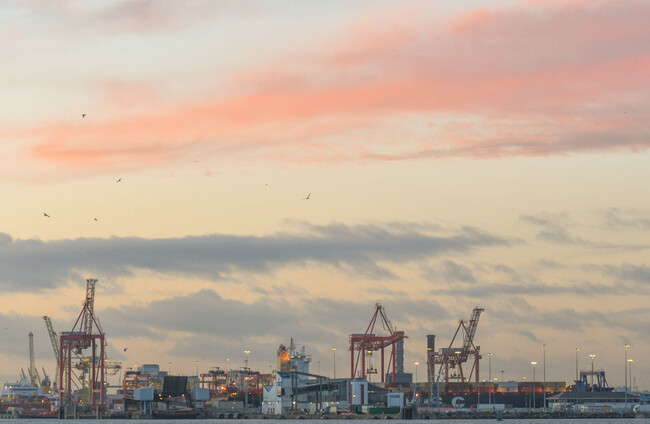
Dublin Port at sunset. Alamy Stock Photo

Fuel prices are soaring - how else will Ireland be affected by the deepening Middle East crisis?

The ‘ripple’ effect of the war is where the country would more closely feel any negative impacts.

THE MOST IMPORTANT thing to know from the outset – we don’t know much.

Trying to assess the economic impact of the Middle Eastern conflict on Ireland is difficult for many reasons. The most important of these is the level of uncertainty we are dealing with.

Will the conflict continue for days, weeks, months?

As of the time of writing, this is still unclear.

How long it lasts, and if it increases or decreases in scale, will likely be the two most important factors in how big an economic hit Ireland will take.

However, we have some knowledge around possible direct and indirect impacts of the war.

Fuel

The most obvious one is fuel prices, which have soared over the last week.

It’s expected that the cost of diesel will shortly move close to or above €2 per litre. Consumers have rightly asked why, given that most of the fuel price in Ireland consists of tax, and price changes are meant to lag by a few weeks.

We covered this issue in detail earlier this week. But to briefly summarise: Iran claimed “complete control” of the Strait of Hormuz, a vital route for world oil and gas supplies. About 20% of the world’s crude oil is transported through this pass, which Iran has now effectively closed.

Ireland does not source much of its fuel directly from the Middle East, with most instead coming from the North Sea area.

However, energy markets are international, and prices are set globally.

Demand for oil has remained the same, and supply has just got tighter. It means it is almost inevitable that prices will rise.

Oil is also closely linked to the price of gas, so there is also a knock-on impact on other power costs.

However, the key takeaway is oil prices are set globally, and Iran has just reduced the global supply.

The longer supply is kept down, the more prices are likely to rise.

Possible direct impact

Now let’s look at the possible direct and indirect economic impacts.

Direct effects are those clearly linked to Iran and the Middle East – for example, if our trade with the region drops.

Indirect effects are those which have a wider ‘ripple’ effect on Ireland’s economy, such as the effect on fuel.

In short, it is unlikely that Ireland will face a big direct impact.

To start with, trade with Iran is extremely limited. Irish exports to the country amounted to just under €6 million for the first 10 months of 2025, according to figures from the Central Statistics Office (CSO).

This is compared to €40 million worth of exports in 2024 – an enormous drop-off, as the US has threatened to impose tariffs on any country doing business with Iran.

Ireland does much more trade with other countries in the Middle East. Exports to Arab countries, which includes North African countries such as Egypt, rose to €1.5 billion in the first half of 2025. Saudi Arabia and the UAE (United Arab Emirates) are the two most important markets.

But we should put these numbers into context.

Say annual Irish exports to the region are approximately €3 billion. The country’s total exports in 2025 were €260 billion – meaning that trade with the Arab regions is only just over 1% of that number.

Of course, Ireland’s headline economic data tends to be skewed by multinational shenanigans.

And there are certain industries where the Middle Eastern market tends to be more important – for example, agri-food and dairy. Irish farmers could well feel major pain if the conflict ends up dragging on.

However, for the wider Irish economy, the direct impact is likely to be relatively small.

Possible indirect impact

The ‘ripple’ effect of the war is where Ireland would more closely feel any negative impacts.

Fuel price rises fall into this category, so they’re a clear example.

There are also concerns about a knock-on effect on the cost of living. After Russia invaded Ukraine in 2022, energy price spikes led to a surge in inflation, with prices in Ireland rising at an annual rate of nearly 10% in October 2022.

To compare, prices are currently rising at just under 3% per annum, which is considered much more normal.

Any noticeable impact on inflation will depend on how long the conflict lasts. If it drags on and more countries end up being dragged in, there is a higher chance of global trade disruption and knock-on inflation.

It could also hit Irish economic growth. The Central Bank has estimated that a 13% rise in oil prices could reduce Ireland’s GDP by about 0.5%, although it took about three years for the full impact to filter through.

Again, this reiterates that a shorter conflict is better, from an economic point of view.

Then there is the potential of a global economic slowdown. A study published late last year found that a 5% reduction in global export demand could drop Irish economic activity by 3%, and also cause a 3.5% rise in unemployment.

It’s not surprising that a fall in global exports would be bad for business. That’s true for almost every country in the world.

But the scale of the impact would be greater for Ireland, given how much we rely on being able to trade internationally.

Finally, it’s worth briefly mentioning aviation. The Middle East is a global transit hub – most passengers going from Ireland to much of Asia or Australia will stop off in the region.

There have already been plenty of media articles looking at possible alternatives, which do exist.

For example, Irish people could instead first go to the likes of London or Amsterdam, before flying directly to south-east Asia. But most of these options will be more hassle and cost more money than transiting through the Middle East, making international tourism more difficult.

Finishing up, it’s worth noting again how much time we’ve spent looking at ‘coulds’, ‘ifs’ and ‘maybes’.

The simple truth is we don’t know the scale of any economic hit Ireland will take from the war in Iran, because so much about the conflict – most importantly, its potential duration – is still so unclear.

But what we do know at a high level is that there is the potential for a significant shock.

And the longer the conflict lasts, the worse any effect will likely be.

Readers like you are keeping these stories free for everyone...
A mix of advertising and supporting contributions helps keep paywalls away from valuable information like this article. Over 5,000 readers like you have already stepped up and support us with a monthly payment or a once-off donation.

Close
38 Comments
This is YOUR comments community. Stay civil, stay constructive, stay on topic. Please familiarise yourself with our comments policy here before taking part.
Leave a Comment
    Submit a report
    Please help us understand how this comment violates our community guidelines.
    Thank you for the feedback
    Your feedback has been sent to our team for review.

    Leave a commentcancel

     
    JournalTv
    News in 60 seconds