We need your help now

Support from readers like you keeps The Journal open.

You are visiting us because we have something you value. Independent, unbiased news that tells the truth. Advertising revenue goes some way to support our mission, but this year it has not been enough.

If you've seen value in our reporting, please contribute what you can, so we can continue to produce accurate and meaningful journalism. For everyone who needs it.

This Jordanian warehouse is holding tonnes of aid for Gaza but Israel won't let it through

Aid workers at the Al-Ghabawi facility called it ‘death by bureaucracy’ as the vital aid supplies sit gathering dust.

LAST UPDATE | 15 Jan

The Journal / YouTube

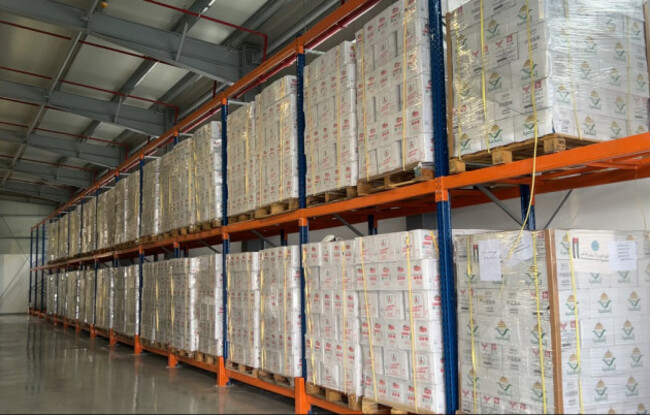
IN A WAREHOUSE in North-Eastern Jordan, an aid worker is standing in the middle of a warehouse full of food donations from countries across the world intended to reach people who are starving in Gaza.

Some of the pallets have been there for months, some for a year.

Speaking to The Journal amid the rows and rows of vital supplies, the aid worker said that when he looks at the boxes all he sees are the expiration dates. Tinned meat that could provide 5,000 meals goes off next month. Nearby, there’s baby formula that needs to be dispatched by autumn to be usable.

This worker, from the Jordan Hashemite Charity Organisation says that he is “very afraid” of these expiration dates. When the dates are reached, the only option he and his colleagues have is to dispose of the supplies.

This warehouse is one of ten. In another, full of medical supplies, there is almost €100,000 worth of antibiotics donated by India that have expired.

“Yes, of course this medicine could have saved lives,” he said. Next to those expired antibiotics, tens of thousands more are due to expire.

“Now we have a dilemma with our donors because they want to send more aid, but we aren’t receiving it anymore.

“We have ten full warehouses here of aid we cannot send. We just wait for the expiration dates to come.”

Aid route closed 

Time is of the essence but for the charity workers and the United Nations Office for Project Service (UNOPS) workers on the ground here in Jordan, there is nothing they can do.

Israel closed the Government to Government aid route that was functioning between Jordan and the Israeli authorities at the King Hussein Bridge into Gaza, which is manned by Israel Defence Forces (IDF) personnel, after a truck driver shot and killed two Israeli soldiers last September.

Jordan condemned the attack at the time, and has since made various assurances to Israel that every measure they demand to ensure the safety of the route will be taken, but it’s been to no avail.

The ambition was to have 600 trucks passing through with aid every week, but the commercial providers who hand over aid to the IDF at the border for transportation were only able to send fifty trucks in the last month.

View recent photos (1) Aid that workers at the centre fear will expire before the route reopens.

Foreign Affairs minister Helen McEntee is currently on a tour of the Middle East and visited the aid stockpiles at Al-Ghabawi earlier this week. 

In a meeting on Wednesday, King Hussein of Jordan told the minister that his country could send 10,000 trucks to Gaza within days if the IDF would allow it to happen.

The aid facility was purpose-built using EU member state and US funds.

The project involved procuring, within an extremely challenging timeline, 282 trucks that were custom built to IDF specifications at a cost of over $220,000 each.

Those vehicles are now sitting in a holding bay, unused for the last four months.

“It’s death by bureaucracy,” another aid worker said. 

“Nowhere near enough aid is entering Gaza, and we have 3,000 truckloads here waiting to be dispatched.”

Another worker involved in aid logistics added: “Each week, we think that next week the route will be reopened, and then it is pushed back once again.” 

The Journal / YouTube

A precarious peace is now in place in Gaza, but people there are still living in unimaginable circumstances.

Israel still occupies half of the strip, tightly controls aid entry, and strikes by the IDF are still taking place.

The UN has said that while Gaza is no longer in a state of famine, hundreds of thousands are still experiencing very high rates of acute malnutrition.

Last year, between mid-October and the end of November, 1.6 million people in the strip faced crisis-level hunger or worse, according to an international tracker.

Minister McEntee said that the attack in September on IDF soldiers was committed by a “lone person” and that Jordan had done “everything possible for this to be a safe corridor”. 

“The fact that we have all this aid going out of date is a travesty,” she added, calling for Israel to re-engage on opening the crossing. 

Funding shortfall

Not far away in the Marka Camp for Palestinian refugees, some of whom are second generation, over 62,000 people are feeling the impact of cuts to US aid. 

The United Nations Relief and Works Agency for Palestine Refugees (UNRWA) operates both the schools and the primary care facilities for the children and families who live there, and since the US totally pulled its funding, it is now facing a shortfall of $280 million this year. 

In real terms, sources say that this will result in a 20% reduction in staff hours, and a cut to employee wages this year. The swingeing cuts come after they barely managed to maintain their services in 2025. 

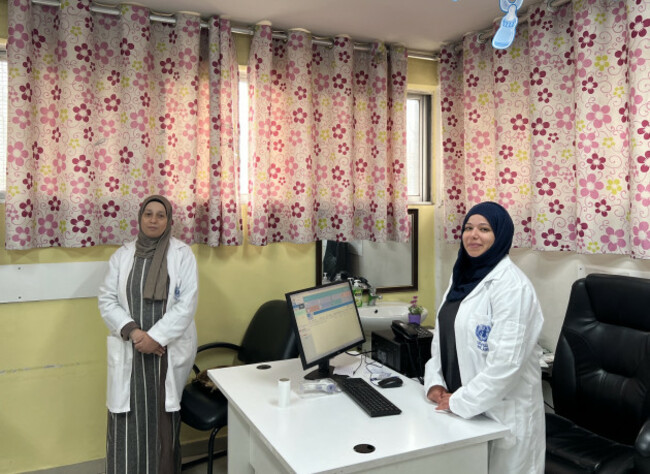
Image 14-01-2026 at 23.35 Medical staff at the clinic who work with women and children in the Marka refugee camp in Jordan.

Tamara Alfirai, UNRWA’s Head of Communications in Jordan, says the staff working for the organisation have been cleared by international investigations of Israel’s allegation that they somehow facilitated the deadly 7 October Hamas attacks on Israeli communities which left over 1,200 dead and many taken hostage. 

She said that Israel had run a campaign of disinformation against UNRWA which had had massive consequences. 

“The US was our biggest funder. Now other countries, including those in Europe, have changed their posture, including in Switzerland and Italy. There’s a direct correlation between the stance of these countries on the Israeli and Palestine issues and their willingness to fund us,” she said. 

Jordan has the largest population of Palestinian refugees in the world, amounting to close to 2.4 million people. Almost 20% of these people live in camps that the agency administers. 

Islam al Haj, the area education chief in the Marka Camp, said that the cuts to funding mean that teaching posts won’t be funded despite a high level of demand. 

“UNRWA is totally free for the refugees. As I mentioned before, they are very poor. They cannot afford the little amount of money for the health centre, or public school. We provide this to them for free, and help them to be ready for the world,” she said. 

Tamara Alfirai explained that the organisation is no longer able to get many supplies for educational aid into Gaza for the use of teachers there because Israel is rejecting some items as being of “dual use”, including crayons. 

Rather than operating within the limits of the shortfall of funding, as the Gaza peace plan moves forward, UNRWA will need more funds to meet the educational and health needs of children in the region, who have been left “traumatised” by the conflict, she said. 

McEntee said that she will raise the need for UNRWA funding to be increased with European partners in the coming weeks. 

Readers like you are keeping these stories free for everyone...
A mix of advertising and supporting contributions helps keep paywalls away from valuable information like this article. Over 5,000 readers like you have already stepped up and support us with a monthly payment or a once-off donation.

Close
JournalTv
News in 60 seconds