Sign in. It’s quick, free and it’s up to you.
An account is an optional way to support the work we do. Find out more.
Sign in. It’s quick, free and it’s up to you.
An account is an optional way to support the work we do. Find out more.
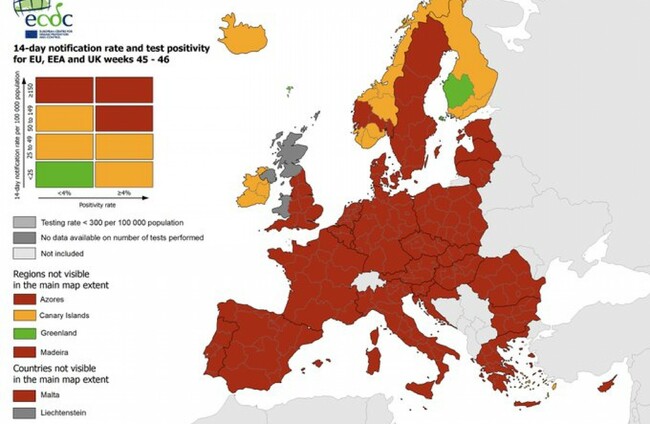
IMPROVEMENTS IN IRELAND’s Covid-19 figures has seen the country switch from ‘red’ to ‘orange’ on the EU traffic light map for international travel.
The Canary Islands have also turned orange on the map, which is published weekly every Thursday.
Under the new EU traffic light plan, the European Centre for Disease Prevention and Control publishes a weekly map of the EU using a three-stage colour system to indicate the level of risk in each area.
Levels are determined by a variety of epidemiological factors including the 14-day incidence per 100,000 population and the level of positive tests.
Ireland signed up to the plan in October, and it became fully operational this month.
The majority of Europe is listed as ‘red’. However, other than Ireland and the Canary Islands, Iceland, some Greek islands, Norway and the majority of Finland are orange. One region in Finland is listed as ‘green’.
#JustPublished
— ECDC (@ECDC_EU) November 19, 2020
Updated weekly 🚦 maps are now online!
These maps aim to support the @EUCouncil Recommendation on a coordinated approach to the restriction of #FreeMovement in response to the #COVID19 pandemic in the EU and UK.
Find more here: https://t.co/CcBVx6B0o5 pic.twitter.com/1rGx66xCr0
As of earlier this month, travellers arriving from orange regions do not have to restrict their movements if they carry the results of a negative Covid-19 test taken three days before their arrival.
Those who do not have a negative test upon arrival in Ireland can have a test taken five days after their arrival.
Passengers will be asked to restrict their movements until they get the test.
From midnight on 29 November, travellers arriving into Ireland from so-called ‘red’ regions in the new traffic light system will be advised that they no longer need to restrict their movements once they pass a Covid-19 PCR test (usually a nasal swab) five days following their arrival here.
Currently, a person is advised to restrict their movements for 14 days following arrival from a ‘red’ region.
Travellers from ‘green’ regions are not requested to restricted their movements or need a test prior to arrival.
If you are travelling to a region that is listed as orange, passengers are urged to check the requirements in relation to testing and restrictions for their destination country, as each EU country sets its own rules.
Covid-19 test centres are no up and running at all major airports in Ireland, with a drive-thru centre opening for business at Dublin Airport today.
Official government policy on international travel is provided by the Department of Foreign Affairs.
Anyone looking to travel into Ireland or abroad, would generally be guided by this advice, which is available on the DFA website.
The department states that if you are considering travelling, it continues to advise against non-essential travel overseas - other than to countries that are part of the EU ‘traffic lights’ approach.

To embed this post, copy the code below on your site













have your say