Sign in. It’s quick, free and it’s up to you.
An account is an optional way to support the work we do. Find out more.
Sign in. It’s quick, free and it’s up to you.
An account is an optional way to support the work we do. Find out more.
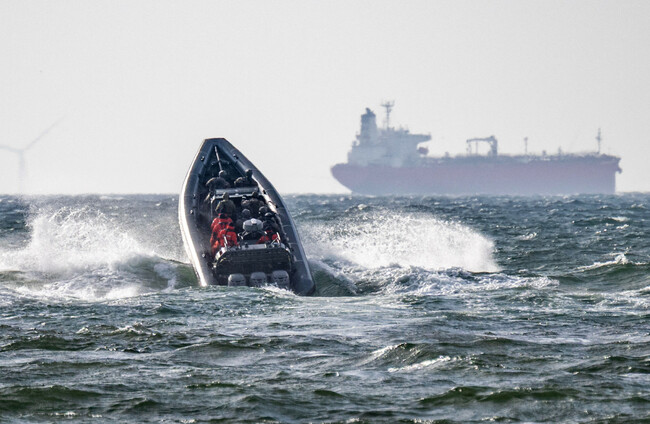
THE IRISH DEFENCE Forces has confirmed for the first time it is using Artificial Intelligence (AI) to monitor oil smuggling Shadow Fleet ships.
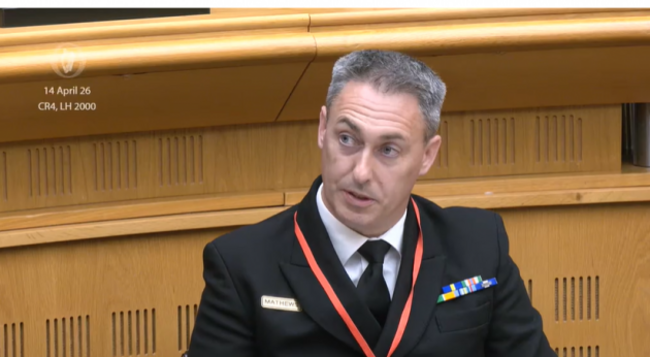
Commander Brian Matthews of the Irish Naval Service spoke during an appearance by the Defence Forces, Department of Defence and National Cyber Security Centre (NCSC) at the Joint Oireachtas Committee on Artificial Intelligence.
Matthews was asked by committee chair Malcolm Byrne to explain the use of AI by the Irish Defence Forces.
The Naval Commander outlined that the software is being used to monitor ships in the Irish maritime area and particularly suspicious vessels on a continuous basis.
Matthews explained that there is a large volume of traffic through the Irish Exclusive Economic Zone (EEZ). He said such is the vastness of maritime domain to patrol that a solution had to be found.
The naval officer said that the AI software is used by analysts to monitor the movement of suspicious ships. The Journal has previously reported that militaries across the globe have begun using the software for their operations – controversy has swirled around its use in targeting.
The AI being used by the Irish military can pick up on ships using certain routes that go against the norm. This can be indicative of ships being part of the Russian Shadow Fleet – an armada of around 500 ships used to smuggle oil in breach of international sanctions.
“That’s something that we are using AI as a tool for presently, but that’s as a support to the analysts,” he said.
“We would never have enough analysts to do that level of work.”
“And then, as we now explore the move towards the subsea domain awareness programme, there’s going to be an inordinate level of data that we gather,” he said.
The subsea project is associated with the purchase of sonar to monitor the undersea environment and find suspicious activity such as submarines. Sonar is used to pick up on underwater activity such as the sound of submarines.
The sonar will be able to detect the signatures of this activity but AI would be used to separate the false from the true detections.
Byrne asked if AI posed any issue for recruitment. Matthews said rather than reduce work it was simply enabling analysts to cover more ground.
“AI and other technology will be critical to us developing a rich understanding of what’s going on in our maritime domain. I don’t see AI as a threat to potential employment in the Defence Forces,” Matthews added.
Brigadier General Mark Staunton, who leads the military’s cyber capability, said that they have carried out a number of exercises with Nato and other organisations here in Ireland.
In one such ‘wargame’, the operation was focused on restoring power stations to full operation after a cyber attack.
Richard Browne, the head of the NCSC, told the committee that AI offers “huge promise” in its use in cyber security but it is also a tool for hackers looking to exploit vulnerabilities.
The cyber security industry is being revolutionised by a rapidly developing swath of agentic AI solutions on the response side, some entirely new, others embedded in existing offerings.
“Furthermore, the traditional task of identifying and fixing vulnerabilities is being revolutionised – recent announcements by Anthropic are a case in point,” he said.
Browne cautioned that there are limitations on the effectiveness of AI tools to launch cyber attacks but the technology is developing.
He described AI as a “force multiplier” meaning that it increases the scale of attackers’ operations.
Browne said this has enabled the attacks to proliferate as groups require less resources.
Last week, Anthropic announced that its latest model Mythos is capable of finding and exploiting vulnerabilities inside all operating systems and web browsers. Browne said that the Mythos system is only available to a small number of tech companies.
As reported previously by The Journal Anthropic has been used in compiling target packages for the US military in Iran and Venezuela.
In aggressive questioning Social Democrats TD Sinéad Gibney raised her concerns for the new system who said it was a threat to the State.
Browne said he did not agree that the Mythos system is a threat to Ireland.
“The issue is not that Anthropic has created this, the issue is that Anthropic has demonstrated that this is possible,” he added.

To embed this post, copy the code below on your site















have your say