We need your help now

Support from readers like you keeps The Journal open.

You are visiting us because we have something you value. Independent, unbiased news that tells the truth. Advertising revenue goes some way to support our mission, but this year it has not been enough.

If you've seen value in our reporting, please contribute what you can, so we can continue to produce accurate and meaningful journalism. For everyone who needs it.

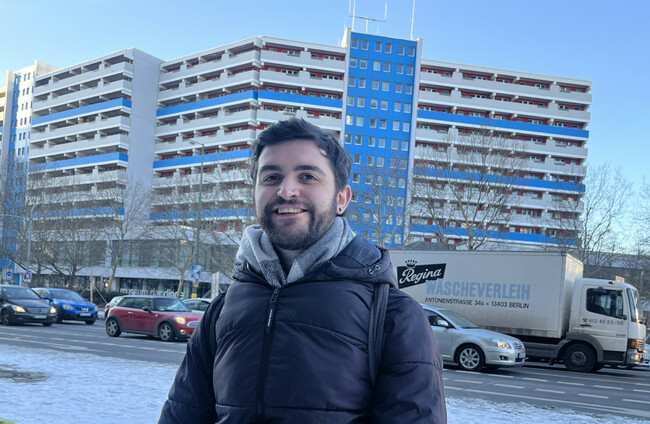
Adrian McCarthy from Ballincollig - 'It's a different world in the jobs market to when I first came here five years ago.' Eoghan Dalton/The Journal

'It's a far cry from poor-but-sexy': Irish in Berlin on a nervous time as Germans go to the polls

The country has critical elections taking place this Sunday.

WITH GERMANY APPROACHING a crossroads ahead of this Sunday’s election, the ebbs and flows of the country have set its capital city’s Irish population thinking.

There is an increased anxiety around the country’s future, owing to a pessimistic combination of harsher cost-of-living problems, “coarser” politics, and the rise of the German far-right, which is at its strongest position in generations.

Almost 20,000 Irish people live in Germany according to Ireland’s Department of Foreign Affairs, with Berlin estimated to be home to several thousand of them. 

The country entering recession two years ago is seen as the root cause for many of the issues facing the country, causing knock-on problems in the German jobs market for previously booming sectors. 

Adrian McCarthy is one example of that. The 30-year-old Cork man lost his job in one tech firm after it went insolvent recently and he has been looking for similar work since.

“So far I think I’ve sent 30 applications and had five call-backs for an interview,” he told The Journal in a cafe on the eastern end of the city.

That’s a different world in the jobs market to when I first came here five years ago, when you’d be getting almost endless messages from recruiters into your inbox on LinkedIn, trying to interest you.

The figures bear this out: larger German companies announced over 60,000 layoffs this year alone. 

Adrian’s situation mirrors that of Monica, also from Co Cork, who told The Journal that she has gone through two redundancies in the past two years due to job losses in the country’s tech sector. She noted the contraction in the tech and start-up sectors since 2020, leading to increased competition and layoffs.

She later drew back and apologised for “being so negative” about the city. “While it’s true it’s not as easy as it was a few years ago – the job market is bad and rents are higher – I don’t think people should be totally put off moving to Berlin. Like everything in life, it has its challenges, but it’s still an amazing experience.”

A factor in some of the outlook was, she added, that night life had become less attractive in recent times, pointing to club closures due to rising costs. The German techno clubs are famous enough to have received UNESCO recognition for their “intangible cultural heritage” last year.

“It’s a far cry from poor-but-sexy Berlin anymore,” she said.

The phrase ‘poor but sexy’ is used several times by various Irish people, and refers to a saying coined by a mayor in the early 2000s who declared it as a way of looking at the city.

The impact of housing

Even still, those who have lost their jobs say they have been helped by a generous dole package which sees you receive 60% of your old salary if you were employed for at least one year.

Without that safety net, both Cork natives would have left for another country – but not necessarily Ireland.

In large part, this was due to Ireland’s housing crisis which many people interviewed by The Journal cited as an obstacle to returning home. 

David Hartery looked to buy in Dublin and his native Waterford, before eventually opting last year to remain longer-term in Berlin by purchasing an apartment. “I don’t know if I would have stayed in Berlin if I hadn’t,” the Tramore man added.

He said that the house in Waterford (population 60,000) would have cost much the same as what he eventually got in Berlin (population 3.4 million), something David classed as “insane given Berlin is one of the biggest cities in Europe”.

Now in his 20th year in Berlin, Donegal man Donal Peoples found the mica issue has made it harder to find somewhere to live.

Donal, who works in further education, pointed to childcare as another major consideration, with he and his wife set to welcome their second child soon.

Under Germany’s federal system, the state of Berlin has a policy which effectively means families don’t have to pay for childcare for usually the first five or six years of their infant’s life.

“So if you compare the lifestyle we have here versus the lifestyle we have in Ireland, we’d have to earn a lot more money and spend a lot more – so our work-life balance would be bad,” Donal added.

“So here we work, have okay jobs, we earn okay money, but we have a good lifestyle. Whereas in Ireland, I think we’ve been forced to really push it on, to really drive it on and then – looking at houses and stuff like that -it just didn’t seem like a feasible longer term option.”

David and Adrian were among those praising the marked difference in health policy compared to Ireland.

Simply, they can get important medication for €10 every quarter, whereas it costs around €140 for the same timeframe in Ireland. “It’s a big consideration,” Adrian said.

Berlin’s Irish musicians

If the outlook is glum for some, it’s chirpier among musicians. They reported finding it easier to make a living in Germany’s capital than Ireland’s. 

Conor Kilkelly tells The Journal in between Irish folk music sessions at the tiny U Bar that public transport, where trains run within minutes of each other at multi-storey train stations for the millions of residents, has meant that he’s not sinking most of his gig earnings within hours of making it. 

At the same time, he points to the likes of Cavan folk singer Lisa O’Neill as someone who was able to sustain herself and become a success while staying in Ireland.

“So it’s not impossible is what I’m saying,” Conor added, “I definitely had lots of issues with having the confidence to give it a go – I only eventually was able to do it after quitting a job that had my stomach in knots each day, to go and do music full-time here.

“I’ve just found it so much more possible.”

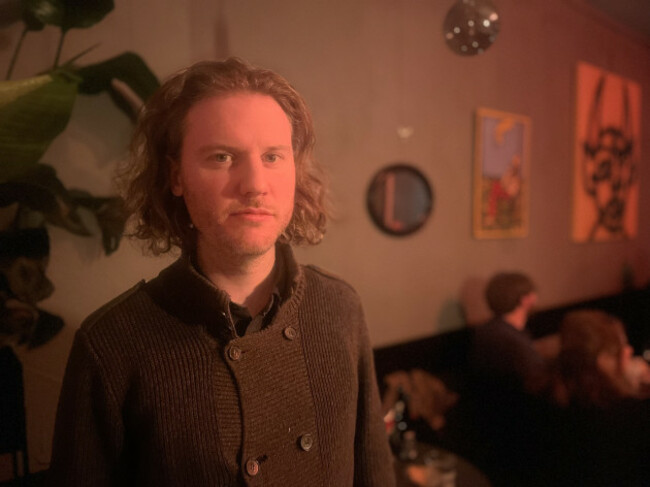
IMG_0250 'I've just found it much more possible in Berlin' - Conor Kilkelly EOGHAN DALTON / THE JOURNAL EOGHAN DALTON / THE JOURNAL / THE JOURNAL

However, he intends to leave the city and country behind later this year to go live in Co Clare in a small cottage with his wife. “Something that’s really got me thinking is the basic income scheme in Ireland – I have friends on that who have said it’s life changing. It’s €300 a week – that would be incredible.”

‘Some people think the Irish are crazy now’

Several of those we spoke to said that Germans express warmth towards Irish people, with one long-time resident describing them as “like limpets”, the clingy aquatic snail – meaning that they’ll do far more to “maintain a friendship than Irish people might be ready for”.

But there has been a change detected among others. A number of people said that the war in Gaza had “opened up divides” in Berlin society, pitting Irish people and Germans in opposition to each other. 

One of the longer-term residents said Gaza has become a “messy topic” in Germany and said he tries to avoid it due to “sensitivities” among the population that views support of Israel as part of atonement for its heinous crimes against Jewish people during the Second World War.

Conor Kilkelly, the musician, said he increasingly feels Irish people are now viewed as “crazy or weird” in some quarters because of the split on Gaza among Germans, where each of the mainstream parties have stressed a stance that is supportive of Israel.

Adrian McCarthy felt similarly: “I’ve seen how some of the Palestine solidarity protests have been treated by police and it is not something I am comfortable with.”

‘I don’t know how you’re going to put the genie back in the bottle’

Over Frankenfurters and sauerkraut, Birr native Denis Madden spoke about moving from job to job in Germany throughout the 1980s and 1990s before getting moving in tech.

In the early 2000s, in that ‘poor-but-sexy’ phase, Madden set up the German Property Centre, which has gone on to renovate and invest in properties across the city and further east. “The Irish here did their bit to rebuild parts of the city,” Madden said.

He’s more optimistic about the state of the economy than others, explaining that he views the Germans as a “people who always see the glass as empty when I think it’s maybe half-full”.

But he sounded a note of caution around the direction of the country’s politics and what the rise of Alternative for Germany (AFD) means for more vulnerable immigrant communities. “I don’t know how you’re going to put the genie back in the bottle.”

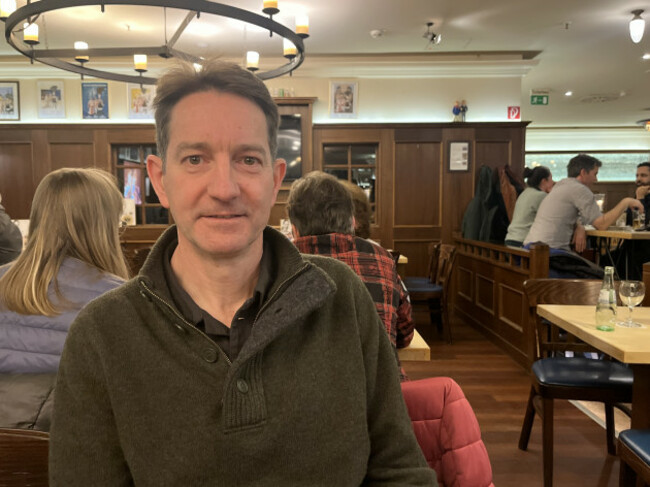
IMG_0242 Denis Madden EOGHAN DALTON / THE JOURNAL EOGHAN DALTON / THE JOURNAL / THE JOURNAL

Adrian McCarthy and Donal Peoples were among those setting out plans to apply for citizenship if staying in Germany, so they can have a vote in future elections.

“If I’m staying here, I want to have a say in the future,” Peoples said, explaining that he’s found it “impossible” to look away after seeing the rise of the AFD.

Earlier this week, The Journal reported on the case of Meadhbh Greene whose family, she alleged, have repeatedly been mistreated by state authorities due to her husband Mohammad’s Egyptian background.

Comparisons are occasionally made with the period that saw the rise of the Nazis, but others caution that life is still very good and the safety net makes more awkward times easier to manage.

It’s a marked contrast to one of Germany’s grimmest periods, in the 1920s, when prices quadrupled each month during 16 months of hyperinflation – paving the way for extremist politics.

But even still, the growing influence of the AFD will bring its own “ripple effects” according to David Hartery.

“It’s a turbulent time and I think it’s very much worth paying attention to. It will make ripples in other countries around Europe and Ireland depending on what happens.”

Readers like you are keeping these stories free for everyone...
A mix of advertising and supporting contributions helps keep paywalls away from valuable information like this article. Over 5,000 readers like you have already stepped up and support us with a monthly payment or a once-off donation.

Close
109 Comments
This is YOUR comments community. Stay civil, stay constructive, stay on topic. Please familiarise yourself with our comments policy here before taking part.
Leave a Comment
    Submit a report
    Please help us understand how this comment violates our community guidelines.
    Thank you for the feedback
    Your feedback has been sent to our team for review.

    Leave a commentcancel

     
    JournalTv
    News in 60 seconds