We need your help now

Support from readers like you keeps The Journal open.

You are visiting us because we have something you value. Independent, unbiased news that tells the truth. Advertising revenue goes some way to support our mission, but this year it has not been enough.

If you've seen value in our reporting, please contribute what you can, so we can continue to produce accurate and meaningful journalism. For everyone who needs it.

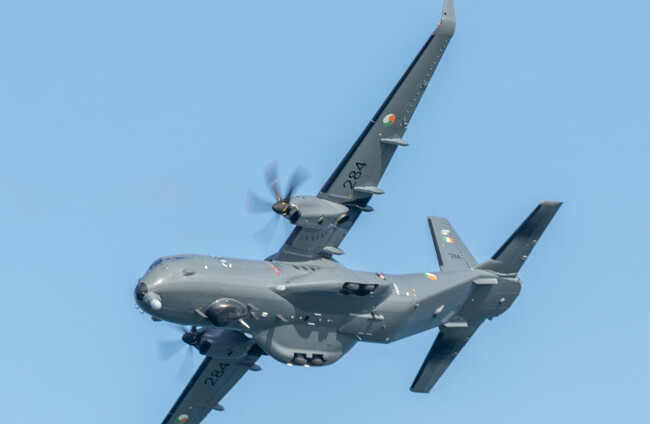
An Irish Air Corps 295 aircraft.

Irish Air Corps plane safely out of Beirut after mission to extract army engineers

It is understood that the mission took place this afternoon with the Air Corps C295 cargo aircraft making one of the first wartime resupply flights to Beirut.

THE IRISH AIR Corps has flown a special mission to Beirut to fly in senior military leadership personnel and to extract a team of engineers who have been stuck in Lebanon since the IDF launched its invasion of the south of the country. 

The Lebanese capital has been under almost daily bombardment since the Israeli Defence Forces (IDF) launched its incursion across the so-called Blue Line, which is a truce demarcation marker.

Irish peacekeepers are based at a number of locations in the south of Lebanon. 

Sources said there was widespread fighting across the area today as IDF forces traded small arms fire with Hezbollah fighters.

Is is also understood that there were bombings in the southern suburbs of the capital this afternoon as the Irish were on the move. The IDF also said they were bombing Beirut. 

The mission took place this afternoon with the Air Corps C295 cargo aircraft making one of the first Irish wartime resupply flights to Beirut.

The military leadership, which includes officers and non-commissioned officers, were brought from Ireland to work in Lebanon, while an engineering team, known as a work party, travelled to the city to fly home on the same plane.

Sources said that the joint operation planning for the convoy to move through the active warzone was hugely complex, made even worse as Israel has bombed major bridges crossing wide valleys, rivers and dry wadis along routes used by the Irish. 

The plan was carried out in strict secrecy with colleagues from the Department of Defence and the Department of Foreign Affairs working behind the scenes to expedite paper work and diplomatic clearances. 

Sources said that there were high level discussions with the Israelis to ensure so-called “deconfliction” – which, in layman’s terms, means that there was information shared with the IDF to prevent the convoy being hit. 

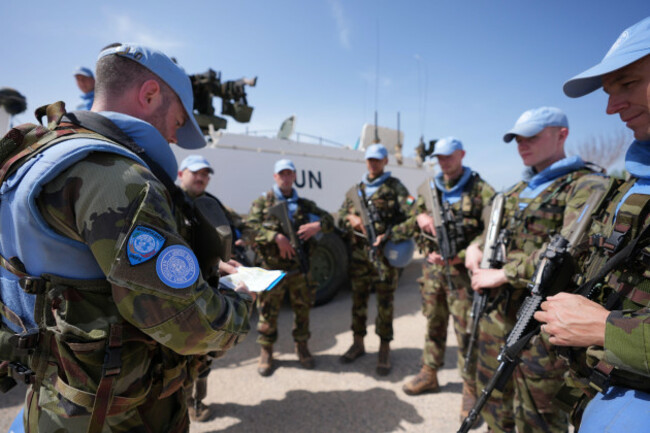
irish-defence-forces-soldiers-near-camp-shamrock-near-the-border-with-lebanon-and-israel-during-a-visit-by-tanaiste-simon-harris-to-meet-irish-defence-forces-troops-serving-with-the-unifil-peacekeepin A stock image of Irish troops preparing a mission at UNP 2-45, aka Camp Shamrock. Alamy Stock Photo Alamy Stock Photo

The Air Corps aircraft travelled from Dublin and after a number of stops it landed in Beirut this afternoon. It spent just around an hour and a half on the ground before lifting off again.

The heavily-armed Irish convoy then set off on a perilous route south down the coast road near Tyre and Sidon before making the difficult journey across routes heavily bombed with active fighting nearby.  

Lebanon became a renewed target of Israel on 2 March after Hezbollah fired rockets towards northern Israel in response to the US-Israeli attacks on Iran that killed Tehran’s supreme leader Ayatollah Ali Khamenei.

The response from the IDF has been ground incursions and heavy bombing across the south, cities such as Nabatieh, Tyre and Sidon as well as the Bekaa Valley and in Beirut.

More than one million people have moved north from the south to flee the IDF bombing. Tens of thousands are in tents and makeshift shelters. Some 1,100 people are estimated to have been killed in the airstrikes.

While there have been reports that Israel intends to occupy as far as the Litani River, which enters the sea near Tyre, analysis is now suggesting that it is more likely that the strategy will focus on an eight kilometre-wide buffer zone inside the de facto border with Israel. 

A statement has been requested from the Irish Defence Forces. 

Readers like you are keeping these stories free for everyone...
A mix of advertising and supporting contributions helps keep paywalls away from valuable information like this article. Over 5,000 readers like you have already stepped up and support us with a monthly payment or a once-off donation.

Close
JournalTv
News in 60 seconds