Sign in. It’s quick, free and it’s up to you.
An account is an optional way to support the work we do. Find out more.
Sign in. It’s quick, free and it’s up to you.
An account is an optional way to support the work we do. Find out more.
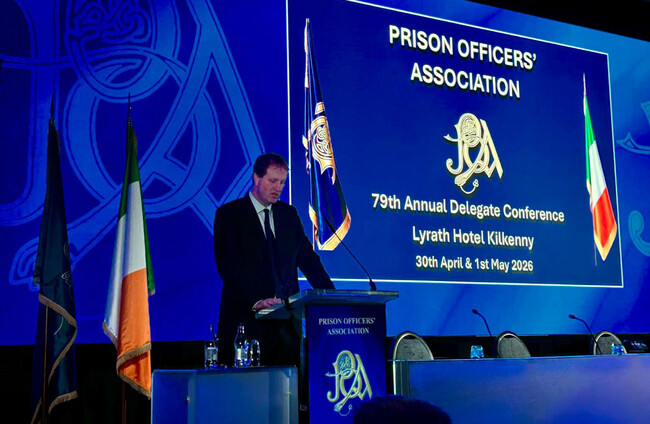
JUSTICE MINISTER JIM O’Callaghan faced a frosty reception when he addressed delegates ahead of the annual banquet at the Irish Prison Officers’ Association (POA) conference on Thursday.
Figures published by the Irish Prison Service (IPS) the same day set the tone.
In 2025, direct assaults on prison officers rose by 23% to 132 incidents, while aggressive and threatening behaviour increased by 132%.
The number of identified gangs operating inside prisons almost doubled. Overcrowding has left hundreds of prisoners sleeping on mattresses on cell floors, with the system holding 1,173 more inmates than its official capacity.
The message from the POA on the consequences of this crisis was blunt. In a speech directed at the minister on Thursday morning Acting President Peter Redmond said overcrowding had left officers facing an “impossible task” and rising danger.
“The only solutions we have coming from the Minister and his department are community return schemes, probation reforms, failed electronic tag pilots, a piecemeal dysfunctional building strategy, mattresses on cell floors, bunkbeds, bunkbeds and more bunkbeds,” Redmond said.
O’Callaghan did not attend the conference itself to hear Redmond’s address. He told delegates he had a “good excuse” as he’d been meeting the British Secretary of State for Northern Ireland in Hillsborough, but that he’d read a copy of it in the car.
“We were snubbed,” one officer said after the Minister’s address.
Another described the minister as having arrived “empty-handed”.
“It’s the same promises we heard last year, and assaults are up, overcrowding is up. It’s the same promises Helen McEntee made before him,” they added.
In his speech, O’Callaghan said challenges remain “acute on the ground” but argued the Government is making “progress” towards a system “fit for a 21st century Ireland”.
He pointed to a “record” capital allocation this year as part of a €500 million plan to expand prison capacity, including funding to plan and begin a new prison at Thornton in north Dublin. He acknowledged, however, that many officers believe such action should have happened “yesterday”.
Tensions between the POA and the Department were on show when O’Callaghan rejected criticism of investment in single-occupancy accommodation.
The Grove unit at Castlerea Prison, designed in a residential style, is one of the projects the POA has taken issue with. Its leadership argues that while such initiatives may have merit in a functioning system, they do little to address widespread overcrowding as only certain prisoners are eligible.
“I know the POA doesn’t like the Grove project, but it is an example of a development done very quickly,” O’Callaghan said.
The minister accepted that “it was a failure of previous governments that we did not keep prison capacity in line with our increasing population,” but said construction alone would not resolve the crisis.
“Courts need to have other options than incarceration,” he said, pointing to legislation progressing through the Dáil to expand the use of community service orders.
He reiterated plans for electronic tagging for certain cohorts of offenders and said he is “confident” a pilot will begin this year following a recent procurement process.
O’Callaghan did receive applause when he said any act of violence against prison staff is “unacceptable”.
He said body-worn cameras would be rolled out across more prisons following a trial in Portlaoise, and that action is being taken on introducing incapacitant spray.
In a doorstep with media, O’Callaghan was asked if he accepts Redmond’s contention that overcrowding is now a “national scandal”.
“It’s not about words or descriptions,” the Minister replied, adding that overcrowding is a “problem that needs to be resolved”.
Deputy General Secretary Gabriel Keaveny was questioned about a perceived lack of political will to treat the situation in prisons as a matter of urgency.
“Me and you, we’ve been doing this for years now at this stage through successive Ministers and successive Governments, and we never seem to get anywhere,” RTÉ Crime Correspondent Paul Reynolds put to him.
Keaveny said that more bed spaces will have to be added to the prison system, as the current situation is unsustainable.
“Something will happen in one of our prisons, and it’ll be too late then,” he warned.

To embed this post, copy the code below on your site














have your say