Sign in. It’s quick, free and it’s up to you.
An account is an optional way to support the work we do. Find out more.
Sign in. It’s quick, free and it’s up to you.
An account is an optional way to support the work we do. Find out more.
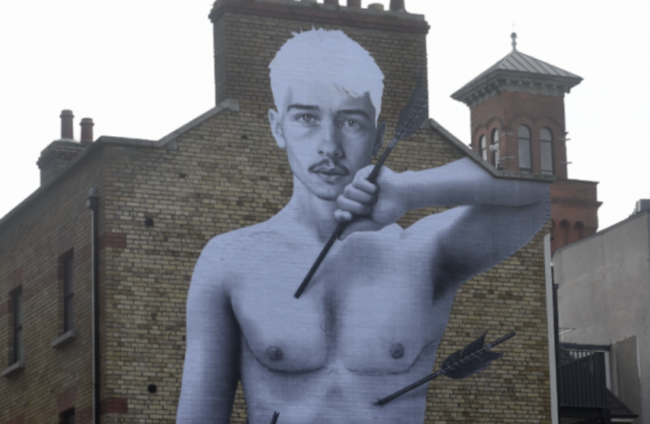
A RENOWNED IRISH street artist has said that his mural depicting a trans person faced additional scrutiny from Dublin City Council due to its subject matter.
Joe Caslin last month unveiled his latest mural, SEEN, on Townsend Street in Dublin city.
Caslin is best known for his large-scale murals and among his most notable works is The Claddagh Embrace, a piece depicting two men embracing.
It was created in support of the #YesEquality campaign in advance of the Marriage Equality referendum in 2015.
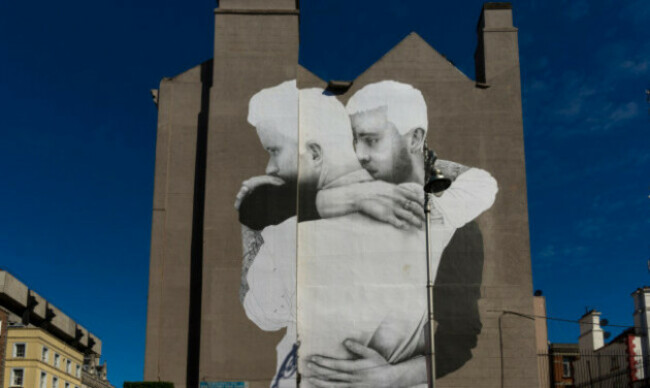
Caslin also faced difficulties with The Claddagh Embrace and later revealed he was sent a “warning letter” from Dublin City Council in relation to it. Dublin City Council warned that the artwork may have to be removed as no planning permission was sought.
Planning authorities later decided the piece was fine to stay, as it fell within the remit of referendum campaign materials. The mural, however, had been designed as a temporary fixture, and in keeping with the artist’s plans it washed away within weeks of its appearance.
His new work, SEEN, was commissioned by the Irish Red Cross and saw Caslin work with 12 LGBTQIA+ participants from the Irish Red Cross Ukrainian Community Centre.
The 50-foot installation depicts a young trans man being pierced by arrows to symbolise “harm inflicted by external forces”, while his gaze and upright stance represent “resilience and survival”.
Speaking to The Journal, Caslin said he has previously completed murals in Dublin City around Down’s syndrome and on mental health and “there was no problem”.
However, he added: “The minute I make anything about being a refugee or being queer, it’s a different ball game completely.”
Caslin had intended to install the mural during Pride 2025 and had contacted close to 30 locations, but some cited “concerns about backlash because the work centred on trans people”.
The Peter McVerry Trust later agreed to host the mural at 180 Townsend Street in the south city centre, close to Trinity College and Pearse Street Garda Station.
After a location was secured, Caslin initially sought to develop the mural via Dublin City Council’s “street art in partnership” process.
Any street art proposal is obliged to work within the provisions of the planning legislation as there is no specific provision for street art within the planning acts.
However, in certain instances public street art can be exempted from the requirement to secure planning permission if it is carried out in partnership with the council.
Caslin’s mural was assessed but not approved via this process and was later referred to the planning department of Dublin City Council.
Caslin said he later learned that the Council’s Arts Office had supported and approved the artwork via the street art in partnership process but that the planning department overruled this recommendation.
This meant that a full planning application for the temporary artwork had to be submitted, but the initial application was deemed invalid.
A revised application was then granted planning permission, but further approvals were required before the project could proceed to installation.
Caslin said this meant that the project was formally assessed by the planning department on three separate occasions, and it took close to a year to get the mural approved.
An email to Caslin to the council refusing permission and seen by The Journal cited “criteria in relation to what can be displayed in public space in terms of child-appropriate, violent, political or religious content”.
Later correspondence cited “watershed principles” and “public realm appropriateness”.
When Caslin queried the decision not to move ahead, he said he was “effectively told that the decision would not be revisited”.
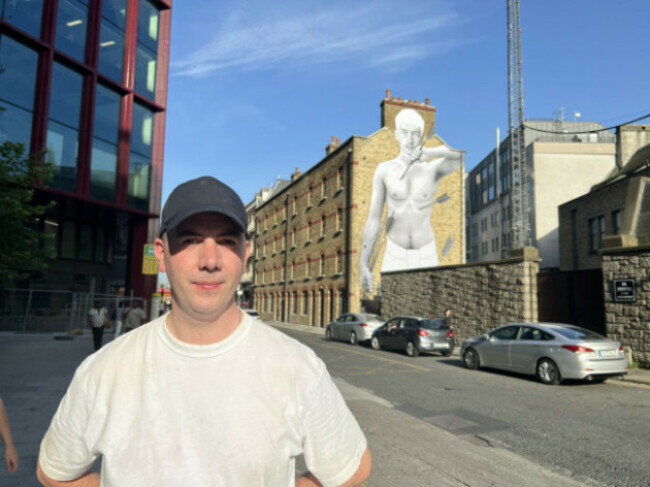
Caslin said that in a phone call a council staff member pointed towards the blood and arrows depicted as evidence of the mural being too “violent”.
He said he reluctantly revisited the mural and toned down some of its features.
All visible blood was removed in one redesign, but the project was still rejected.
After being rejected via the street art in partnership route, Caslin was advised to pursue full planning permission for the work but said “thousands of euros were spent navigating a system that was never designed for temporary public art”.
Caslin said the arduous process required to make large-scale public artworks means that very few end up being done, and that artists are increasing being funnelled towards “safe” local history and biodiversity projects.
Meanwhile, Caslin noted that the Council’s website states that it is committed to making the planning process as “simple and streamlined as possible”, but that he felt he had to become an “expert” in planning law to get the project over the line.
Caslin meanwhile said that other “prominent street artists” have encountered issues with the process.
For example, in 2022, Dublin street-art collective Subset called for an overhaul of the planning laws after it was prosecuted over three murals, including one of David Attenborough.
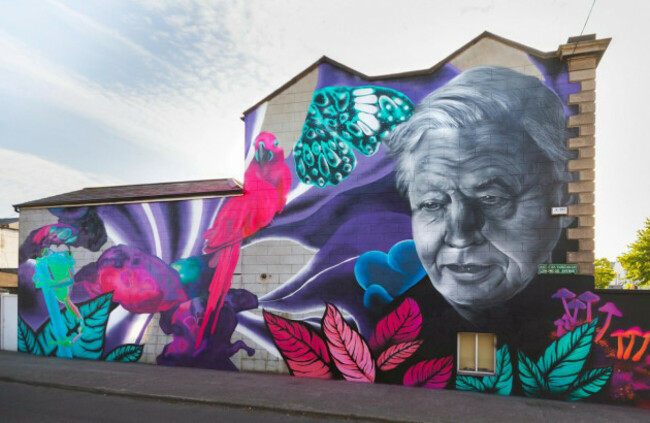
The case was later struck a year later after a judge noted that the Council had settled legal costs with Subset.
Meanwhile, Caslin said he knows of a street artist that has stopped making work in Dublin City “because it’s just so difficult”.
“Who’s losing out then? It’s the people. We’re not having big conversations, and we use street art in this country to have those conversations.
“We did it around Repeal and around marriage equality, it’s how we discuss things.
“If we remove all sharpness and risk out of our voice, and art is our voice, then we’re just left with nice pretty pictures.”.
Meanwhile, Caslin said someone connected to the council once advised him to “just go to a private developer”.
“If I want to make a piece around homelessness, there’s no private developer that’s going to allow me to do that.
“And this would be to give the role of public art curator to developers and allowing developers to have free rein on what they want to say within the city.”
We sent Dublin City Council a list of questions based on the issues raised by Caslin.
A spokesperson sent a short response, simply stating that the “planning process is standard for all planning applications” and adding that the local authority would not be commenting further.
- With reporting by Cliodhna Travers

To embed this post, copy the code below on your site











have your say