Sign in. It’s quick, free and it’s up to you.
An account is an optional way to support the work we do. Find out more.
Sign in. It’s quick, free and it’s up to you.
An account is an optional way to support the work we do. Find out more.
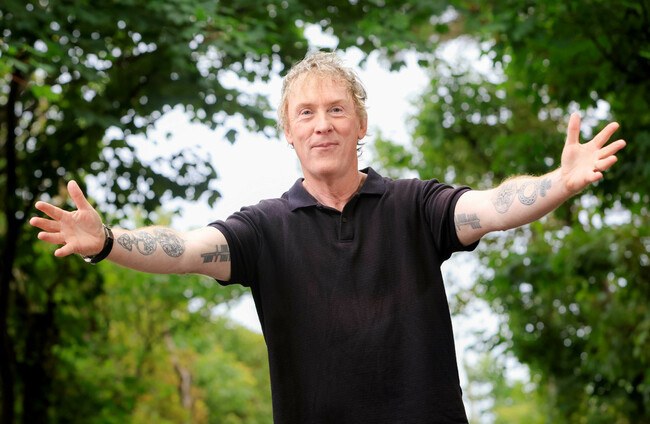
THIS IS THE golden age of the Irish language and the credit for that must go to the heroes who founded Irish-medium schools across the country over the past half century, Hector Ó hEochagáin has suggested this week.
Speaking to The Journal, the TG4 presenter, author, podcaster and, possibly, Meath’s most prominent Irish speaker called for a radical re-imagining of the way Irish is taught in schools, including greater access to Gaeltacht courses for thousands more young people.
There is plenty of evidence of this language boom, the presenter said, making specific reference to the Irish-speaking bands playing on multiple stages at Electric Picnic, the growth in the use of Irish on social media and, of course, the influence of TG4.
“That shows the hunger and everything that’s going on right now, it’s incredible.
“On social media too, there’s more Irish on Instagram and Tiktok – social media is a great tool in some ways, it’s terrible in other ways.”
Hector has little time for those who are looking back at how Irish was in the past. Hector believes that we need to look forward.
“That’s really true – all languages change, there was Middle Irish, Old Irish and there is New Irish, we shouldn’t be looking back at how it was, we need to look forward, because in front of us, all languages change.
“But when the language is almost gone, dead with flies circling, it’s difficult to start that revival, to start the regrowth, we don’t need to be giving up, we should be celebrating it.”
Ó hEochagáin referred to the new programme on RTÉ, The Traitors, and the amount of Irish that was heard in its first week on air.
“They were using Irish words on one of the games and using the old Ogham script on one of the biggest ‘game shows’ in the country right now, on prime time.
“These are the signs that are before us, people are falling in love with the language, people are trying to reclaim the language, are reclaiming the language.
“That’s what it is, it’s not a revival, it’s a reclaiming. I don’t know what the Irish is for that but what harm, not everyone should have every word in every language.
People are trying to get Irish back for themselves – and if it’s broken Irish, that’s better than no Irish at all.”
Regarding the teaching of Irish in secondary schools, he said that Irish teachers in secondary schools have a difficult job and “it’s getting harder every year”, in his opinion.
“They don’t have the help. Secondary school teachers don’t have the standard of speaking they should,” said Hector.
He pointed out that there were many teachers – at secondary and primary level – with good spoken Irish who were keen to use Irish and teach as Gaeilge in class but cautioned that it was a situation that needed to be monitored.
“If the primary and secondary school teachers do not have that standard, we will not succeed in terms of the language and the teenagers who are passing through our hands.
“We need better care and support, more personal service, better facilities, better opportunities, better chances of going to the Gaeltacht and more money to invest in the young teachers who are in the primary and secondary schools and in the colleges of education all over the country.”
He also said that there should be more emphasis on spoken Irish in the curricula of teacher training colleges.
They say the emphasis is on spoken Irish – but that’s not the case and that’s what I hear from the teachers.”
Ó hEochagáin referred to the cost of sending a teenager to a Gaeltacht course, over €1,000 for a period of three weeks. He believes a grant of at least €300 should be available for each child for such endeavours.
In response to the question about the cost of this in comparison to the Government’s spending priorities, Ó hEochagáin said:
“The Government has… a surplus of €16 billion that they received, there is money here.”
He would like to see the possibility of “teachers being more fluent in Irish when they go out to teach for the first time ever”.
“In terms of scholarships to the Gaeltacht, why are there only a few scholarships available across the country, why shouldn’t there be thousands of scholarships for the Gaeltacht available across the country – not just for special colleges or someone who is good at Irish and gets a scholarship.”
He said that thousands of scholarships should be available so that young people have the opportunity to ‘get a taste of spoken Irish’ because the cost of attending courses in the Gaeltacht could be a barrier for some.
“We can’t forget the Gaeltacht, the mná tí and the Summer Colleges who have been doing so for a long, long time.
“I started when I was young in Rath Chairn and then around the country with Coláiste na bhFiann.
“I wouldn’t have my life, my job, my livelihood if it weren’t for Irish. I didn’t know that when I was a teenager but Irish has given me work and my life, why shouldn’t it be available to someone else?”
He says he has hope and confidence in the future of Irish and that he notices that more people are using their Irish “every day” and the advice he gives to everyone who comes to him with questions is to use the Irish they have. “Why don’t you use your bit of Irish?”
“This is what’s happening now – people are happy to say a few words, people are happy to say ‘heileo’ in Irish, people are happy to say “go raibh maith agat”, “Dia dhuit” and “dhá pinta Guinness”.
“We are in a golden age because people are in love with the language, as they are with the culture, you saw it on TG4 at the Fleadh Cheoil down in Wexford, the crowd was so big there, we can’t go to the Fleadh because it’s grown so big.
“We are in this golden generation but it took centuries to get to this point but now we have to drive forward, we have to push forward.”
His next series on TG4, Hector Oz/NZ, will start this month and in between he will have a solo show at the Smock Alley Theatre next week during the Dublin Fringe Theatre Festival.
The Journal’s Gaeltacht initiative is supported by the Local Democracy Reporting Scheme.

To embed this post, copy the code below on your site















have your say