We need your help now

Support from readers like you keeps The Journal open.

You are visiting us because we have something you value. Independent, unbiased news that tells the truth. Advertising revenue goes some way to support our mission, but this year it has not been enough.

If you've seen value in our reporting, please contribute what you can, so we can continue to produce accurate and meaningful journalism. For everyone who needs it.

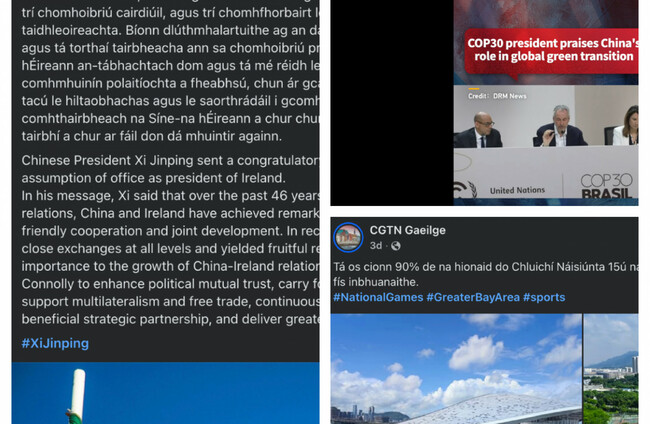
A selection of some of the posts on this Facebook page which appear to be aimed at Irish speakers.

Chinese-made news as Gaeilge is being published on Facebook, is Beijing behind it?

A security expert has suggested that a Facebook page with news items in Irish might be an attempt by China to exert influence on Irish speakers.

(Foireann Gaeltachta The Journal a chuir an scéal seo ar fáil. Tá leagan as Gaeilge anseo.)

NEWS STORIES IN Irish, many of which appear to praise China, have been circulating on a Facebook page for about a month now, it has emerged.

The stories appear to have been translated by a translation machine from English or a  Chinese language into Irish.

Among the latest stories to be reported on the Facebook page calling itself CGTN Gaeilgeis a report on a congratulatory message sent by Chinese President Xi Jinping to Irish President Catherine Connolly after she was inaugurated this week.

According to the Facebook post, the message reportedly sent by President Xi Jinping to Irish President Connolly reads:

In his message, Xi said that China and Ireland have achieved great success through mutual learning, friendly cooperation, and common development over the past 46 years since the establishment of diplomatic relations

This message is identical to a posting on the website of the Permanent Mission of China to the United Nations and Other International Organizations. This Permanent Mission is located in Vienna, Austria.

In another story, there is a report praising China for its role in the “green transition” at COP 30 currently taking place in Brazil.

There are many other items on the Facebook page, which are short stories with attractive pictures but no link to an external website to click on. Furthermore, no publisher is mentioned with the site under the information tag on Facebook.

According to security expert, Declan Power, the stories being published appear to be an attempt to use ‘soft power’ to strengthen China’s influence in Ireland.

“The Chinese understand that there are tensions and tensions in Ireland and Irish affairs have been on the international scene for some time because of the Presidential election,” Power told The Journal.

“It seems that China’s strategic communicators are trying to make a profit from this and at the same time make themselves more vulnerable.”

Among the posts on Irish business on this Facebook page are also stories about China, one describing newly built venues for China’s national games, which claim to be embracing a “sustainable vision”.

According to Power, these posts, like others aimed at other communities in the West, were intended to attract people with their short messages illustrated with eyecatching photographs, and that it was in the nature of people to connect with such accounts as they do not demand much attention.

“People do not pay much attention to them because they do not seem political – but they are a way to steer the discussion in a certain direction, which is not hostile to China.”

He said that a group was working between the European Union and the Nato to combat disinformation and disinformation and exchange information about it.

“For a country like ours, we’re very fortunate, the kinetic battlefield is less. It’s far less likely to be an issue for us because of geography and relationships.

“Now we’re looking at a situation where we are part of the targeting on the form of hybrid warfare, because it allows access in, it’s jumping the horizon.

“The State can’t keep that kind of stuff out, because we’re a free and open state.

“The State cannot withhold that information because we are an open and free state – if they find out that the information is having an impact, they will be in a position to turn up the heat on more controversial issues.

“People have access to it, and it can affect people’s interpretation about things that matter. Then when it comes to an election, or when it comes to policy shifts, or it can if it’s working, if they can discern that this stuff is landing, then it can be used if you want to turn up the temperature on things like migration or other contentious type of issues, and that’s why we have to take note of it.”

He said the best defence was to inform people about what was happening so they could make their own decisions.

The Journal’s Gaeltacht initiative is supported by the Local Democracy Reporting Scheme


Readers like you are keeping these stories free for everyone...
A mix of advertising and supporting contributions helps keep paywalls away from valuable information like this article. Over 5,000 readers like you have already stepped up and support us with a monthly payment or a once-off donation.

Close
JournalTv
News in 60 seconds