Sign in. It’s quick, free and it’s up to you.
An account is an optional way to support the work we do. Find out more.
Sign in. It’s quick, free and it’s up to you.
An account is an optional way to support the work we do. Find out more.
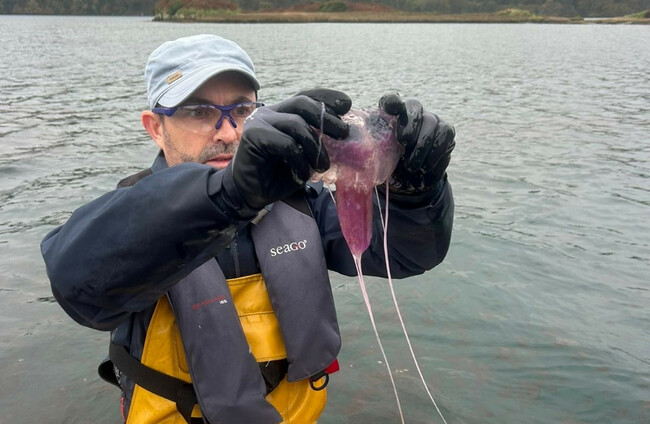
TENS OF THOUSANDS of Mauve stinger jellyfish are currently in dense blankets inshore along almost the entire south Irish coast, according to a university professor.
University College Cork (UCC) jellyfish scientist Dr Tom Doyle says he has received reports of “extremely high numbers” of this particular species, named Pelagia noctiluca, extending from Tramore, Co Waterford to Crookhaven off west Cork this week.
This follows confirmation last week that many thousands of Mauve stingers are in Lough Hyne, Ireland’s first marine nature conservation reserve, where they now pose a threat to many other species.
There have been reports of Mauve stingers in smaller numbers in Lough Hyne in the 1930s and in 2014.
Sea swimmers have been advised to stay out of the water, as the small bluey purple or mauve jellyfish with a globe shaped “umbrella” or “bell” and long tentacles can emit a painful sting.
More common in the Mediterranean, they have been seen with increasing frequency in Irish and British waters.
Dr Doyle has been researching this species for the past 11 years off the Irish coast, and says their increased presence may be due to a change in a coastal current 500 metres deep in the Atlantic which has acted as a barrier to oceanic jellyfish.
The “Slope current” runs around Ireland’s continental shelf edge around 500 metres deep, and can be weaker in certain years, due to the influence of the North Atlantic oscillation and the eastern Atlantic pattern, he says.
“The last time I witnessed Mauve stingers in such densities was in 2007, but they were offshore up to 500 km off Ireland in areas from the Rockall bank down to the Porcupine,” Dr Doyle says.
“Their movement in large golden brown slicks into inshore waters is unusual,”he says.
Records dating back to those kept by pioneering marine scientist Maud Delap show there were previous shoals of these jellyfish off Kerry’s Valentia island in 1906, he says.
He describes the Mauve stinger as not only a predator of fish larvae and other species, but a “real survivor” as it can shrink its body weight by up to 80% when faced with food shortages.
“They may start to move up the west coast, and we will be studying their progress, and we have already taken samples from Lough Hyne,” he says.
Their concentration in Lough Hyne may affect “sea sparkle” or Noctiluca scintillans, a marine species of dinoflagellate that can cause bioluminescence .
At just a kilometre long and three to four kilometres wide, Lough Hyne is connected to the Atlantic Ocean via Barloge Creek, by a narrow tidal channel.
Tidal flows from the Atlantic fill Lough Hyne twice a day, running over the rapids at up to 16km per hour, and creating a unique habitat of warm oxygenated seawater, which sustains a huge variety of marine plants and animals.
To embed this post, copy the code below on your site
















have your say