Sign in. It’s quick, free and it’s up to you.
An account is an optional way to support the work we do. Find out more.
Sign in. It’s quick, free and it’s up to you.
An account is an optional way to support the work we do. Find out more.

LAST UPDATE | 27 Mar 2024
THE AUTO-ENROLMENT pension scheme has been approved by Cabinet.
Social Protection Minister Heather Humphreys today secrued Cabinet approval for draft legislation on the Automatic Enrolment Retirement Savings System Bill.
It will apply to almost 800,000 workers between the age of 23 and 60 who are employed but not enrolled in an occupational pension scheme, and drawdown will be aligned with the State Pension.
The landmark scheme is being targeted to this cohort to allow them to begin saving for their pension earlier and to ensure that people are not left on just the State pension when they retire.
The scheme will see employees contribute into the pension pot, with their contributions matched by their employer, as well as a further top-up from the State.
So, if an employee were to pay in €3 to their pension pot, their employer must match their contribution and put in €3, while the State provides a €1 top-up.
For every €3 an employee puts in, they will end up with €7 in their pension pot.
It’s understood that Humphreys is keen to ensure the new Auto-Enrolment system is easy to understand and to communicate to the public.
Humphreys has previously noted that an Auto-Enrolment system has been “talked about for decades” in Ireland.
It’s expected that the Social Protection Minister will tell Cabinet that approval of the legislation will pave the way for one of the biggest reforms of the pension system in the history of the State.
All employees who are not already in an occupational pension scheme, and are aged between 23 and 60 and earning over €20,000 across all of their employments, will be automatically enrolled under the new legislation.
It will be possible for workers to opt out of the scheme if they wish or to suspense their contributions, after six-months mandatory participation.
Where a worker opts-out or suspends their contributions, they will be automatically re-enrolled after two years, after which they may opt-out or suspend again after a further six-months mandatory participation.
However, data from other countries shows that once people are automatically enrolled, very few decide to leave the system.
Following approval, the Bill will start its passage through the Oireachtas when the Dáil returns after Easter.
Humphreys previously said the Auto-Enrolment scheme was on track to be introduced in early 2024.
It’s understood she now wants to have the Bill enacted as soon as possible so that the new system can commence and first contributions can start on 1 January, 2025.
It will be gradually phased in over the course of a decade starting on 1 January.
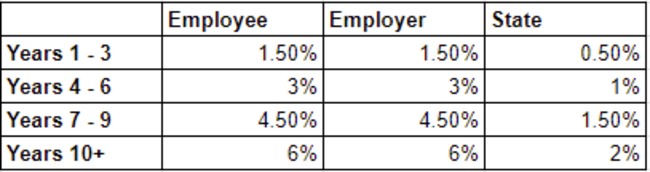
Employer and employee contributions will start at 1.5% of gross salary for Years 1-3, and rise to 3% in Years 3-6, to 4.5% in Years 6-9, and to the maximum contribution rate of 6% from Year 10 onwards, as seen below:
Speaking to reporters this morning, Minister Humphreys said the Department has been “engaging with businesses”, adding that she “understands their concerns because this is an additional cost”.
The existing State Pension system will remain in place.
Humphreys rejected the suggestion that the roll-out of the auto-enrolment scheme is an admission the the State Pension isn’t going to be able to cover people’s needs into the future.
“The State Pension is the bedrock of our pension system, that continues,” she said.
Humphreys said the auto-enrolment scheme is an addition to the State Pension, adding: “Most people find that when they retire, if they don’t have any pension provision, there’s a cliff edge drop in their income.
“I want to stop that. I want to make sure that when they retire there’s extra money in their pocket. It’s good for society, it’s good for economy, it’s good for businesses because there’s more money available to spend.”
A Department spokesperson said Auto-Enrolment is about ensuring workers have additional pension savings for retirement on top of their State Pension, so that they do not experience a drop in living standards.
A new authority, named the National Automatic Enrolment Retirement Savings Authority, will be established to manage the system.
Meanwhile, commercial investment companies will compete through an open tender for the role of ‘registered provider’ and will invest contributions on behalf of Auto-Enrolment members.
Participants will have a range of savings funds to choose from, which will include a default fund for those who prefer not to choose, as well as an alternative choice of funds for those who wish to make a more active choice.
With reporting by Hayley Halpin

To embed this post, copy the code below on your site














have your say