Sign in. It’s quick, free and it’s up to you.
An account is an optional way to support the work we do. Find out more.
Sign in. It’s quick, free and it’s up to you.
An account is an optional way to support the work we do. Find out more.
POSTERS PAYING TRIBUTE to Hezbollah fighters killed in the recent war with Israel line the streets and hillsides of South Lebanon.
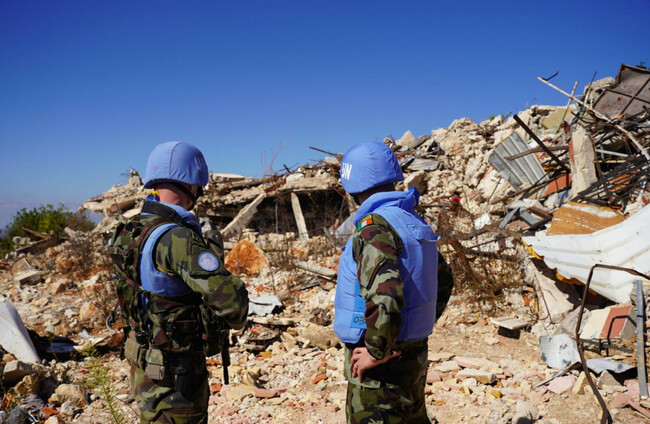
People have now returned to villages and towns in the region. Bomb-damaged houses are visible on the routes near the Irish Defence Forces camp.
There are no posters to the dead civilians killed in the short-lived war, just the remains of homes and rubble-cleared plots of land.
The shops and businesses are mostly back open, ordinary Lebanese citizens going about their lives, restarting again as they return home.
Ask them about their expectation for the future and they all told us that they are dreading the withdrawal of UNIFIL.
The mission, ongoing since 1978, has seen Irish peacekeepers essentially act as a ‘buffer’ between Israel and Lebanon.
It’s all set to end in 2027 after a vote at the UN Security Council during the summer.
The Israelis have, for the most part, withdrawn from the area. But there are nightly reports of mortar and air strikes on targets across the area. There have also been incidents in which Israeli forces have targeted UN peacekeepers with drone-launched stun grenades, and some incidents of shots fired.
The sound of drones is a regular occurrence, to such an extent that the Irish peacekeepers based there now consider the lawnmower-like sound of the pilotless aircraft as normal background noise.
Sources told us that it is often a sign of an impending airstrike is when the mobile phone signal vanishes.
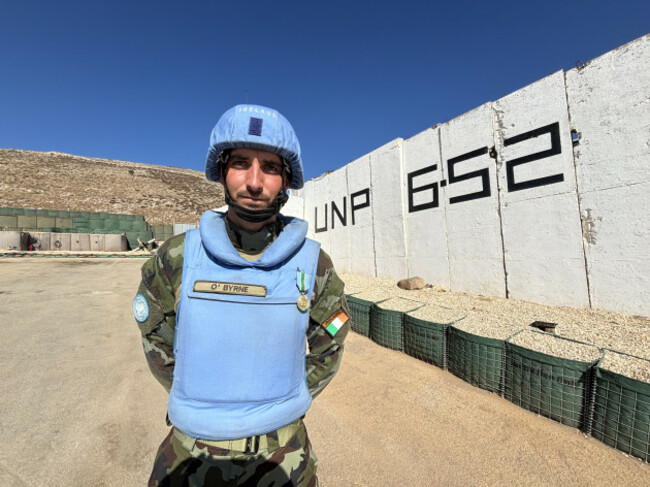
The atmosphere across the Irish area of operations is exceptionally tense, none more so than at UNP 6-52 – the Irish outpost just a few hundred metres from the Blue Line demarcation that divides Lebanon from Israel, and within sight of IDF positions.
Israeli tanks surrounded the tiny outpost at the height of Israel’s incursion into the region. In the scrub land between it and Israeli positions Chinese military engineers are working to clear unexploded ordnance.
When we visited they were clearing the lethal remnants of war left behind from the scorched-earth fighting.
On the hill above the outpost, the town of Maroun ar Ras does not exist anymore – it was razed by Israeli bombers and artillery. The devastation is stark. The impact on the local population was a forced total displacement from their homes.
There is a small detachment of Irish soldiers in the outpost led by 27-year-old Dubliner Lieutenant Marcus O’Byrne.
“We’re busy, that’s for sure and it continues to be. Here at 6-52 we have two street patrols out by day. One of the main taskings is an incident response team as well, on a ten minute notice to move.
“Then our other responsibility is reporting all activity along the Blue Line.
“On a daily basis there are notable incidents of quadcopters flying over and we have artillery rounds within the Area of Operations.”
Irish troops, O’Byrne said, hadn’t come into contact with the IDF directly – but they see Merkava battle tanks on a daily basis, drones above camp and IDF troops using the roads nearby.
He said that there was great camaraderie among the troops at the outpost and that was noticeable as we observed. The soldiers all told us that being busy meant the time flew by.
The soldiers received their UNIFIL service medals on the day we were at the camp, as Chief of Staff of the Defence Forces Lt General Rossa Mulcahy visited. He also paid a visit to the larger camp UNP 2-45, also known as Camp Shamrock.
The issue in the background, as reported by The Journal earlier this week, is that UNIFIL has been told to make cuts of 15% because of a shortfall of more than €2 billion in their peacekeeping budget.
It is an added complication to the already fraught situation of the impending end of the UNIFIL mission after 47 years and 48 Irish lives.
It is understood planning has begun as the end date of 31 December 2026 looms – with visits of Irish military logistical officers in recent weeks and other experts to assess for the plan to bring home the Irish equipment.
The Irish made a recent successful move of their equipment and vehicles home when the UNDOF mission ended in Syria, but this will be even larger and will require significant planning.
A number of other officers and officials accompanied Mulcahy on this week’s trip – including Brigadier General Céimin Keogh, senior Department of Defence official Stephen Hall and diplomats Aidan O’Hara and Joe Kennedy.
In regard to the enforced cuts, Mulcahy would not be drawn on the realities of what that will look like, but he admitted that there will need to be a reduction to some of the activities. He is clear however, patrols and the military and civilian outreach into the community on local projects will continue in spite of those cuts.
Regardless of that, the work goes on. The activities of Israel, not just in South Lebanon but across the region, make the Irish job much more complicated.
Sources said the IDF operation and largescale killing of Hezbollah leadership has removed the ‘head of the snake’ but not the threat the organisation poses.
A map, seen by The Journal, shows massive amounts of Hezbollah arms seizures, many clustered around noted stronghold towns. The seizures are being conducted by peacekeepers alongside the Lebanese Armed Forces (LAF).
There are occasional incidents in which peacekeeping patrols are stopped by local people in a DFOM (Denial Freedom of Movement). These DFOMs are most likely to be organised by Hezbollah and designed to either frustrate UNIFIL troops or to prevent them from seeing them preparing weapons or moving items.
The LAF are back patrolling in the south and are working closely with the peacekeepers in their attempts to disarm the militant group.
The Lebanese Government has undertaken to take control of the whole of the country, but sources said they are still struggling with critical underfunding and the difficult relationship the State of Lebanon has with the factional and almost tribal based political situation.
Often in Lebanon, the sight of yellow flags denotes where the Hezbollah strongholds are. Israel bombed and killed its leader Hassan Nasrallah in a bombing campaign against targets inside Dahiya, in the south of Beirut city.
On past visits by The Journal there were also substantial flags in the southern Beirut suburbs, near the Dahiya stronghold of Hezbollah. Noticeably there are now far less flags on the motorway heading south near the suburb than there were in previous trips to the country.
Some sources said that this is perhaps because people who own the buildings they usually hang from don’t want to have a de facto target on where they live for Israeli operations. The other reason is that there is an embryonic crackdown by the Government.
The south is different – through the towns of Sidon and Tyre and then up into the villages and towns there are new flags fluttering. Whether or not that is a true indication of Hezbollah popularity in the area is not known.
Locals will not talk about the group when asked to say how they feel about Hezbollah. One particular sign of a drop in the strength and capability of the militant group is perhaps that the militant group has stopped launching rocket barrages from launch sites in olive groves and dry river Wadis into Israel, despite Israel continuing a campaign of aerial destruction.
Sources said the two reasons for this are that Hezbollah has been decimated or that it has taken a strategic pause to rebuild its forces.
The key to understanding the picture on the ground can often be by understanding the tribal or religious allegiances – each village is a nation of its own with people of the same background there. Bint Jbeil for example is Shia muslim, while the town of Tebnine is Christian.
In general Shia communities are aligned with Hezbollah while Christian communities are not.
The clientelism system of governance in the south, in which Hezbollah provide local services, seems not to be present as much as it was before the war but that means that residents then must find other solutions.
The Government presence is denoted by the LAF but the Lebanese troops we met during our visit this week seemed drawn and tired, some openly disinterested – they are still struggling to be paid their wages, colleagues have been killed and the equipment they are using is old and battered.
The Irish come into this situation with a complex set of tasks, to observe and respond to violent incidents. They are working to support local people also as the Lebanese people clear rubble from bombed out homes and have also been working to restart the critical civil military engagement with local communities.
One such project is the construction of a solar panel farm on a building in a village in Kounine. They are also sinking wells for villages and helping to refurbish or kit out schools and sports facilities.
Regardless, speaking to experienced Irish soldiers and locals alike, there is a sadness there that the mission will end.
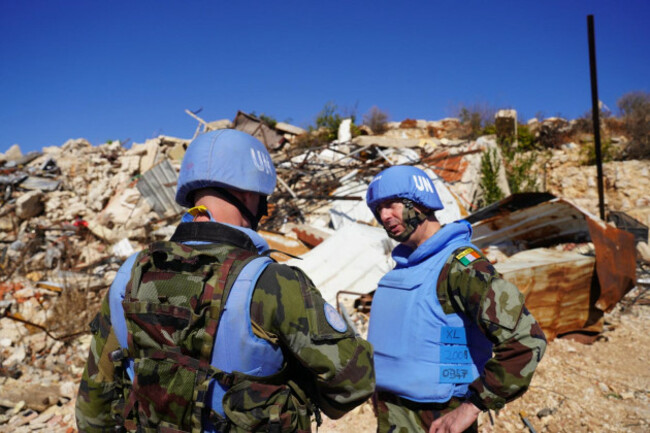
The legacy of the Irish soldiers is obvious from the warmth shown to them by local people as we were out on the ground. The tensions towards UNIFIL that were very evident in March on our last visit were not as obvious this time.
Mulcahy said that the decades-long Lebanese mission has had a huge benefit for the forces as they were able to learn from the operations in UNIFIL. It has also, he said, helped Ireland to perfect working with other nations.
But Mulcahy said the key take away is the positive relationship with the local population and how, even 20 years later, he still meets those he kept safe as a young officer on deployment.
“The Irish soldiers have come over here in the worst of times and the best of times… it is a massive legacy.”

To embed this post, copy the code below on your site









have your say