Sign in. It’s quick, free and it’s up to you.
An account is an optional way to support the work we do. Find out more.
Sign in. It’s quick, free and it’s up to you.
An account is an optional way to support the work we do. Find out more.
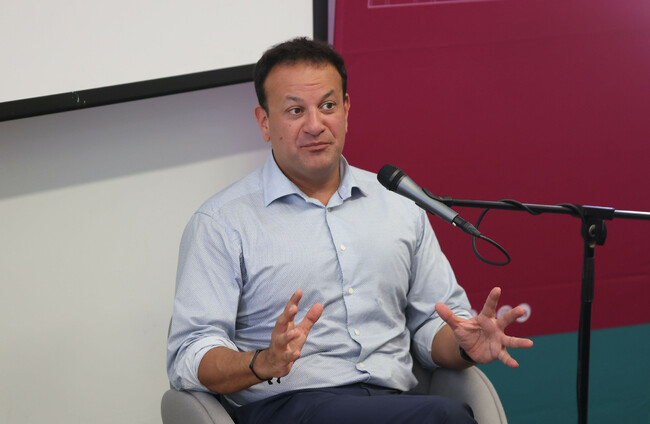
FORMER TAOISEACH LEO Varadkar said there’s a perception in rural Ireland that people living there are the “real workers” who are “paying all the bills” – but it is urban Ireland who do so.
Varadkar made the comments while appearing on Matt Cooper’s Path to Power podcast.
“People in rural Ireland are very quick to tell people in urban Ireland that ‘we’re the real workers, we’re the ones paying all the bills, we’re the ones feeding the country’,” he said.
“I think we maybe need to be a little bit more blunt in urban Ireland and say actually, that’s not the case. We’re the ones paying all the bills and you’re the ones in receipt of a lot of subsidies and a lot of tax benefits that other people don’t get.
“Maybe we need to sit around the table and have an honest discussion about that kind of stuff.”
The former Fine Gael leader is from Castleknock in west Dublin.
A frequent guest on Cooper’s podcast, Varadkar and broadcaster Áine Kerr appeared on the podcast episode aired today, ‘Powder keg Politics and Protests’, to discuss the fuel protests that occurred across the country last week.
Cooper put it to his guests that rural Ireland is perceived to be mainly agriculture based, which is not entirely accurate. He asked his guests whether the agricultural sector in Ireland is perhaps getting a “disproportionate influence over political decisions”.
The likes of the Mercosur deal, which Ireland voted against in the European Parliament, and the nitrates directive were brought up as examples.
Varadkar responded that this may be rooted in Irish culture as historically, what was good for farmers and the agricultural sector was what was good for Ireland.
Over the past ten to twenty years however, he continued, “we’re now in a space where things are actually starting to go the other way – what’s in the interest of farmers and the agriculture industry is by and large not in the interests of Ireland as a nation”.
He said that’s “starting to play out” and farmers and people working in the sector “don’t quite realise that yet”.
“They still see themselves as the people who bring money and jobs into Ireland, where actually a lot of the time they bring costs on Ireland.”
Cooper said farmers are not the main source of food in Ireland as it’s estimated around 80% of food consumed in Ireland is imported.
It must also be noted that Ireland exports the vast majority of its beef and dairy products and its exports dwarf the imports of meat.
Ireland’s climate and topography mean we import large amounts of fruit and vegetables, as well as things like grain, nuts, chocolate, tea, and coffee. We also import animal feed.
Varadkar said he understands frustrations for those in the sector by conflicting messages from government, and said a positive thing about the urban-rural divide is it’s “not as deep” as it is in the likes of the US.
“I’m a very urban person, I live in a terraced house inside the canals here in Dublin, but I’m only one generation from the farm,” he said. “And that’s the norm, I think in Ireland.”
He then made his comments on urban Ireland funding rural Ireland.
Cooper said the protests weren’t entirely centred on fuel, mentioning some of the anti-immigrant sentiment that came to the fore later in the week as people from outside the core protester demographic of farmers, hauliers, and transport businesses joined the blockades and demonstrations.
He said he understands that some parts of rural Ireland feel they have been left to cope with things like losing the use of their local hotel to Ipas accommodation, and seeing a “large influx of people from overseas” move into the area.
The host said these changes in society are “more visible and more noticeable” in less-populated areas of rural Ireland than in bigger and busier places in Dublin.
Varadkar agreed with Cooper and said “it’s a whole different dynamic” in small towns and villages than in Irish cities.
“I can totally understand why people in rural towns and villages don’t like that. They see a hotel that provided amenities, that provided employment, now being taken up by people who are awaiting decision on immigration protection,” he said.
He said when he was in government, they needed to find accommodation for people quickly, and “we got to the point where we couldn’t”.

To embed this post, copy the code below on your site










have your say