We need your help now

Support from readers like you keeps The Journal open.

You are visiting us because we have something you value. Independent, unbiased news that tells the truth. Advertising revenue goes some way to support our mission, but this year it has not been enough.

If you've seen value in our reporting, please contribute what you can, so we can continue to produce accurate and meaningful journalism. For everyone who needs it.

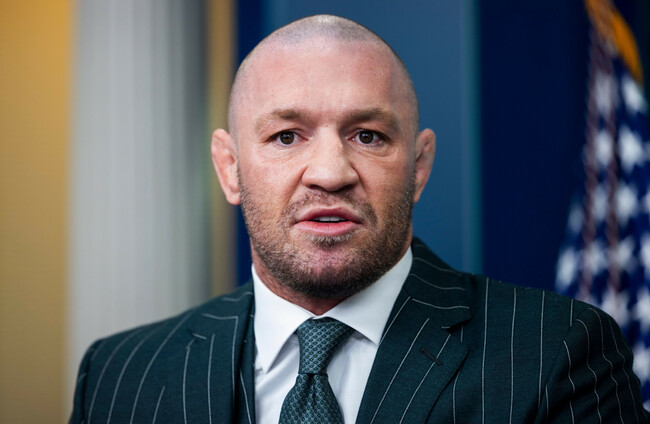
Conor McGregor officially withdrew from the presidential election today. Alamy Stock Photo

Over half of McGregor's presidential campaign posts on X filled with false claims and threats

A report from EDMO Ireland has found that his rhetoric, amplified by Elon Musk, normalised misinformation during his bid.

A MAJOR SHARE of Conor McGregor’s social media posts promoting his presidential ambitions on X contained false or misleading claims, according to a new report.

The analysis, published today by the European Digital Media Observatory (EDMO) Ireland and Dublin City University, looked at 127 campaign-related posts McGregor made between January 2025 and this month. 

Researchers found that 58% of these posts misrepresented either the Irish constitution, the presidency, or Irish history.

The former UFC fighter began positioning himself as a candidate in March, promising to “save Ireland” and styling himself as a political outsider.

But his social media posts relating to his presidential campaign also quickly became a lightning rod for criticism from politicians and watchdogs.

McGregor’s presidential content was viewed more than 100 million times worldwide, boosted by appearances on international platforms including Tucker Carlson’s YouTube channel and Fox News.

In a post this morning, McGregor announced that he was dropping out of the presidential race.

Despite his bow out, McGregor’s false claims have normalised “fact-free and extremist ideas”, the report’s authors state.

They add that McGregor has pushed “narratives seeded by fringe media, amplified by celebrities with little political understanding, and broadcast at scale through the platform of the world’s richest man.”

In the course of the period that he maintained he was intent on running for the Áras he lost his appeal against a civil jury’s finding in favour of Dublin woman Nikita Hand, who accused McGregor of rape and succeeded in her civil action against him last year.

False claims

The report highlights a pattern of misinformation at the core of McGregor’s campaign messaging. Of the 127 posts analysed in the report, 74 were identified as political misinformation.

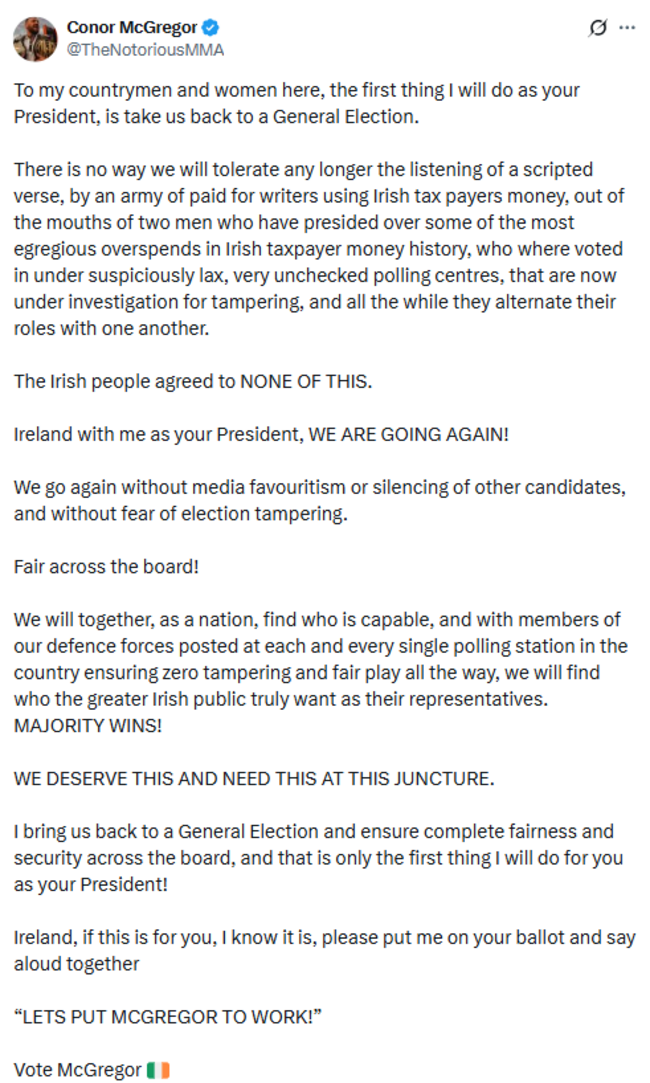
On 23 July, he falsely claimed that the Irish president could dissolve the government and call a general election – powers that rest solely with the Taoiseach.

Screenshot (194) X X

A day later, he asserted that the president could summon ministers and cut funding to NGOs, again misrepresenting constitutional provisions.

Among other false claims was an assertion that he could unilaterally amend the constitution, and that he could exercise authority over housing, immigration, trade, and economic policy.

He also advanced claims about Irish history and the constitution that bear no relation to reality.

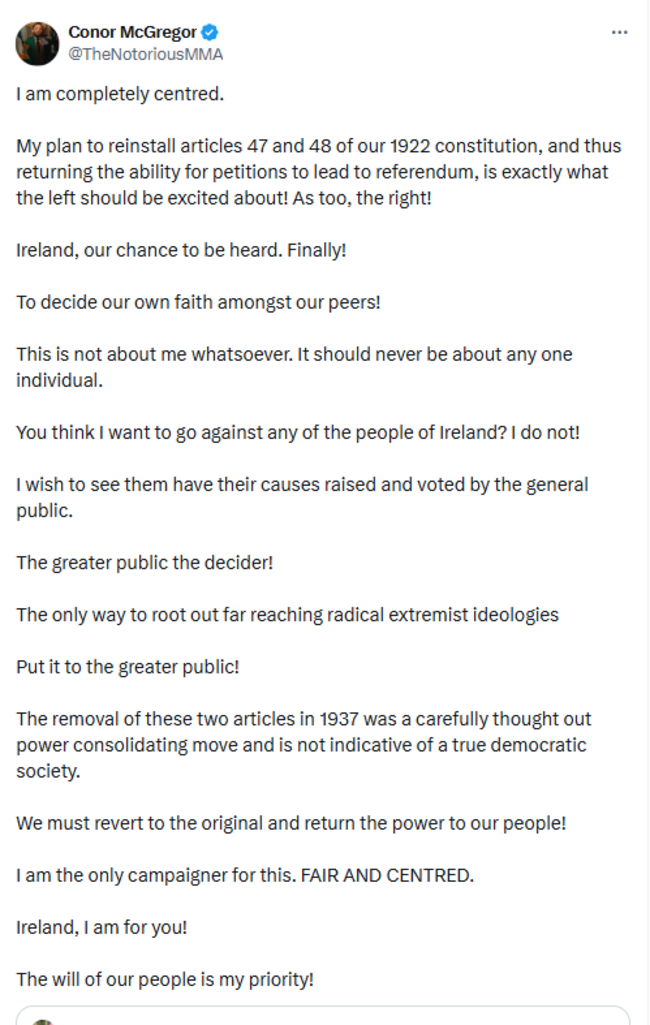
In one tweet, McGregor claimed he intended to “reinstall articles 47 and 48 of our 1922 constitution,” suggesting this would restore the ability for citizen petitions to trigger a referendum.

Screenshot (198) X X

While Article 47 of the 1922 Constitution of the Irish Free State allowed petitions, it never automatically led to a referendum, and Article 48 was unrelated to citizen initiatives.

The 1937 Constitution removed these articles as part of a broader reform, rather than as a targeted “power grab,” meaning McGregor’s description of the changes is misleading.

The report found that posts such as these misled audiences both in Ireland and abroad “about the nature of Irish democracy.”

Personal attacks and extremist rhetoric

Researchers also found that 10 of McGregor’s posts contained personal attacks, often infused with misinformation.

Several singled out Tánaiste Simon Harris, describing him as a “conniving, coward of a man” and a “treacherous weakling.”

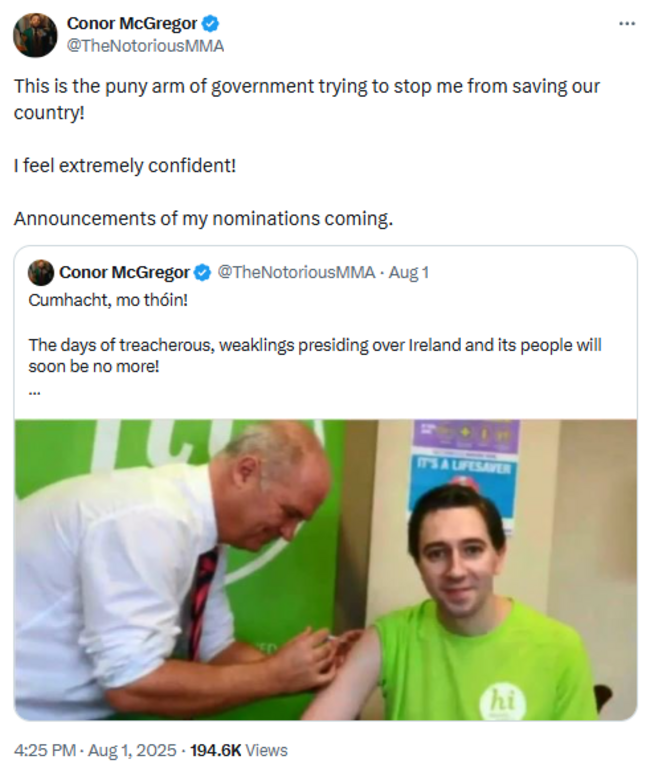
In another post, McGregor shared a photo of Harris receiving a Covid-19 vaccination, claiming it showed the minister as the “puny arm of the government trying to stop me from saving our country.”

Screenshot (195) X X

Nearly a third of posts analysed in the report contained ethnonationalist rhetoric.

On 7 April, McGregor appealed to “real Irish people” and “real Irish sport” while warning of “population replacement.”

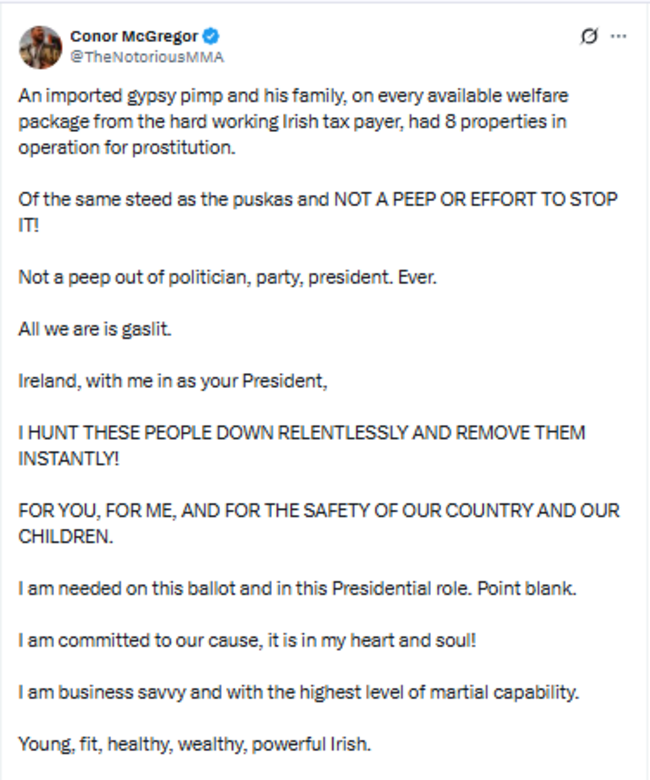
In another post, he compared himself – “a young, fit, healthy, wealthy, powerful Irish man” – with what he described as “an imported gypsy pimp and his family, on every available welfare package from the hard working Irish tax payer.”

Screenshot (196) X X

Threats of political violence

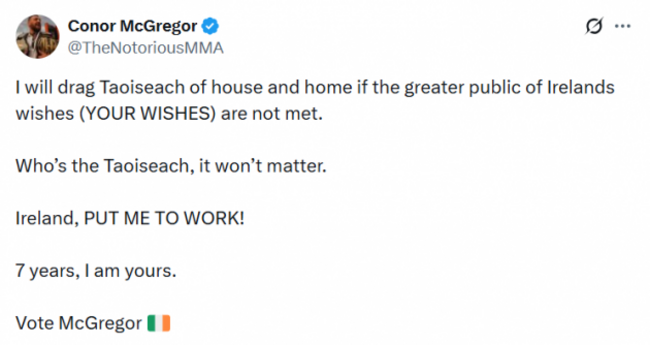
At least six posts by McGregor contained either explicit or implied threats of political violence.

In one, McGregor vowed that if elected he would march into a town with “the army in tow” after reports of a crime by migrants.

In another, he suggested staff at Tusla, the child and family agency, should be “hung, drawn and quartered.”

He also threatened to drag the Taoiseach “out of house and home.”

Screenshot (197) X X

The post amassed over 1,900 likes.

Such rhetoric normalises violence against political figures and institutions, the report has warned.

Earlier this month, Tánaiste Simon Harris faced several threats against his family and home, including a bomb threat.

Musk involvement

The study also emphasises the role of Elon Musk, who owns X and repeatedly endorsed McGregor’s candidacy.

In September, Musk accused Harris of “tyrannically blocking the will of the people of Ireland”, amplifying a claim that originated from an anonymous user and a fringe outlet later fact-checked as false.

McGregor’s presidential posts were viewed more than 108 million times, thanks in part to his 10.7 million followers and Musk’s 225 million.

Despite the reach, X’s fact-checking system proved ineffective.

Only 23 of McGregor’s posts attracted proposed ‘Community Notes’, a feature where where X users can add context such as fact-checks under a post. None of these Community Notes were published.

“The dismantling of moderation on X has enabled high-profile figures to spread misinformation, intolerance, and threats with minimal resistance,” the report found.

X has been contacted for comment.

The full report by EDMO Ireland and DCU can be found here.

The Journal FactCheck, along with DCU and Newswhip are partners in EDMO Ireland. Find out more about our independent work and our funding from a European Union programme on our About FactCheck section here.

Readers like you are keeping these stories free for everyone...
A mix of advertising and supporting contributions helps keep paywalls away from valuable information like this article. Over 5,000 readers like you have already stepped up and support us with a monthly payment or a once-off donation.

Close
JournalTv
News in 60 seconds