We need your help now

Support from readers like you keeps The Journal open.

You are visiting us because we have something you value. Independent, unbiased news that tells the truth. Advertising revenue goes some way to support our mission, but this year it has not been enough.

If you've seen value in our reporting, please contribute what you can, so we can continue to produce accurate and meaningful journalism. For everyone who needs it.

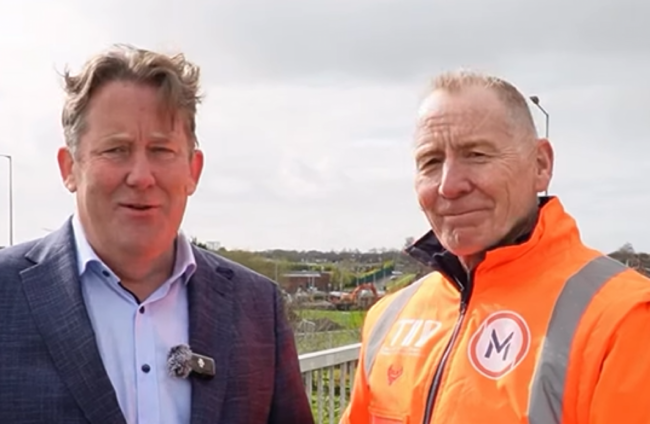
Seán Sweeney (r) with Transport Minister Darragh O'Brien in March. Darragh O'Brien via Facebook

MetroLink boss Seán Sweeney steps down in fresh blow to long-awaited rail project

The New Zealander, who was appointed to the role in June 2024, said being separated from his family had become “unsustainable”.

THE PROGRAMME DIRECTOR for Dublin’s long-awaited MetroLink project has announced that he is stepping down. 

New Zealander Seán Sweeney was appointed to the role less than two years ago, having overseen major infrastructure projects in his home country, along with Australia and the US over three decades. 

In a statement, he said leading the MetroLink project had been “one of the greatest professional privileges of my career”.

“However, after several years away from home, the sacrifice of being separated from my partner, children, and grandchildren, who are over 10,000 miles away, has become unsustainable,” he said.

“It is with deep regret that I leave MetroLink, however, I know it is the right thing to do for everyone.”

Sweeney continued: “A programme like MetroLink will have many parents and I always believed my role was to get the programme up and running.

I am proud to leave the programme with a highly committed and experienced executive team, full Government support as well an operational Railway Order and MetroLink fully funded into construction.

“MetroLink is no longer a ‘proposed’ plan; it is a live delivery project.”

‘Sad to see him leave’

Transport Infrastructure Ireland CEO Lorcan O’Connor said Sweeney joined the Dublin rail-link project “at a critical juncture” when it was in need of “a steady hand to build a strong team, generate market interest, secure planning and steer the programme into the procurement phase”.

“During his time, the project has secured its most significant milestone to date: securing the Operational Railway Order in January 2026,” he said. 

“While we are sad to see him leave we wish him well with the next chapter of his life.”

O’Connor said a competition to replace Sweeney will begin immediately, with deputy programme director Michael Flynn stepping up in the interim “to ensure MetroLink continues to progress towards delivery”.

Transport Minister Darragh O’Brien said he was sorry to see Sweeney go. 

“He has made a great contribution to the progress of MetroLink and I wish him the very best for the future,” he said, adding that one of his key achievements “was to establish a highly experienced, highly skilled and high-performing senior leadership team”.

“It is this team who will continue to keep MetroLink on course for its scheduled milestones.”

O’Brien said securing planning approval in January means “we are now firmly in the procurement phase, and MetroLink is rapidly taking shape with work already under way to allow for construction”.

He added: “The MetroLink project team have my full support, that of my Department, and of the Government.”

Resignation ‘must not delay project’

Labour’s transport spokesperson Ciarán Ahern described Sweeney’s resignation as “a blow that requires an urgent response from Government”.

“We need to see a new appointment sooner rather than later to ensure that this project is delivered on time and cost effectively. Government needs to move swiftly so that we get this critical public transport project over the line.”

Green Party councillor for Dublin’s north inner city Janet Horner also said Sweeney’s resignation must not delay the “critical” transport project. 

The Government must move quickly to fill the Director position without delay to ensure the project does not get sidetracked at this critical juncture with construction due to begin next year.

Horner added: “Sean Sweeney has a very strong record in delivering large scale transport infrastructure; the Government should move to find someone with a similar background to keep the project moving.”

The Department of Transport announced Sweeney’s appointment in June 2024. It confirmed that he would earn a salary of €550,000, a figure it said was below the mean equivalent rate for his level of expertise globally.

Sweeney has Irish roots and referenced them in comments following his appointment.

“My late father was born and raised in Castlebar, Co Mayo. He would be thrilled and immensely proud, as I am, to know his son was going back to lead this major project for Dublin.”

His departure is the latest in a long line of hurdles to the long-awaited rail project, which was first mooted in 2000 before being shelved years later due to the financial crash.

MetroLink was announced in 2018, replacing the previous ‘Metro North’ plan.

The proposed 18.8km Dublin rail line, which will be the single biggest public transport project in the history of the State, will have 16 stations stretching from Swords to Charlemont with an end-to-end journey time of 25 minutes.

It’s expected that construction on the project may not begin until at least 2028

An application for a judicial review of An Coimisiún Pleanála’s decision to grant permission to the project had been lodged by a number of Ranelagh residents late last year. 

But it emerged on Christmas Eve that the judicial review had been withdrawn after TII struck a deal whereby the homes would be sold to clear the way for development for MetroLink.

In January, Sweeney told RTÉ News at One that the government is likely to pay more than €30m to buy the homes in Dartmouth Square

The most recent cost estimate for MetroLink from the TII totalled €9.5bn, though this figure was published in 2021.

Speaking at the Oireachtas Transport Committee last November, Sweeney said the latest estimate would be published in early 2026, though he added that the project would more than likely cost more than that projected figure.

He said that construction is “a highly uncertain process”, and that it would be “beyond human comprehension to identify every risk and complexity in the pricing”.

He also told the committee that the construction of the MetroLink will require around 8,000 workers.

The contract will likely be handed to a major international contractor, Sweeney said, as an analysis of Irish construction firms found that none had the expertise required for the construction of the MetroLink.

Readers like you are keeping these stories free for everyone...
A mix of advertising and supporting contributions helps keep paywalls away from valuable information like this article. Over 5,000 readers like you have already stepped up and support us with a monthly payment or a once-off donation.

Close
41 Comments
This is YOUR comments community. Stay civil, stay constructive, stay on topic. Please familiarise yourself with our comments policy here before taking part.
Leave a Comment
    Submit a report
    Please help us understand how this comment violates our community guidelines.
    Thank you for the feedback
    Your feedback has been sent to our team for review.

    Leave a commentcancel

     
    JournalTv
    News in 60 seconds