Sign in. It’s quick, free and it’s up to you.
An account is an optional way to support the work we do. Find out more.
Sign in. It’s quick, free and it’s up to you.
An account is an optional way to support the work we do. Find out more.
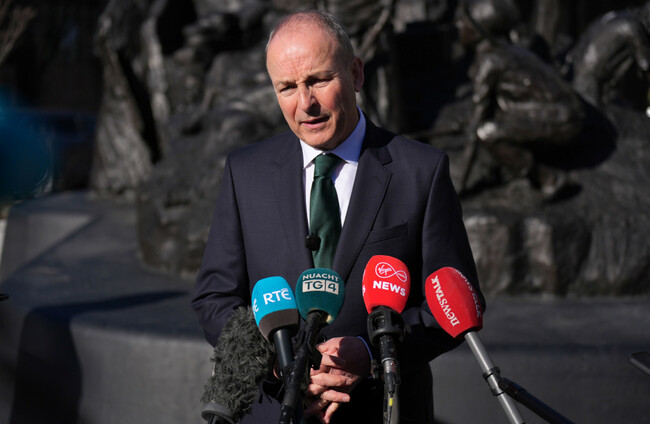
REDUCTIONS IN OTHER taxes and levies on fuels, such as excise, would have a far bigger impact on pricing than cutting the carbon tax, Taoiseach Micheál Martin has said.
As petrol, diesel and home heating fuel remain high, pressure is mounting on the government to take action to reduce costs for customers.
Speaking to reporters in Philadelphia, where the Taoiseach kicked off his St Patrick’s Day programme of events in the US, Martin strongly hinted that cuts to excise duty on fuel are being considered, saying the impact of delaying or scrapping carbon taxes “is not anywhere near the impact of other levies and taxes”.
The carbon tax is a “very important” tax that allows the government to expand the fuel allowance to working families, as well as retrofitting homes, he said.
“There are other mechanisms that we can use. The impact of that [cutting carbon tax] is not anywhere near the impact of other levies and taxes,” said Martin.
More than half of the price of a litre of fuel goes toward taxes, with the bulk of this being in the form excise and VAT. Carbon tax accounts for around 9-10% of the costs.
VAT accounts for more than 20% and excise duty more than 30% of the cost of fuel.
The government is monitoring how things are evolving, stating:
“It’s been volatile, and we have to look at it both in the short-term and medium-term, because there could be a second round of inflationary impacts as a result of the impact of war and particularly oil and gas prices,” he said.
“We understand that people are under a lot of pressure,” added Martin.
The Taoiseach said he will travel straight from the US to the European Council meeting in Brussels next week where member states will be discussing the gas connectors and pricing.
“It’s a very complex framework that results in the energy prices that we experience. And in Ireland, we’re higher than most, and there are a number of factors that are responsible for that.
“There are about four component parts to energy prices, first the actual generation cost themselves. Secondly, the grid charges, thirdly, taxes and levies, and fourthly, the ETS (Emissions Trading System”). And clearly, member states have flexibility in respect of taxes and levies,” he added.
The Taoiseach said everything is being kept “under active review on a number of fronts”.
“Anything we do, we want to target and make sure that we target and help those most in need and those furthest behind [on their bills], and who will be most impacted,” he added.
“But there are a number of potential issues that we have to address, and we are looking at it and examining and keeping everything under review. And obviously, if you look back in terms of the outbreak of war in Ukraine and the impact of it, we didn’t move immediately,” said Martin.
When asked by The Journal how long the government would be monitoring the situation before taking decisive action, the Taoiseach said:
“I’m reluctant to put timeframes on it, but obviously it’s a very moving situation,” he said, stating that he didn’t want to get into specifics, but everything is under “active review”.
When war broke out in Ukraine in 2022, it took the government two weeks to reduce excise. This weekend will mark the two week period since violence erupted in the Middle East.
Martin said the carbon tax provides ring-fenced funding, stating that the carbon fund provides a sustainable means of transforming not just climate measures, but energy efficiency.

To embed this post, copy the code below on your site
















have your say