We need your help now

Support from readers like you keeps The Journal open.

You are visiting us because we have something you value. Independent, unbiased news that tells the truth. Advertising revenue goes some way to support our mission, but this year it has not been enough.

If you've seen value in our reporting, please contribute what you can, so we can continue to produce accurate and meaningful journalism. For everyone who needs it.

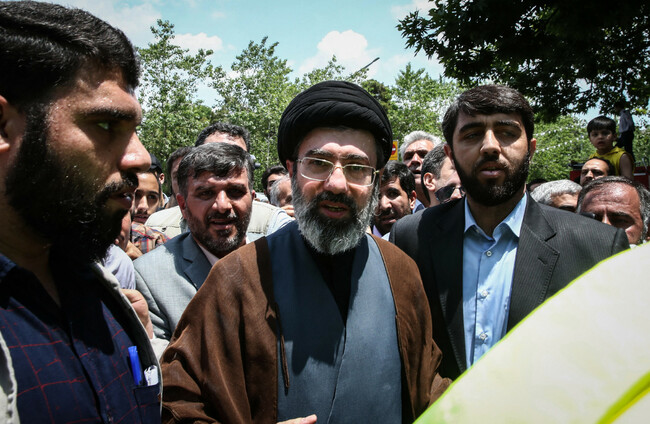
Mojtaba Khamenei pictured in 2019 Alamy Stock Photo

Iran's new supreme leader urges Gulf states to close US bases in first statement of the war

Donald Trump dismissed concerns over fuel prices today, saying the destruction of Iranian nuclear capacity was more important.

LAST UPDATE | 12 Mar

IRAN’S NEW SUPREME leader Ayatollah Mojtaba Khamenei has said that his country’s military must keep the strategic Strait of Hormuz closed and urged other states in the Middle East to shut US military bases.

“The lever of blocking the Strait of Hormuz must definitely be used,” Khamenei said of the waterway his first statement since his father was killed in the intial US-Israeli attack on 28 February.

The statement was read out by a television news anchor and no new images or audio of Khamenei were aired.

There has been speculation about the status of the new ayatollah since he was reportedly injured in an attack. Yesterday, an Iranian government official said Khamenei was “safe and sound”, but he is yet to appear in public.

The statement also promised revengre for the deaths of the 1,200 people who have been killed in Iran since the war began. 

Khamenei also advised countries in the Middle East to shut US military bases, which Iran has been attacking in retaliation.

“I recommend that they close those bases as soon as possible, because they must have realised by now that the claim of establishing security and peace by America was nothing more than a lie,” he said.

Following Khamenei’s statement, Iran’s Revolutionary Guards’ navy leader promised to follow the order to keep the Striat of Hormuz shut.

Iran’s deputy foreign minister has said that ships from “some countries” were being allowed to cross the strait, without giving details.

He also denied reports that Iran was laying mines in the waterway. 

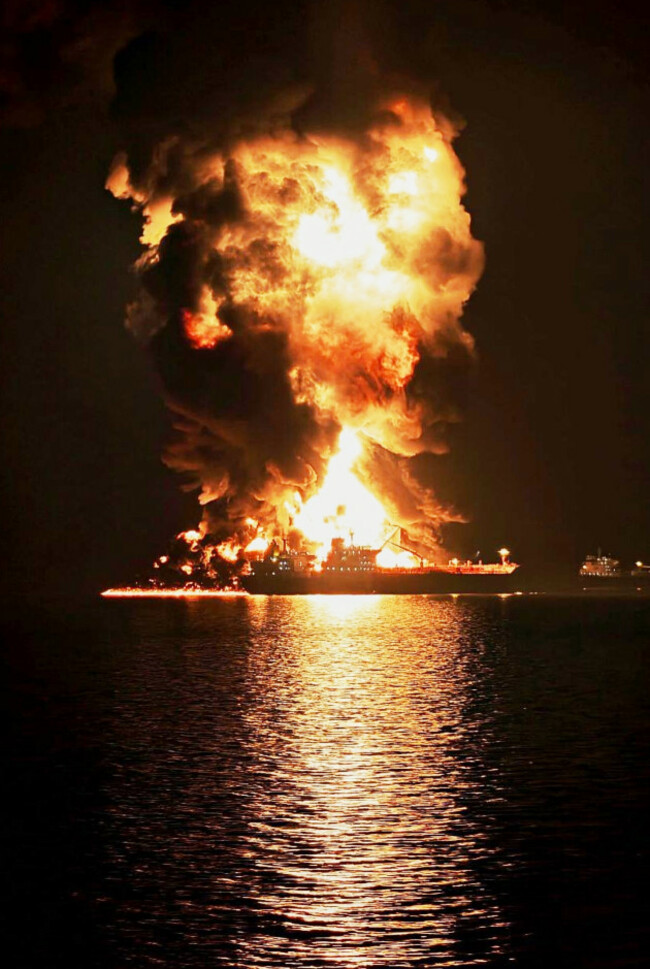
aptopix-iraq-iran-us-israel A ship on fire in the Strait of Hormuz PA PA

The regional and global fallout from the war has continued today. 

Oil prices surged back above $100 a barrel this morning after Iran launched fresh attacks on energy facilities and commercial vessels across the Persian Gulf.

Brent crude rose about 9% in Asian trading to reach $100 a barrel, while US-traded crude climbed to around $95, as the conflict between Iran, the United States and Israel continued to disrupt global energy markets.

The spike came despite the International Energy Agency approving the largest release of emergency oil reserves in its history in an attempt to stabilise prices.

The International Energy Agency has attempted to calm markets by agreeing to release 400 million barrels of oil from strategic reserves, including 172 million barrels from the United States.

Iran has warned that no oil will leave the Persian Gulf for countries it considers enemies while the war continues. A military spokesperson said the world should prepare for oil prices as high as $200 a barrel. 

In Ireland, the dramatic increase in fuel prices as a result of the conflict is pushing many customers to cross the border into Northern Ireland for petrol and diesel.

US President Donald Trump dismissed growing concerns over fuel prices today, writing on social media that “of far greater interest and importance to me, as President, is stoping an evil Empire, Iran, from having Nuclear Weapons, and destroying the Middle East and, indeed, the World”. 

Iran launched a new wave of drone and missile strikes overnight targeting energy infrastructure and shipping across the region.

Fuel tanks caught fire on Bahrain’s Muharraq Island, where the country’s international airport and oil facilities are located.

Authorities urged residents to stay indoors and close windows because of smoke from the blaze.

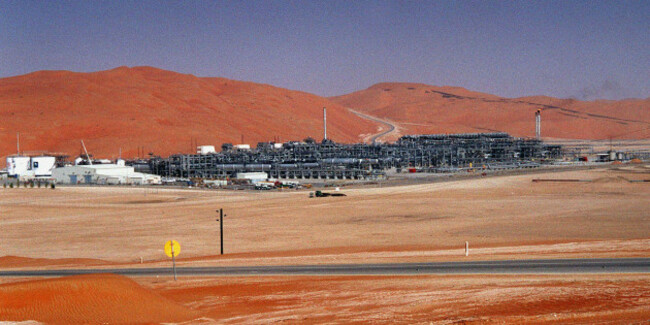
Saudi Arabia said it intercepted drones heading toward the Shaybah oil field and the diplomatic district of the capital, while earlier strikes hit fuel storage at Oman’s Salalah port, forcing a suspension of operations.

file-an-industrial-plant-strips-natural-gas-from-freshly-pumped-crude-oil-at-saudi-aramcos-shaybah-oil-field-at-shaybah-in-saudi-arabias-rub-al-khali-desert-in-this-monday-march-8-2004-file Shaybah oil fields in Saudi Arabia. Alamy Stock Photo Alamy Stock Photo

Commercial shipping has also come under attack in and around the Strait of Hormuz, the narrow waterway through which about a fifth of the world’s oil supply passes.

A container ship near the United Arab Emirates was struck by what the UK Maritime Trade Operations agency described as an “unknown projectile”, causing a small fire on board. All crew members were reported safe.

Elsewhere in the Gulf, two oil tankers were attacked in Iraqi waters, killing at least one crew member. Authorities said dozens of sailors had been rescued but search efforts were continuing.

Iranian forces were also suspected of setting two tankers ablaze in the same area, while a Thai bulk carrier travelling through the Strait of Hormuz was hit by projectiles a day earlier.

Twenty sailors were rescued but three crew members were believed to be trapped in the vessel’s engine room.

The escalating attacks have effectively halted much of the shipping traffic through the strait, raising fears of a prolonged disruption to global energy supplies.

Trump said yesterday that Iran was “pretty much at the end of the line”, though he added that the conflict would not necessarily end immediately. He made a similar claim earlier in the week. 

The war has cost the United States more than $11.3 billion, lawmakers were told in a Pentagon briefing, according to The New York Times.

“If the White House imagines the conflict will stop when Donald Trump decides it… they’re making a mistake and ignoring the lessons of history,” Pierre Razoux, director of studies at the Mediterranean Foundation for Strategic Studies, told AFP.

“The Iranian regime, which no longer has anything to lose, will wage a war of attrition against the United States and Israel to punish them for their aggression.” 

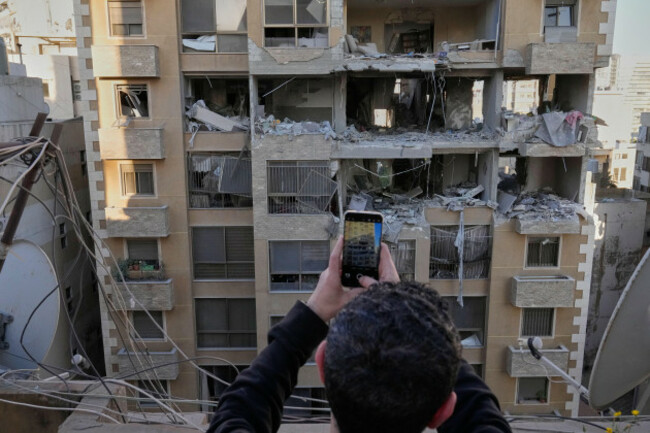
a-man-takes-pictures-of-destroyed-apartments-that-were-hit-by-israeli-airstrikes-in-beirut-lebanon-wednesday-march-11-2026-ap-photohussein-malla A man takes pictures of destroyed apartments that were hit by Israeli airstrikes in Beirut. Alamy Stock Photo Alamy Stock Photo

Across the wider region, the fighting has continued to spread.

Israeli strikes and ground operations in Lebanon have killed hundreds of people and displaced more than 800,000, according to Lebanese authorities.

In Israel, authorities said 14 people have been killed, while attacks in the Gulf have killed 24 people, including 11 civilians and seven US military personnel, according to local authorities and the US Central Command.

Additional reporting from David Mac Redmond. and AFP

Readers like you are keeping these stories free for everyone...
A mix of advertising and supporting contributions helps keep paywalls away from valuable information like this article. Over 5,000 readers like you have already stepped up and support us with a monthly payment or a once-off donation.

View 120 comments
Close
120 Comments
This is YOUR comments community. Stay civil, stay constructive, stay on topic. Please familiarise yourself with our comments policy here before taking part.
Leave a Comment
    Submit a report
    Please help us understand how this comment violates our community guidelines.
    Thank you for the feedback
    Your feedback has been sent to our team for review.

    Leave a commentcancel

     
    JournalTv
    News in 60 seconds