We need your help now

Support from readers like you keeps The Journal open.

You are visiting us because we have something you value. Independent, unbiased news that tells the truth. Advertising revenue goes some way to support our mission, but this year it has not been enough.

If you've seen value in our reporting, please contribute what you can, so we can continue to produce accurate and meaningful journalism. For everyone who needs it.

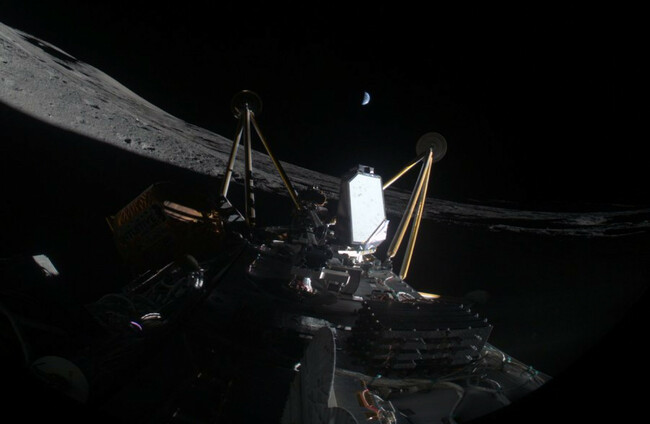
Intuitive Machines' Athena spacecraft on its side after landing on the Moon. Intuitive Machines

US spacecraft's batteries die after wonky Moon landing sees it fall over

It meant the spacecraft was unable to recharge its solar-powered batteries.

THE SECOND MOON mission of private explorers Intuitive Machines ended in disappointment today after its spacecraft tipped over and was left unable to recharge its solar-powered batteries, mirroring the US company’s first attempt last year.

It marked a premature conclusion to a mission that had sparked excitement in the space community, thanks to its cutting-edge payloads, including a futuristic hopping drone, multiple rovers, an ice drill, and a 4G network test.

Houston-based Intuitive Machines (IM) had hoped to make history with Athena, a hexagonal lander roughly the height of a giraffe, designed to touch down on a spot called the Mons Mouton plateau, closer to the lunar south pole than any mission before.

But after traveling more than a million kilometers through space, the spacecraft came to rest inside a crater, 250 meters from its intended target, face down on the lunar surface.

A photo released by the company showed Athena resting on an incline, with Earth visible between two of its splayed landing legs — a similar fate to IM’s prior landing with its Odysseus spacecraft in February 2024.

Despite this, teams were able to “accelerate several program and payload milestones,” including a NASA experiment designed to drill beneath the lunar surface in search of ice and chemicals, before Athena’s batteries depleted, the company said.

“With the direction of the Sun, the orientation of the solar panels, and extreme cold temperatures in the crater, Intuitive Machines does not expect Athena to recharge,” it continued.

“The mission has concluded, and teams are continuing to assess the data collected throughout the mission.”

The science investigations and technology demonstrations were originally expected to last approximately 10 days, with the company hoping to capture a lunar eclipse from the Moon’s perspective on March 14.

On Thursday, IM executives suggested that issues with Athena’s laser altimeters contributed to the bad landing, similar to the previous mission, when Odysseus came in too fast, caught a foot on the surface, and toppled over.

Specifically, the Terrain Relative Navigation (TRN) laser, designed to provide altitude and velocity readings, was returning “noisy” data that could not be fully trusted, while the Hazard Relative Navigation (HRN) sensors only returned intermittent signals, IM said on Thursday.

Athena, like Odysseus, has a tall, slender build, standing 15.6 feet (4.8 meters) in height, raising stability concerns.

But CEO Steve Altemus isisted that the lander’s weight distribution kept the center of gravity low, and the company remains confident in its design.

Texas rival succeeds

Adding to the disappointment, the latest mishap came just days after Texas rival Firefly Aerospace successfully landed its Blue Ghost lander on its first attempt.

These missions are part of NASA’s $2.6 billion Commercial Lunar Payload Services (CLPS) program, which seeks to leverage private industry to lower costs and support Artemis — NASA’s effort to return astronauts to the Moon and eventually reach Mars.

Of the four CLPS missions attempted so far, only one lander managed an upright touchdown, two landed sideways, and one failed to reach the Moon altogether.

IM has been awarded two more lunar missions but will be reviewing data from IM-2 to better understand its implications for IM-3. The company has also secured a NASA contract to deploy data relay satellites around the Moon.

– © AFP 2025

Author
View 29 comments
Close
29 Comments
This is YOUR comments community. Stay civil, stay constructive, stay on topic. Please familiarise yourself with our comments policy here before taking part.
Leave a Comment
    Submit a report
    Please help us understand how this comment violates our community guidelines.
    Thank you for the feedback
    Your feedback has been sent to our team for review.

    Leave a commentcancel

     
    JournalTv
    News in 60 seconds